Introduction: Choosing the Right Manufacturing Method for Medical Devices
Every medical device product team faces the same early-stage decision: how should we manufacture this part? The answer depends on material, geometry, volume, precision, and regulatory requirements. CNC machining is often the default choice for medical components — but it is not always the right one, and it is not right for every part.
This guide honestly compares CNC machining against the three most common alternatives in Medical Device Manufacturing: 3D printing (additive manufacturing), investment casting, and injection molding. We look at precision, material options, cost, lead time, strength, and regulatory compliance — so you can make the right call for your specific part. For the underlying process, see our complete medical CNC machining guide.
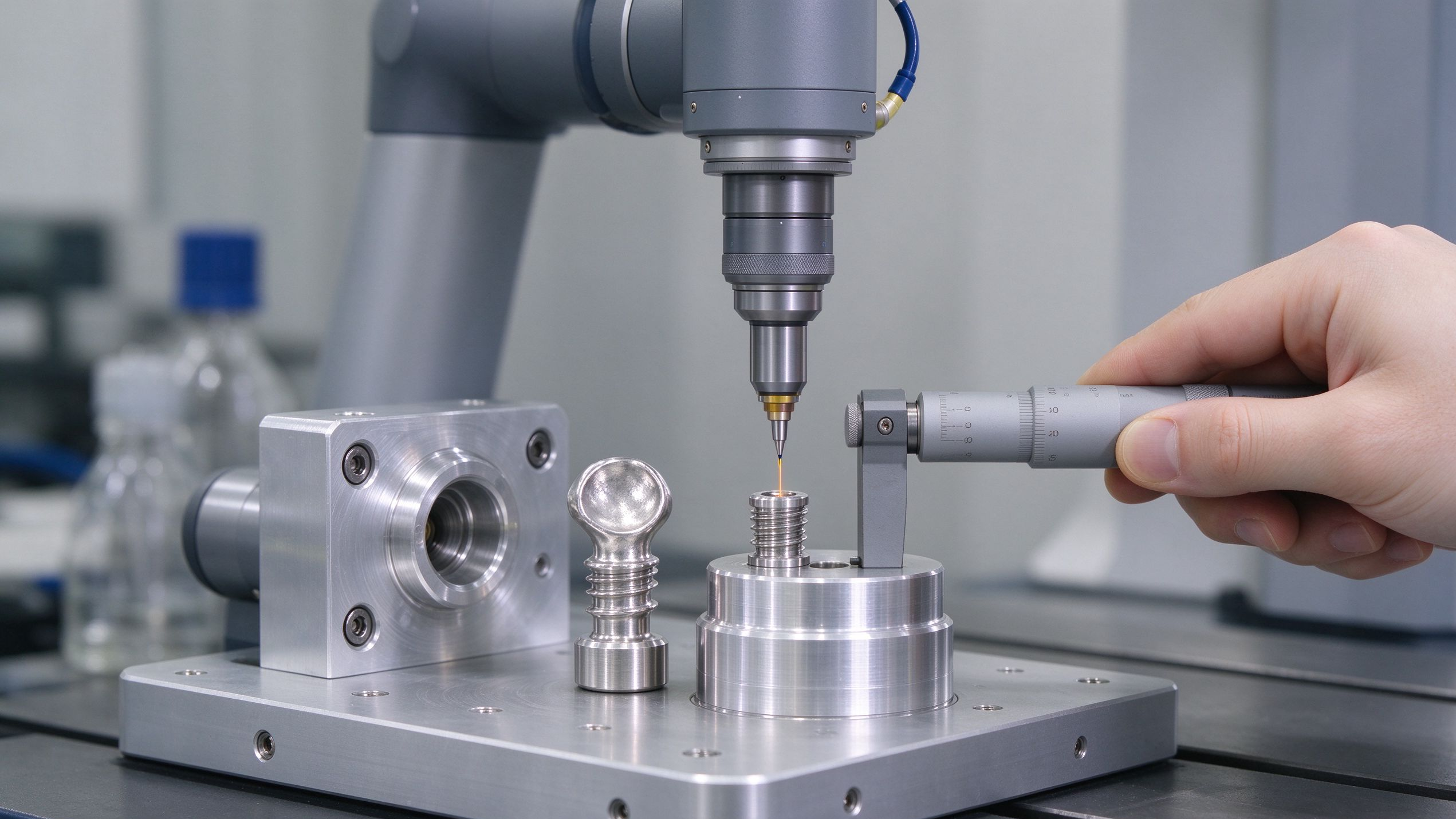
Core Advantages of Medical CNC Machining
Before the comparison, it helps to understand why CNC machining is so widely used in medical device manufacturing:
1. Unmatched Material Options
CNC works with virtually any medical-grade material — Ti6Al4V, 316LVM, CoCr, PEEK, aluminum, engineering plastics. 3D printing is limited to a narrower (and more expensive) material set. See our medical-grade materials guide.
2. Tight, Repeatable Tolerances
CNC routinely holds ±0.01mm (and ±0.005mm for precision work) across thousands of parts. For medical implants and instruments, this repeatability is non-negotiable. See precision medical machining.
3. Full Material Strength
CNC machines from wrought bar stock — the material's full mechanical properties (fatigue strength, tensile, impact) are preserved. 3D Printed Parts have layer-dependent anisotropy and often require post-processing to reach wrought properties.
4. surface finish Control
CNC + post-processing can achieve mirror polish (Ra < 0.05μm), passivation, electropolishing, and specific rough textures. 3D printed surfaces are typically rough (Ra 5–15μm) and require extensive post-processing.
5. No Tooling Cost
CNC machining has zero upfront tooling investment — you start production from a CAD file. This makes it ideal for prototypes, low volumes, and custom parts.
6. Full Traceability & Regulatory Acceptance
CNC is a mature, well-understood process. Regulators (FDA, notified bodies) are familiar with it; process validation is straightforward.
CNC vs 3D Printing (Additive Manufacturing) for Medical Parts
This is the most common comparison medical device teams make. Both are digital, both start from CAD — but they produce very different parts.
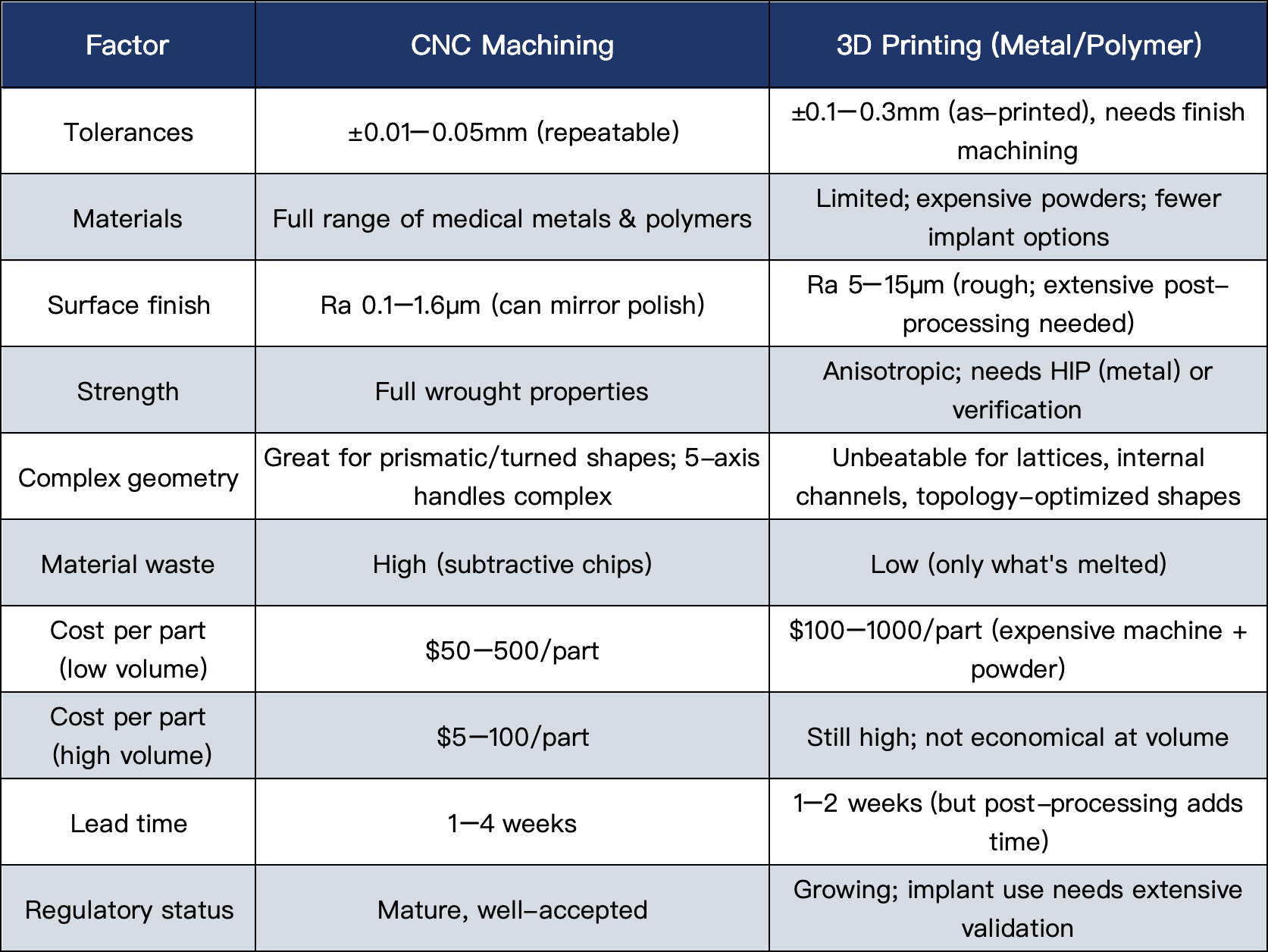
When CNC wins:
You need tight tolerances or mirror-polished surfaces
You use titanium, 316L, or CoCr at volume
The part is rotationally symmetric or prismatic
You need full material strength for load-bearing implants
When 3D printing wins:
The part has complex internal lattices (bone ingrowth structures)
Patient-specific geometry (custom implants, surgical guides)
You need topology-optimized lightweight structures
Very low volumes where CNC setup time dominates
The hybrid reality: Most modern implants use both — 3D print the porous lattice surface, then CNC finish the precision bearing/mating surfaces. See our orthopedic implant cnc machining guide.
CNC vs Casting and Forging for Orthopedic & Trauma Parts
For load-bearing orthopedic and trauma implants, casting and forging are the traditional alternatives.
Investment Casting (Lost-Wax)
How it works: Wax pattern → ceramic shell → pour molten metal → finish machine
Best for: High-volume, complex shapes where tooling is justified
Pros: Near-net shape, low per-part cost at volume, complex geometries
Cons: Porosity risk, lower fatigue strength, ±0.5mm casting tolerance (needs finish machining), long mold setup (weeks)
Medical reality: Most cast parts are still CNC-finished on critical surfaces
Forging
How it works: Hammer/press metal billet into a die → CNC finish
Best for: High-volume hip stems, femoral components (best fatigue properties)
Pros: Excellent grain structure, highest fatigue strength
Cons: Expensive dies ($10k–100k+), long setup, still needs CNC for tolerances
Medical reality: Forged + CNC finished is the gold standard for high-volume load-bearing implants
When CNC alone wins:
Low to medium volume (no tooling cost to amortize)
Custom or patient-specific implants
Prototypes and clinical trial parts
Complex part geometries where casting/forging tooling is uneconomical
When CNC + near-net shape wins:
CNC vs Injection Molding for Plastic Medical Components
For plastic medical parts — device housings, handles, fixtures, disposables — injection molding is the high-volume alternative.
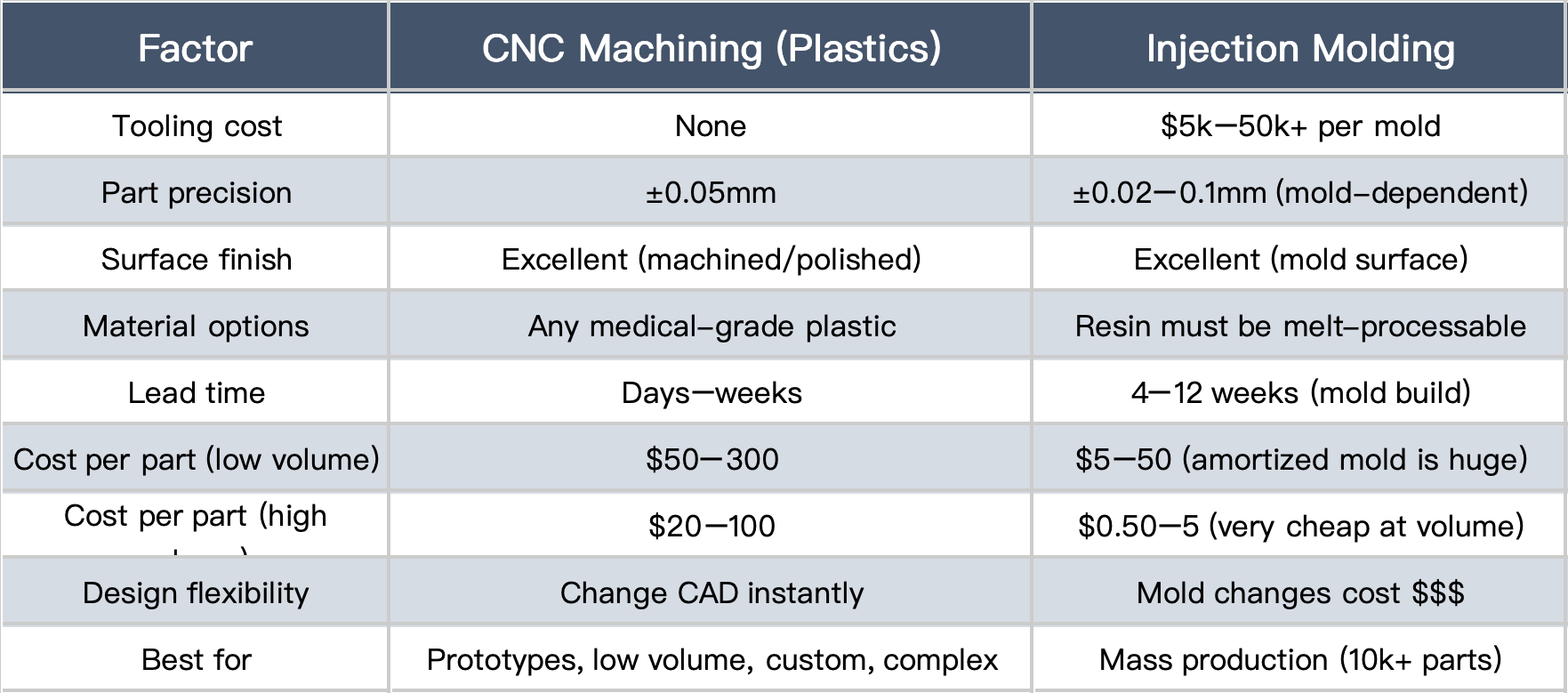
When CNC wins:
Volumes below ~5,000–10,000 parts (mold cost not justified)
You are still iterating the design
Materials that cannot be easily molded (PEEK for small custom parts)
Medical-grade housings for low-volume devices
When injection molding wins:
Volumes of 10,000+ units
Stable, production-ready design
Disposable devices (catheter components, housings)
Hybrid approach: Many companies CNC-machine prototypes and first-article parts to validate the design, then invest in injection molds when volume is confirmed.
Decision Framework: Which Process Should You Choose?
Use this quick decision tree:
Step 1: What is your annual volume?
< 500 parts → CNC machining (no tooling, fastest to market)
500–5,000 parts → CNC, or CNC + soft tooling
5,000–50,000 parts → CNC for metal, consider injection molding for plastics
50,000 parts → near-net shape (cast/forge) + CNC finish for metal; injection molding for plastics
Step 2: What material?
Metal implant → CNC (or cast/forge + CNC)
Metal device part → CNC
Engineering plastic, low volume → CNC
Plastic disposable, high volume → injection molding
Complex lattice / patient-specific → 3D print + CNC finish
Step 3: What tolerances?
±0.05mm or tighter → CNC (3D print and casting can't compete)
±0.1–0.5mm → any process possible
Cosmetic only → molding or casting
Step 4: What stage of product development?
Prototype / clinical validation → CNC (fast, no tooling)
Production → evaluate volume-based economics
Reality check: Most successful medical device companies use multiple processes. CNC is the workhorse for prototypes, custom parts, and low-to-medium volume production. Other methods take over when volume justifies tooling investment.
For Supplier Selection across all processes, see our how to choose a medical CNC machining service provider.
Frequently Asked Questions About Medical CNC vs Other Processes
Q1: Is CNC machining more expensive than 3D printing?
A: For one-off prototypes, often similar ($100–500). For production volumes, CNC is cheaper because material costs are lower and cycle times are faster. 3D printing's cost stays high at volume.
Q2: Is CNC machining stronger than 3D printing for medical implants?
A: Yes — CNC uses wrought bar stock with full, isotropic mechanical properties. Metal 3D printed parts have layer anisotropy and often require hot isostatic pressing (HIP) to approach wrought strength. For load-bearing implants, CNC remains the standard.
Q3: When should I switch from CNC to injection molding?
A: Typically when volumes exceed 5,000–10,000 plastic parts. Below that, the mold cost ($5k–50k+) is not amortized. CNC is cheaper for low volumes.
Q4: Can CNC machining match injection molding surface finish?
A: Yes — especially after polishing, bead blasting, or anodizing. For plastic parts, CNC can match or exceed molded finishes on low-volume runs.
Q5: What is the fastest way to get a medical prototype made?
A: CNC machining — 1–2 weeks for a precision metal or plastic prototype with no tooling wait. 3D printing is faster geometrically but often requires extensive post-processing for medical use.
Conclusion: CNC Is the Medical Industry's Most Versatile Process
CNC machining wins on precision, material range, strength, surface control, and no-tooling flexibility — making it the default for medical prototypes, custom parts, and low-to-medium volume production. It is not the cheapest method at very high volumes, but it is the most versatile and regulatory-mature.
At Konsdun, we specialize in medical CNC machining across all materials — and we'll honestly tell you when 3D printing, casting, or injection molding might be a better fit for your specific part. That's the kind of engineering partnership you need.






 Phone
Comment
(0)