Orthopedic implants — hip stems, knee components, spinal rods, bone plates — are among the most demanding medical devices ever manufactured. They must survive millions of load cycles inside the human body, bond with living bone, resist corrosion from bodily fluids, and meet tolerances measured in single-digit microns. Behind every successful implant lies orthopedic implant CNC machining: a discipline combining advanced 5-axis equipment, implant-grade materials, and strict regulatory compliance.
This article covers the types of orthopedic implants made by CNC machining, why titanium implant CNC manufacturing dominates the field, precision and surface requirements, the benefits of CNC versus alternative methods, and how to select a partner for medical implant Precision Machining. For broader context, start with our medical CNC machining guide.
Orthopedic implant CNC machining is the process of manufacturing load-bearing and fixation implants for the musculoskeletal system using computer numerical control machines. The process typically combines CNC Turning (for cylindrical features like femoral heads and screws), CNC milling (for complex geometries like hip cups and plates), and often 5-axis machining for single-setup production of complex contours.
Key process stages for orthopedic implant machining:
CAD design & DFM — implant geometry optimized for machining and biomechanics
Material certification — implant-grade Ti6Al4V ELI, CoCr, or stainless per ASTM standards
Rough machining — bulk material removal with efficient toolpaths
Heat treatment (where required) — aging, annealing, or surface hardening
Finish machining — final tolerances on bearing and mating surfaces
Surface treatment — bead blasting, anodizing (for titanium color coding), polishing
Quality inspection — CMM, surface profilometry, dimensional verification
Cleaning & packaging — cleanroom handling, sterile packaging
The most critical difference from general machining: every stage must be documented and traceable for regulatory submission, including FDA 510(k) or PMA pathways.
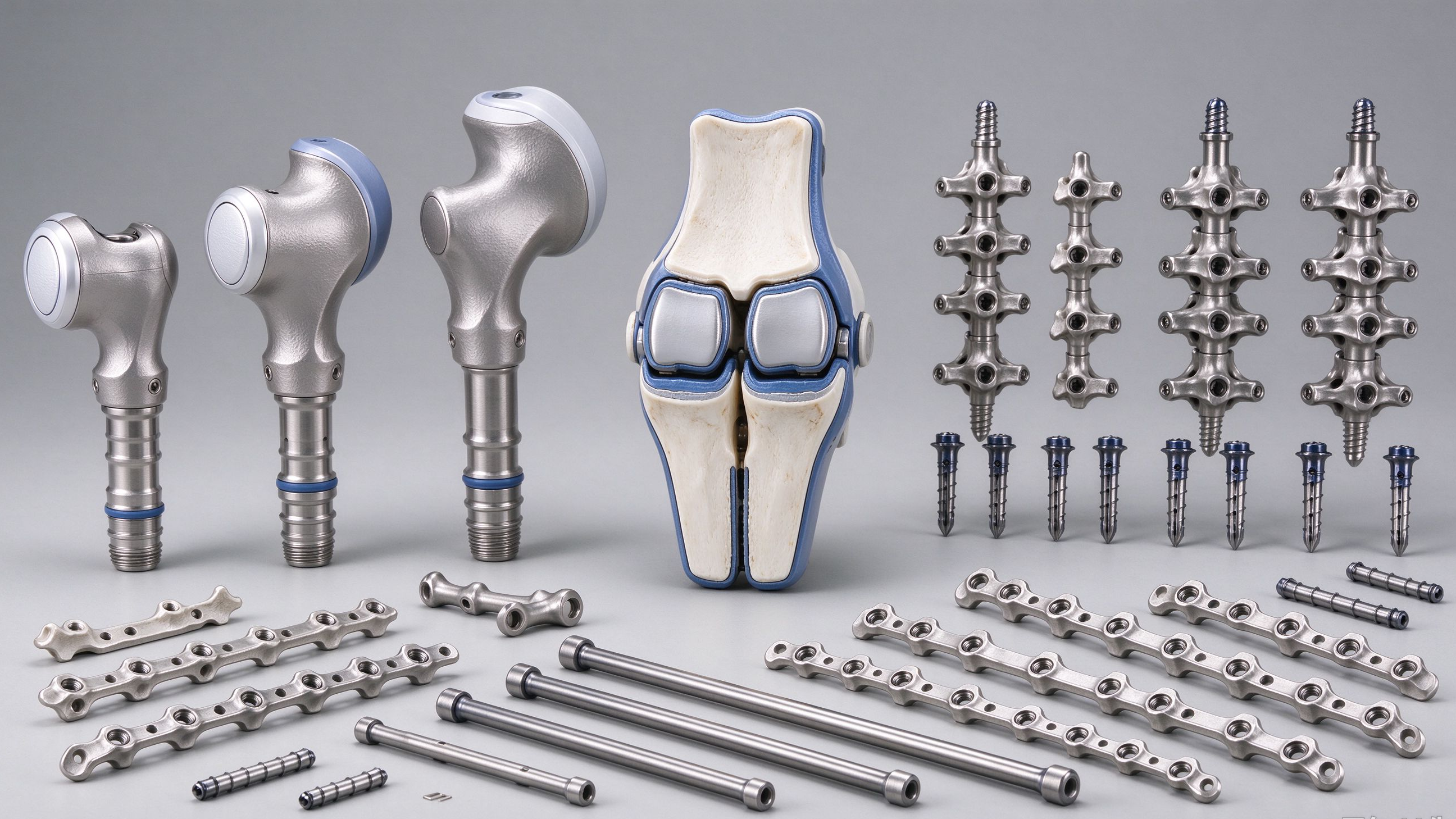
Main Types of Orthopedic Implants Manufactured by CNC Machining
Understanding the implant landscape helps you specify the right machining approach. Here are the main categories:
1. Hip Implants
Components: femoral stem, femoral head, acetabular cup, acetabular shell, liner
Typical tolerances: ±0.01–0.02mm on taper junctions (head-stem Morse taper)
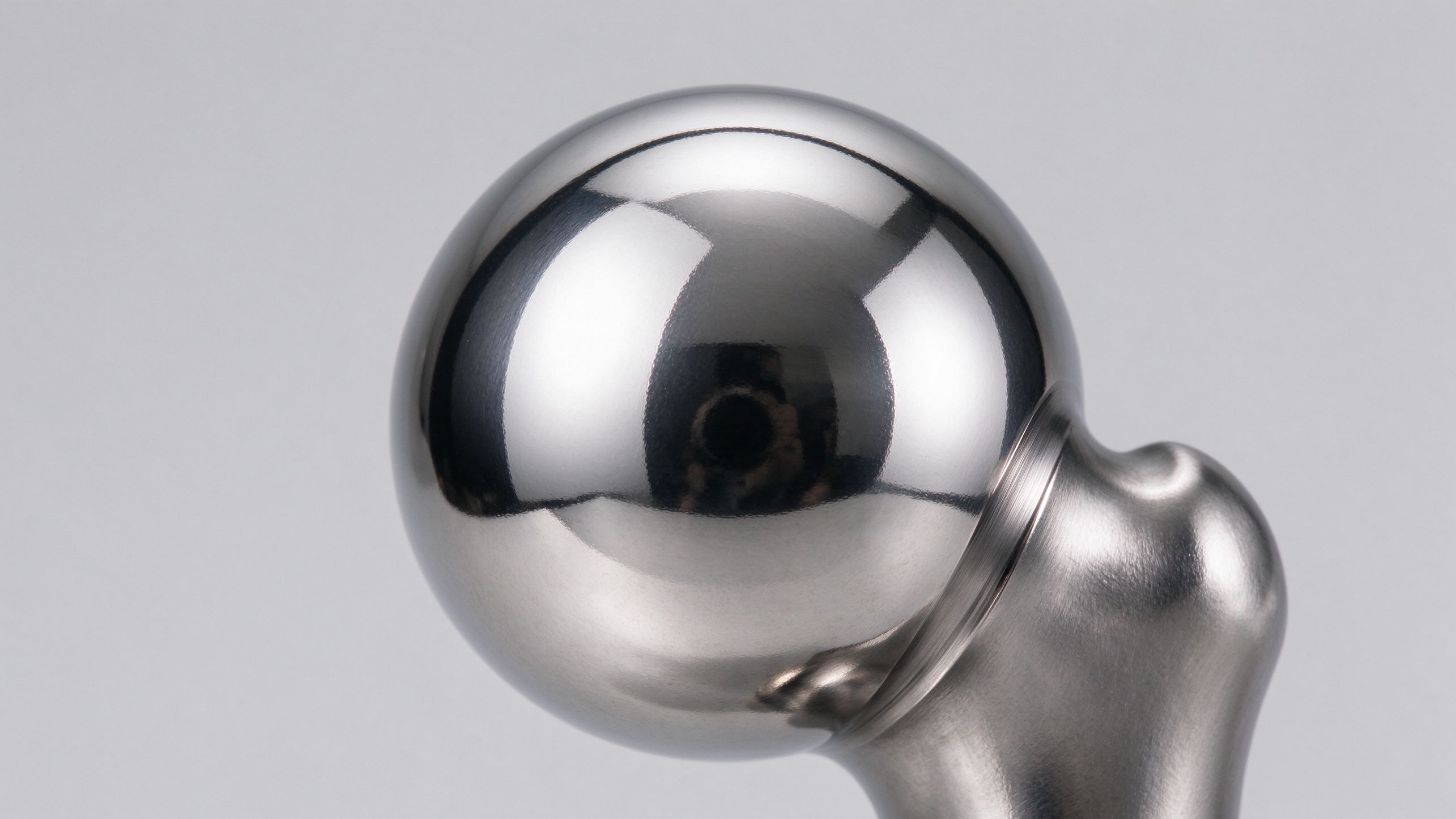
Surface: mirror polish on heads (Ra < 0.05μm), porous coating zones on stems
2. Knee Implants
Components: femoral component, tibial tray, tibial insert, patella button
Typical tolerances: ±0.02mm on articulating surfaces
Surface: multi-radius articulating surfaces require 5-axis machining
3. Spine Implants
Components: pedicle screws, rods, cages (PEEK or titanium), plates
Typical tolerances: ±0.02–0.05mm
Surface: threaded features need thread milling or turning with precise pitch
4. Trauma Implants
Components: bone plates, locking screws, intramedullary nails, washers
Typical tolerances: ±0.05mm (slightly more forgiving)
Surface: often anodized for color coding, bead-blasted for bone contact
5. Small Joint & Extremity Implants
Components: finger joint prostheses, ankle implants, shoulder components
Typical tolerances: ±0.01mm — very small, precise features
For material guidance specific to these implant types, the Medical Machined Parts guide includes a full material selection table.
Titanium Implant CNC Manufacturing: Why Ti6Al4V Dominates
When you talk about implant machining, titanium is the material that comes to mind first. Ti6Al4V ELI (Grade 23) and Ti6Al4V (Grade 5) account for the majority of orthopedic implant CNC manufacturing. Why?
Why titanium wins for implants:
Biocompatibility — osseointegration: living bone actually grows onto titanium surfaces
Strength-to-weight ratio — lighter than stainless and CoCr with comparable strength
Corrosion resistance — a stable oxide layer protects against bodily fluids
MRI compatibility — non-magnetic (unlike some stainless grades)
Elastic modulus — closer to bone than stainless or CoCr, reducing stress shielding
Machining challenges of titanium:
Low thermal conductivity → heat concentrates at the cutting edge
Work hardening → rapid tool wear
Vibration/chatter → especially on thin-wall sections
Chemical reactivity → requires coolants and correct speeds
Best practices for titanium implant cnc manufacturing:
Carbide tools with sharp positive geometry
High-pressure coolant through the spindle
Climb milling for better surface finish
Rigid workholding with minimal overhang
Reduced cutting speeds, increased feeds
Regular tool wear monitoring
Alternative implant metals:
Cobalt-Chromium (CoCr) — superior wear resistance for articulating surfaces (femoral heads)
316LVM / 316L Stainless — cost-effective for temporary and trauma devices
Nitinol — for special shape-memory applications (not load-bearing implants)
Precision Medical Implant Machining: Tolerance and Surface Requirements
Implants live or die by their tolerances and surface finishes. Here are the critical specifications in medical implant precision machining:
Tolerance requirements by feature:
Morse taper junction (hip): ±0.002–0.005mm — the head must lock onto the stem without micromotion
Articulating surfaces (knee/hip): ±0.01–0.02mm — smooth motion, even load distribution
Threaded screw features: ±0.02mm on pitch and flank angle
Bone-contact surfaces: ±0.05mm — functional fit, not press-fit precision
Hole patterns (locking plates): ±0.03mm position tolerance
Surface finish requirements:
Femoral heads: Ra < 0.05μm mirror finish (low friction against polyethylene liner)
Articulating knee surfaces: Ra 0.05–0.1μm
Bone ingrowth zones: Ra 0.8–3.2μm (rough enough for osseointegration, controlled texture)
Screw threads: Ra 0.4–0.8μm (reduced bacteria adhesion)
Inspection methods for implant precision machining:
CMM with sub-micron accuracy for 3D geometry
Optical profilometry for surface texture
Roundness and cylindricity measurement for bearing surfaces
Torque testing for taper junction seating
Fatigue testing on samples (per ASTM F543, F1717)
Getting these numbers right is why medical implant precision machining demands experienced machinists and controlled environments — see our precision medical machining guide for the full methodology.
Benefits of CNC Machining for Orthopedic Implants vs Alternative Methods
Why choose CNC machining for orthopedic implants instead of casting, forging, or 3D printing? Here is an honest comparison:
CNC Machining
Precision: ±0.01mm achievable consistently
Material: full range of implant-grade metals
Lead time: fast for prototypes (days-weeks)
Strength: full wrought material properties (no porosity)
Cost: moderate for low-medium volume; per-part cost rises with complexity
Best for: precise implants, custom/patient-specific parts, prototypes, small-medium batches
Investment Casting
Precision: ±0.5mm (needs finish machining anyway)
Material: limited to castable alloys; porosity risk
Lead time: long mold setup (weeks-months)
Strength: lower fatigue life than wrought
Cost: low per-part at high volume
Best for: high-volume standard implants with simple geometry
Forging
Precision: good shape but still needs machining for tolerances
Material: excellent grain structure for fatigue
Lead time: die costs and setup time
Strength: best fatigue properties
Cost: high die investment, low per-part at scale
Best for: high-volume hip stems and femoral components
3D Printing (AM)
Precision: ±0.1-0.3mm typical (worse than CNC)
Material: limited metal alloys; expensive powders
Lead time: fast for prototypes
Strength: layer anisotropy; needs HIP post-processing
Cost: high per-part; economical only for complex lattices
Best for: porous lattice structures (bone ingrowth), custom guides
The practical reality: most implants are produced by a hybrid approach — forging/casting the near-net shape, then CNC finish machining the critical surfaces. For prototypes, custom patient-specific implants, and low-volume production, full CNC machining is the clear winner in speed and precision.
Compliance Standards for Orthopedic Implant Machining
Orthopedic implant machining is one of the most regulated manufacturing activities in the world. The key standards:
Material Standards:
ASTM F136 — Ti6Al4V ELI implant alloy
ASTM F1472 — Ti6Al4V implant alloy (standard grade)
ASTM F138 / F139 — 316LVM stainless steel implant material
ASTM F1537 — CoCrMo implant alloy
ASTM F67 — unalloyed titanium for surgical implants
Process & Quality Systems:
ISO 13485:2016 — medical device quality management (mandatory)
FDA 21 CFR 820 — US QSR
ISO 5832 series — implant material specifications (international)
ISO 5834 — ultra-high molecular weight polyethylene (UHMWPE) for articulating parts
Validation Requirements:
Process validation — machining parameters must be validated and locked (per FDA design controls)
Cleaning validation — removal of machining oils, chips, and residues
Packaging validation — sterile barrier integrity
Biocompatibility testing — ISO 10993 series (cytotoxicity, sensitization, irritation)
What this means for buyers: when evaluating an implant machining partner, they must demonstrate not just machining ability but documented compliance. Our guide to choosing a medical CNC machining service provider walks through certification verification step by step.
Choosing a Specialist for Medical Implant Precision Machining
Implant machining is not a service every machine shop can offer. When shortlisting partners, verify:
Implant-specific experience — have they machined hip/knee/spine implants before?
5-axis capability — complex articulating surfaces demand 5-axis machines
In-house CMM — sub-micron inspection capability
ISO 13485 + FDA readiness — documented quality system
Cleanroom capability — final cleaning and packaging
Material certifications on hand — ASTM F136/F1537 stock availability
Process validation experience — have they validated machining processes for audits?
References from implant companies — ideally orthopedic device OEMs
Red flags to avoid:
Claims implant capability without implant references
No temperature-controlled machining area (implants need stable environment)
Outsource CMM inspection (traceability breaks)
No documented process validation
Frequently Asked Questions About Orthopedic Implant CNC Machining
Q1: Can CNC machining produce implants that pass FDA approval?
A: Yes — CNC machining is the standard production method for most metal orthopedic implants. FDA approval depends on the full quality system (design controls, process validation, biocompatibility), not the machining method itself.
Q2: What is the typical lead time for orthopedic implant prototypes?
A: 2-4 weeks for machined prototypes including DFM review and FAI. Production lead times range 6-10 weeks depending on volume and material availability.
Q3: Which material is best for hip implant CNC machining?
A: Ti6Al4V ELI for the stem (osseointegration) and CoCrMo for the femoral head (wear resistance). Hybrid material combinations are common.
Q4: Is 3D printing replacing CNC for implants?
A: Partially — 3D printing is increasingly used for porous lattice structures on implant surfaces, but the load-bearing, precision-machined surfaces are still finished by CNC. The two methods are complementary, not competing.
Q5: How do I verify implant machining quality?
A: Request CMM reports, surface roughness data, material certificates (ASTM F136), and process validation documents. Also verify ISO 13485 certification and ask for implant-specific references.
Conclusion: Partner with an Implant Machining Expert
Orthopedic implant CNC machining demands the highest level of precision, material science, and regulatory discipline in manufacturing. Every micron matters — because it translates directly into patient outcomes.
At Konsdun, we specialize in medical implant precision machining with 5-axis capability, in-house sub-micron CMM inspection, ISO 13485 compliance, and documented process validation. From hip stems to custom patient-specific implants, we've delivered implant-grade parts for orthopedic companies across the globe.
Email: konsdun.li@gmail.com ; liu@konsdun.com
WhatsApp: +86 133 9282 6147






 Phone
Comment
(0)