Product Introduction
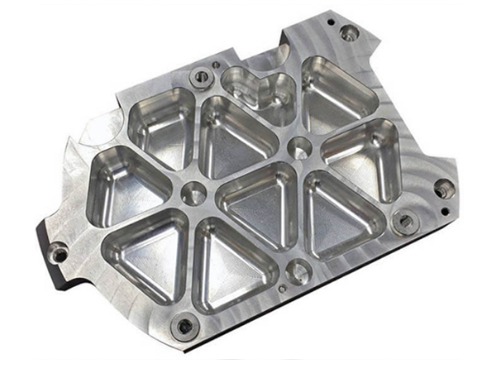
The distinguishing feature of this aluminum base plate is the pattern of triangular pockets machined across its surface. Instead of leaving the entire component solid, material is removed from selected regions while raised sections remain between the pockets.
These connecting sections form a network across the plate, linking the mounting areas and perimeter. The layout creates opportunities to reduce component weight without eliminating the solid material needed around important fastening locations.
Several holes and recessed mounting points are positioned throughout the part. The outer edges also follow an irregular contour rather than a standard rectangular profile, allowing the plate to accommodate surrounding components in a specific mechanical assembly.
The visible machining marks and pocket surfaces are consistent with CNC milling. For applications that involve accurate mounting interfaces, the pockets, fastening locations, and external profile can be produced through a planned sequence of milling and drilling operations.
KONSTUN Precision Technology manufactures aluminum components with complex milled features for equipment manufacturers, fixture designers, and industrial product developers.
Key Specifications & Parameters
Product Type: Lightweight Aluminum Mounting Plate
Manufacturing Process: CNC Milling, Drilling, and Hole Finishing
Material Options: Aluminum 6061, 7075, or Other Specified Aluminum Alloys
Visible Surface: Natural Machined Aluminum Finish
Main Geometry: Irregular Plate Profile with Multiple Triangular Recesses
Structural Details: Raised Connecting Sections Between Machined Pockets
Mounting Features: Distributed Fixing Holes, Recessed Fastening Areas, and Local Mounting Features
Surface Treatment Options: Natural Finish, Anodizing, Bead Blasting, or Other Specified Treatments
Engineering Requirements: Dimensions, Hole Positions, Flatness, and Fit Determined by Customer Drawings
Typical Production Scope: Prototype Machining, Small-Batch Production, and Repeat Manufacturing
Product Features & Functions
Weight Reduction Through Milled Pockets
The triangular pockets remove material from areas of the plate where a fully solid section may not be necessary. Their position, depth, and spacing can be developed according to the intended mounting arrangement and structural requirements.
Connecting Sections Between Recessed Areas
Material remains between the machined pockets, forming continuous sections that connect different areas of the plate. These features help preserve structural continuity, while final stiffness and load capacity depend on the complete engineering design.
Multiple Locations for Fastening
The plate contains several mounting holes and recessed fixing positions. These features provide potential attachment points for other mechanical components and can be dimensioned to match the required fasteners and mating parts.
Machined Surfaces for Component Assembly
Selected surfaces can be finish-milled where accurate contact or component alignment is required. This is particularly useful when the plate must fit against another machined part, mounting frame, or fixture.
Irregular Outline for Space-Constrained Designs
Unlike a standard rectangular base plate, this part has shaped edges and local extensions. The profile can follow the installation envelope of a particular machine or assembly, helping designers accommodate nearby components.
Specific Application Scenarios
Automation Equipment Mounting
A lightweight aluminum plate can provide a mounting interface for automation modules, drive components, and other mechanical assemblies. Hole positions and contact surfaces can be designed around the equipment layout.
Robotic Equipment Structures
For robotic mechanisms where mounting space and component weight are important, pocketed aluminum plates can be considered for selected support or connection locations. Structural suitability must be assessed against the operating loads.
Precision Testing Fixtures
The plate design can be adapted for testing fixtures that require multiple attachment points and a specific arrangement of mounted components.
Industrial Machine Assemblies
Machined base plates can be used between machine components, mounting brackets, and equipment frames. The irregular outline and local fastening features allow the part to follow a defined assembly layout.
Lightweight Mechanical Prototypes
Engineering teams can use CNC machined samples to examine weight-relief pocket designs, mounting-hole accessibility, and component fit before finalizing production drawings.
FAQ
Q1: What is the purpose of the triangular pockets?
A1: The pockets remove material from selected areas of the aluminum plate. This can reduce the weight of the component while leaving connecting sections between the recessed regions. The final layout should be checked against the required loads.
Q2: Are the triangular pockets cut completely through the plate?
A2: The pictured part shows recessed pockets with visible bottom surfaces. Through-cut openings can be considered in other designs, but they would require a separate structural and machining review.
Q3: Which aluminum grades can be used?
A3: Common options include 6061 and 7075 aluminum. The choice depends on the required mechanical properties, machining conditions, surface treatment, and intended operating environment.
Q4: How are the mounting holes manufactured?
A4: Depending on their design, mounting features may require drilling, boring, tapping, or counterboring. The necessary operations are determined by the drawing and fastening requirements.
Q5: Can the plate be manufactured with a different pocket layout?
A5: Yes. Pocket geometry, wall thickness, fastening locations, and outer dimensions can be adjusted to suit a particular assembly, provided the design remains suitable for machining and its intended loads.
Q6: What information is needed to produce a similar mounting plate?
A6: A 2D drawing or 3D CAD model should specify the overall dimensions, material, pocket depths, mounting-hole details, tolerances, and surface finish. Application information is also useful when reviewing the design for manufacture.






 Phone