Every surgical instrument, implant, and medical device you see in a hospital started as a raw block of medical-grade material — shaped by Precision Machining into a medical machined part. In Medical Device Manufacturing, the component is not just "a part": it carries biocompatibility requirements, sterilization compatibility, traceability obligations, and tolerances measured in microns. Getting the part right is the difference between a device that saves lives and one that fails clinical trials.
This guide covers the main types of medical machined parts, where they are used, which materials suit which application, the key challenges of machining medical parts, and how to source them from a qualified supplier. If you are new to the field, our complete guide to medical CNC machining explains the underlying process in detail.
What Are Medical Machined Parts? A Complete Overview of CNC Machined Medical Components
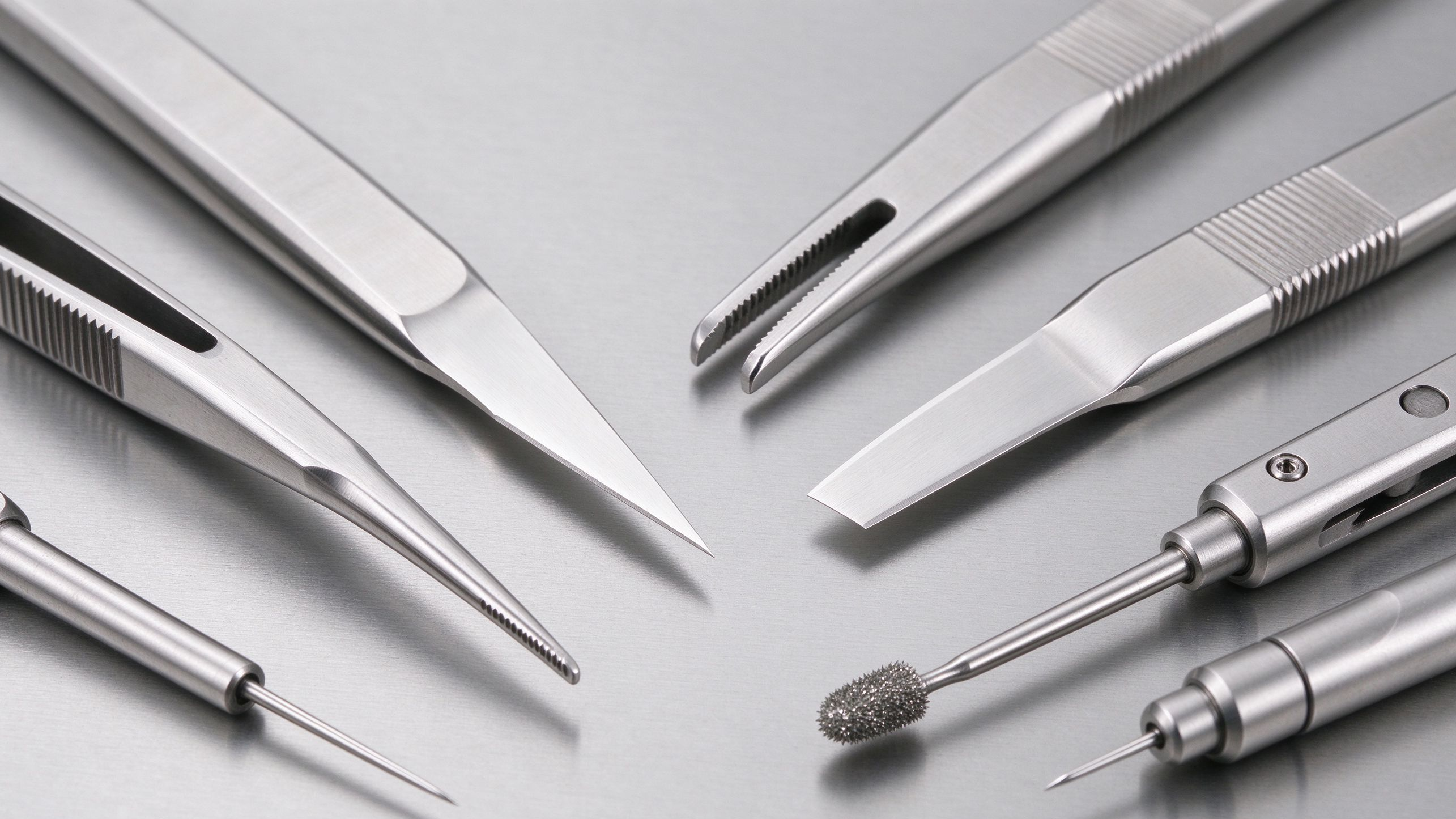
Medical machined parts are components manufactured from biocompatible materials using subtractive manufacturing methods — primarily CNC milling, turning, and Swiss-type machining. They range from 1mm micro-screws used in hand surgery to large MRI machine housings.
What distinguishes CNC machined medical components from ordinary industrial parts:
Biocompatible material certification — every batch requires mill test reports (MTR)
Micro-precision tolerances — often ±0.01mm or tighter
Sterilization compatibility — the part must survive autoclave, ethylene oxide, or radiation
Full traceability — batch numbers, machine IDs, and operator records for regulatory audits
Clean surface finish — burr-free edges to protect human tissue
The medical device cnc parts list typically includes: surgical instrument handles, bone screws, implant bodies, dental abutments, catheter components, valve bodies, device housings, and hundreds of other specialized components.
Main Types of Medical Machined Parts: From Surgical Instruments to Implants
Let's break down the full medical device cnc parts list by category, with typical applications and manufacturing requirements for each.
1. Surgical Instruments
Examples: scalpel handles, forceps, needle holders, retractors, laparoscopic tools
Materials: 316L stainless steel (most common), titanium for lightweight versions
Key requirements: razor-sharp edge geometry, ergonomic handles, corrosion resistance, Ra < 0.4μm on cutting edges
2. Orthopedic Implants
Examples: hip stems, femoral heads, bone plates, locking screws, spinal rods
Materials: Ti6Al4V titanium, cobalt-chromium, PEEK for non-load-bearing parts
Key requirements: biocompatibility, bone-ingrowth surface textures, ±0.01mm mating surfaces
3. Dental Components
Examples: implant abutments, healing caps, orthodontic brackets, framework bars
Materials: Grade 5 titanium, zirconia, PEEK
Key requirements: patient-specific fit, micro-gap sealing, high polish for anti-plaque
4. Medical Device Housings & Structural Parts
Examples: pacemaker enclosures, ultrasound probes, surgical motor housings, monitor frames
Materials: 6061 aluminum (anodized), 304/316 stainless, engineering plastics
Key requirements: EMI shielding, dimensional stability, cosmetic finish
5. Minimally Invasive Surgery (MIS) Components
Examples: trocars, endoscopic jaws, catheter hubs, micro forceps
Materials: stainless steel, titanium, nitinol (specialty)
Key requirements: thin walls, ultra-smooth surfaces, high strength at small scale
6. Medical Fixtures & Custom Tools
Examples: surgical drilling guides, alignment jigs, sterilization trays, instrument cases
Materials: aluminum, PEEK, stainless steel
Key requirements: precision alignment features, reusability, chemical resistance
Common Applications of CNC Machined Medical Components in Modern Healthcare
Where exactly do medical machined parts appear in clinical practice? The applications span every hospital department:
Surgery & Orthopedics
Cardiology & Vascular
Pacemaker and defibrillator housings
Catheter delivery system components
Heart valve frames and rings
Dentistry & Maxillofacial
Diagnostics & Imaging
MRI and CT scanner structural components
Ultrasound probe housings
Laboratory analysis equipment parts
Neurology & Microsurgery
Stereotactic frame components
Micro-neurosurgical instruments
Deep brain stimulation (DBS) lead fixtures
Pharmaceutical & Laboratory
Regardless of the department, one principle holds: the precision of the CNC machined medical component directly determines clinical outcomes. For deeper precision data, see our precision medical machining guide.
Best Materials for Medical Machined Parts: Matching Material to Function
Selecting the right material for medical machined parts is a balance of biocompatibility, mechanical performance, machinability, and cost. Here is a practical material selection table:
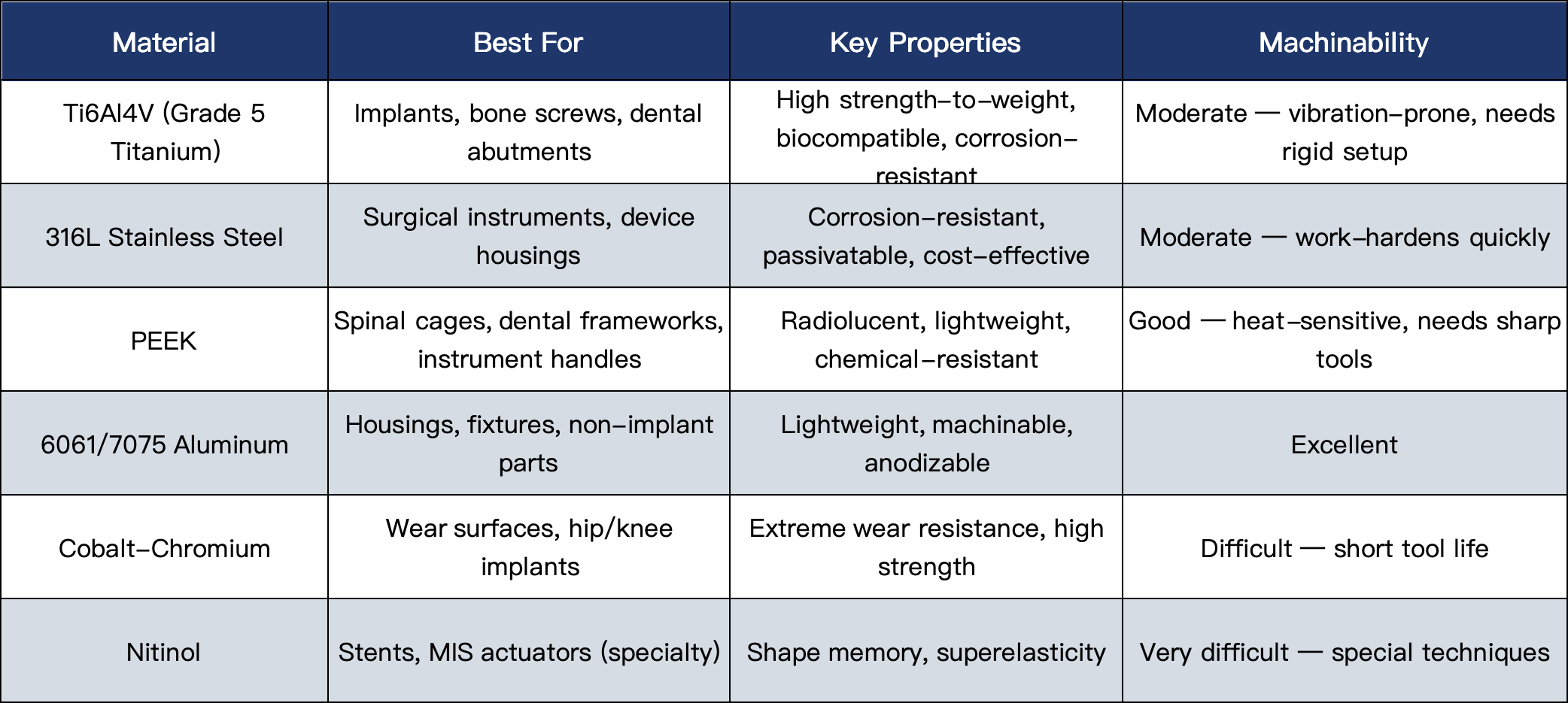
Material selection rules for machining medical parts:
Implant → titanium, CoCr, or implant-grade PEEK (never aluminum or standard steel)
Single-use instrument → 316L stainless (cost balance)
Repeated sterilization → prefer stainless, titanium, or PEEK (check autoclave tolerance)
Imaging compatibility → PEEK or CFR-PEEK (radiolucent) for CT/MRI-visible areas
Cosmetic housings → anodized aluminum (colors, wear resistance)
For a deeper material comparison with processing notes, refer back to our medical CNC machining guide.
Machining Medical Parts: Key Manufacturing Challenges and Solutions
Machining medical parts is technically demanding. Here are the most common challenges and how experienced shops solve them:
Challenge 1: Work Hardening (Stainless Steel)
316L work-hardens rapidly, blunting tools and distorting dimensions. Solution: Use sharp carbide tools, correct chip loads, and avoid dwell — feed continuously through the cut.
Challenge 2: Vibration & Chatter (Titanium)
Titanium's low elastic modulus causes deflection and chatter at thin-wall sections. Solution: Rigid workholding, reduced overhang, climb milling, and vibration-damped tool holders.
Challenge 3: Heat Sensitivity (PEEK & Plastics)
PEEK melts and smears under excessive heat; it also burrs easily. Solution: Sharp tools, low spindle speed with high feed, air blast cooling, and deburring passes.
Challenge 4: Burr-Free Requirements
Any burr on a medical part can injure tissue or block assembly. Solution: Multi-step deburring (manual + vibratory + micro-blasting), plus 100% edge inspection.
Challenge 5: Micro-Features (Sub-1mm)
Catheter components and micro instruments have features smaller than 1mm. Solution: Swiss-type lathes, micro-milling with 0.1mm end mills, and microscope-aided inspection.
Challenge 6: Traceability Documentation
Regulatory audits require complete records for every part. Solution: Digital manufacturing execution systems (MES) that log batch, machine, tool, operator, and inspection data automatically.
Quality and Compliance Requirements for Medical Device CNC Parts
Every medical device cnc part must satisfy quality and compliance standards before it can enter clinical use.
Quality Requirements:
First Article Inspection (FAI) with actual measured values on every new part
CMM inspection for critical dimensions (±0.001mm measurement accuracy)
Surface roughness verification (profilometer)
Statistical Process Control (SPC) for production runs
100% inspection of critical features where failure is safety-related
Compliance Frameworks:
ISO 13485:2016 — Quality management system for medical devices (mandatory for suppliers)
FDA 21 CFR 820 — US Quality System Regulation
EU MDR 2017/745 — European medical device regulation
ASTM F136 — Ti6Al4V ELI implant material standard
ASTM F138 — 316L stainless implant standard
Documentation you should receive with every shipment:
Material test reports (MTR) with heat number
Dimensional inspection reports (actual values)
FAI report for new programs
Batch traceability records
Certificate of conformance
If a supplier cannot produce these documents, treat it as a red flag. Our guide to choosing a medical CNC machining service provider explains how to verify supplier quality systems in practice.
How to Source Medical Machined Parts from a Reliable Supplier
Sourcing medical machined parts requires more than sending a drawing and waiting for a quote. Follow this 5-step process:
Step 1: Prepare a Complete RFQ Package
Include 3D CAD (STEP/IGES), 2D drawing with GD&T, material spec with grade, surface finish requirement, annual volume, target price, and certification requirements.
Step 2: Shortlist 3-5 Qualified Shops
Filter by ISO 13485 certification, Medical Materials experience, in-house CMM, and cleanroom capability. Reject any shop without ISO 13485 for implant or critical parts.
Step 3: Request DFM Feedback
Send your hardest part to each candidate and ask for a Design for Manufacturing review. The depth of their feedback reveals their engineering maturity.
Step 4: Audit Quality Documents
Ask for sample FAI reports, sample inspection reports, and material certificates. Verify they can provide actual measured values, not just "pass" stamps.
Step 5: Start with a Pilot Order
Place a small prototype or low-volume order. Evaluate part quality, communication speed, and delivery reliability before scaling to production.
For a detailed 8-criteria selection framework, read our how to choose a medical CNC machining service provider article.
Frequently Asked Questions About Medical Machined Parts
Q1: What is the difference between medical machined parts and standard machined parts?
A: Medical parts require biocompatible certified materials, tighter tolerances (±0.01mm vs ±0.05mm typical), sterilization compatibility, burr-free surfaces, and full traceability documentation — none of which standard industrial parts need.
Q2: What is the minimum order quantity for medical machined parts?
A: Most qualified shops accept 1-piece prototypes. Production MOQs typically start at 50-100 pieces, but this depends on part size and complexity. Pricing improves significantly above 100 pieces.
Q3: How long does it take to get medical machined parts?
A: Prototypes: 1-2 weeks. Low-volume production: 2-4 weeks. High-volume: 4-8 weeks, depending on material availability and complexity.
Q4: Can medical machined parts be customized?
A: Yes — almost all medical parts are custom-made from your drawings. Standard parts exist for some instruments, but implants and patient-specific components are always custom machined.
Q5: How do I know if a medical part is machined correctly?
A: Ask for CMM inspection reports with actual measured values, surface roughness readings, and material certificates. Reputable suppliers provide full documentation with every shipment.
Conclusion: Get Custom Medical Machined Parts That Pass Audits
Medical machined parts sit at the intersection of precision engineering and patient safety. Choosing the right materials, the right tolerances, and the right supplier determines whether your device performs reliably in the operating room.
At Konsdun, we specialize in CNC machined medical components with ISO 13485 compliance, in-house CMM inspection, and full traceability documentation. From surgical instruments to implant-grade components, we deliver parts that pass regulatory audit every time.
Start your project today:
Email: konsdun.li@gmail.com ; liu@konsdun.com
WhatsApp: +86 133 9282 6147






 Phone
Comment
(0)