Product Introduction
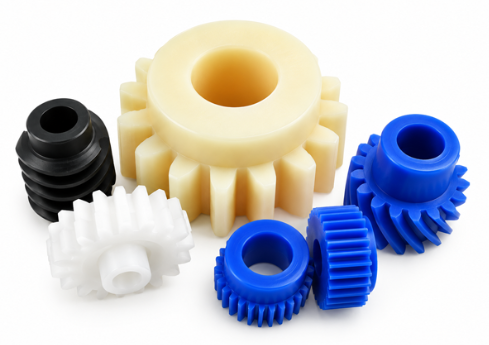
Plastic gears are commonly used in mechanisms where component weight, friction, and material compatibility are important considerations. This collection includes a large cream-colored gear alongside several smaller blue, white, and black gears, illustrating the different sizes and proportions that can be produced for mechanical transmission projects.
Each gear has a toothed outer profile and a central opening for installation onto a shaft or supporting component. The tooth geometry determines how the gear engages with its mating component, while the bore dimensions influence how it fits within the assembly.
CNC machining is particularly useful when a project requires a specific gear diameter, tooth profile, or mounting arrangement that is not readily available as a standard commercial part. Gear blanks and mounting features can be machined from engineering plastic stock, followed by suitable tooth-cutting operations.
KONSTUN Precision Technology manufactures Engineering Plastic Components for equipment development, replacement part projects, and mechanical assemblies. Gear dimensions and material selection are determined by the customer's transmission design and operating conditions.
Key Specifications & Parameters
Product Type: CNC Machined Plastic Gear Components
Gear Type: Spur Gears; Helical Gears and Worm Wheels Available for Project-Specific Designs
Material Options: Nylon, MC Nylon, POM (Acetal), UHMWPE, and Other Suitable Engineering Plastics
Manufacturing Processes: CNC Turning, Milling, Gear Cutting, Drilling, and Bore Finishing as Required
Gear Geometry: Tooth Count, Module, Pressure Angle, Face Width, and Pitch Diameter According to Drawings
Mounting Features: Central Bore, Shaft Fit, Keyway, or Other Specified Connection Details
Color Options: Natural, White, Blue, Black, and Material-Dependent Colors
Surface Condition: Machined Plastic Surface
Production Scope: Prototype Gears, Replacement Components, and Small-to-Medium Production Batches
Product Features & Functions
Gear Teeth Designed Around the Transmission
The shape and spacing of gear teeth determine how motion passes between rotating components. Tooth count, module, and pressure angle need to be compatible with the mating gear. These parameters can be specified to match a new mechanism or an existing transmission assembly.
Engineering Plastics for Different Operating Conditions
Nylon and POM are commonly considered for mechanical gear applications, although their properties differ. Nylon offers toughness and wear-related advantages in suitable conditions, while POM is valued for its dimensional stability and low-friction characteristics. Other plastics require evaluation against the expected load, temperature, speed, and operating environment.
Shaft Bores and Mounting Details
The central bore is an important feature of a machined gear. Its diameter, finish, and fit affect installation on the shaft. Additional connection features, such as keyways or fastening details, can be incorporated when required by the assembly.
Useful for Nonstandard Gear Replacement
Industrial equipment sometimes uses gear sizes or mounting arrangements that are difficult to source as standard replacement parts. CNC machining offers a route to reproduce the required geometry from drawings or verified component measurements without creating an injection mold.
Production Without Dedicated Molding Tools
Machining from plastic stock allows engineering teams to review tooth geometry, material behavior, and assembly fit before committing to a larger manufacturing program. It is particularly practical when gear designs are still being adjusted or the required quantity does not justify molding tools.
Specific Application Scenarios
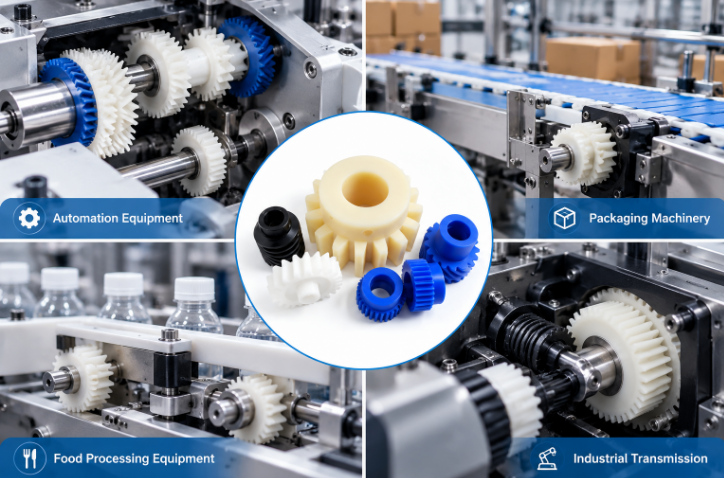
Packaging Machinery Drive Systems
Plastic gears can be used in selected motion-control and transfer mechanisms within packaging equipment. Gear material and geometry are chosen according to the required torque, operating speed, and duty cycle.
Automated Feeding Mechanisms
Compact gear arrangements are used to transfer rotational movement between components in automated feeding and handling systems. Machined plastic gears provide an option for designs requiring nonstandard dimensions or mounting features.
Conveyor Auxiliary Drives
For suitable conveyor mechanisms, plastic gears may be used in auxiliary drive or positioning assemblies. The final gear design needs to account for transmitted loads, alignment, wear, and operating conditions.
Instrument and Equipment Mechanisms
Small-diameter plastic gears are suitable candidates for selected instrument adjustment, positioning, and mechanical control systems where compact transmission components are required.
Industrial Equipment Replacement Parts
Machined plastic gears can support maintenance projects when an existing gear has worn out or a replacement is no longer commercially available. Accurate identification of the original tooth geometry and material is important before production.
Mechanical Product Prototyping
During the development of a new transmission assembly, machined gears allow engineers to check shaft fit, gear engagement, available space, and operating behavior before finalizing the mechanism.
FAQ
Q1: What is the difference between nylon and POM gears?
A1: Nylon is often selected where toughness and wear behavior are important, while POM is commonly used where dimensional stability and low-friction performance are priorities. The appropriate material depends on the load, temperature, moisture exposure, and gear design.
Q2: Can plastic gears be machined without injection molds?
A2: Yes. Plastic gears can be produced from engineering plastic stock using CNC machining and suitable gear-cutting methods. This is especially useful for prototypes, replacement parts, and smaller production quantities.
Q3: What information is needed to manufacture a plastic gear?
A3: Important details include the gear type, tooth count, module or diametral pitch, pressure angle, face width, bore dimensions, material, and any mounting features. Information about the mating gear is also helpful.
Q4: Can CNC machining produce helical gears or worm wheels?
A4: These gear types can be manufactured using appropriate machining equipment and cutting processes. Their feasibility depends on the required geometry, material, size, and available production method.
Q5: Do plastic gears require lubrication?
A5: Some engineering plastics have relatively low-friction properties, but this does not mean lubrication is unnecessary in every application. The need for lubrication depends on the mating materials, contact loads, operating speed, and service conditions.
Q6: How can a replacement gear be matched to an existing machine?
A6: The replacement must match the original tooth geometry and mounting interface. A technical drawing or accurately measured sample is recommended, together with information about the mating gear and operating conditions.






 Phone