Product Introduction
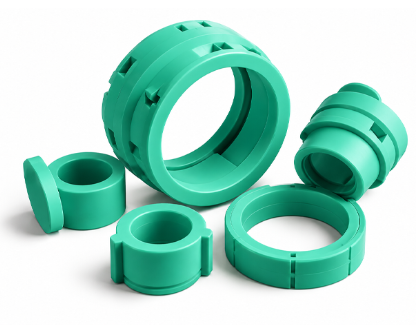
This custom plastic ring and sleeve series is designed for precision mechanical applications where lightweight structure, insulation performance, and dimensional accuracy are required.
The components feature circular structures with positioning steps, grooves, and inner holes, making them suitable as spacers, bushings, insulating rings, guides, and protective sleeves inside industrial equipment.
Compared with traditional metal parts, Engineering Plastic Components provide advantages such as low friction, corrosion resistance, electrical insulation, and reduced weight. Materials including POM, Nylon, and PEEK can be selected according to different working environments and performance requirements.
KONSTUN Precision Technology supports CNC machining, injection molding, and vacuum casting solutions for engineering plastic parts, helping customers develop reliable components for automation equipment, instruments, and mechanical systems.
Key Specifications & Parameters
Product Type:
CNC machined engineering plastic rings and sleeves
Product Form:
Plastic bushings, spacer rings, insulation sleeves, positioning rings, mechanical guides
Material Options:
POM (Delrin), Nylon PA6/PA66, PEEK, ABS, PU, and other engineering plastics
Processing Methods:
CNC plastic machining, injection molding, vacuum casting, drilling, turning, and precision finishing
Surface Treatment:
Natural plastic finish, polishing, texture processing, painting, or customized appearance treatment
Structure Features:
Ring structure, inner hole, positioning step, groove design, lightweight body, wear-resistant surface
Application Fields:
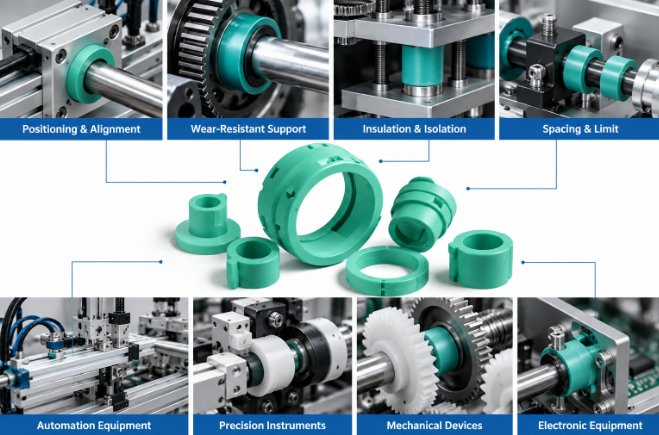
Industrial automation equipment, mechanical devices, instruments, electronic equipment, precision assemblies
Production Support:
Prototype Manufacturing, small batch production, and mass production
Product Features & Functions
Precision Positioning Support
The machined plastic rings provide accurate positioning and alignment functions for mechanical assemblies, helping improve installation stability.
Wear-Resistant Mechanical Performance
Engineering plastics such as POM and Nylon offer good wear resistance and low friction characteristics for moving or contacting components.
Electrical Insulation Capability
Plastic materials provide natural insulation properties, making these components suitable for applications involving electronic or electrical assemblies.
Lightweight Alternative to Metal Parts
Compared with metal components, engineering plastic parts reduce weight while maintaining sufficient mechanical performance.
Flexible Manufacturing Solutions
CNC machining is suitable for prototypes and small quantities, while injection molding provides an efficient solution for larger production volumes.
Wide Material Selection
Different engineering plastics can be selected based on temperature resistance, strength, chemical resistance, and application requirements.
Specific Application Scenarios
Industrial Automation Equipment
Used as positioning rings, guide sleeves, and insulating components inside automated machinery.
Precision Mechanical Assemblies
Suitable for mechanical structures requiring accurate spacing, support, and low-friction movement.
Electronic Equipment Components
Plastic insulating rings and sleeves can help separate and protect electrical components.
Instrument Equipment
Used in measuring instruments and precision devices requiring stable positioning and lightweight structures.
Robotics Systems
Applied as bushings, spacers, and protective components in robotic mechanisms.
Custom Machinery Development
Suitable for customized equipment requiring engineering plastic parts with specific dimensions and functions.
FAQ
Q1: What materials are commonly used for these plastic rings and sleeves?
A1: Common materials include POM, Nylon PA6/PA66, PEEK, and other engineering plastics selected according to strength, wear resistance, and working conditions.
Q2: What are these plastic components mainly used for?
A2: They are commonly used as bushings, spacers, insulation rings, positioning parts, and protective sleeves in industrial equipment.
Q3: Why choose engineering plastic instead of metal?
A3: Engineering plastics offer lower weight, electrical insulation, corrosion resistance, and low-friction performance.
Q4: Can these parts be produced in different sizes and shapes?
A4: Yes. CNC machining and molding processes allow different dimensions, structures, and designs according to application requirements.
Q5: Which manufacturing process is suitable for these components?
A5: CNC machining is suitable for prototypes and small batches, while injection molding is more suitable for larger production quantities.
Q6: Are these plastic parts suitable for high-precision equipment?
A6: Yes. Engineering plastics combined with Precision Machining can achieve stable dimensions for automation equipment and mechanical systems.






 Phone