Introduction: Precision Dentistry Powered by CNC
Dental implants, abutments, crowns, and orthodontic appliances are among the most precisely manufactured products in healthcare — and dental CNC machining is the technology making them possible. A dental implant abutment must seat onto an implant with a micro-gap measured in single-digit microns; a crown must fit a prepared tooth within 50 microns. These tolerances are achieved day after day by dental milling centers and CNC-equipped dental laboratories worldwide.
This guide covers the world of dental medical cnc machining: what components are machined, the materials used, precision standards, workflow from scan to finished part, and how to choose a partner for custom dental CNC parts. For broader medical context, our medical CNC machining guide is a good starting point.
What Is Dental Medical CNC Machining? Precision for Dentistry
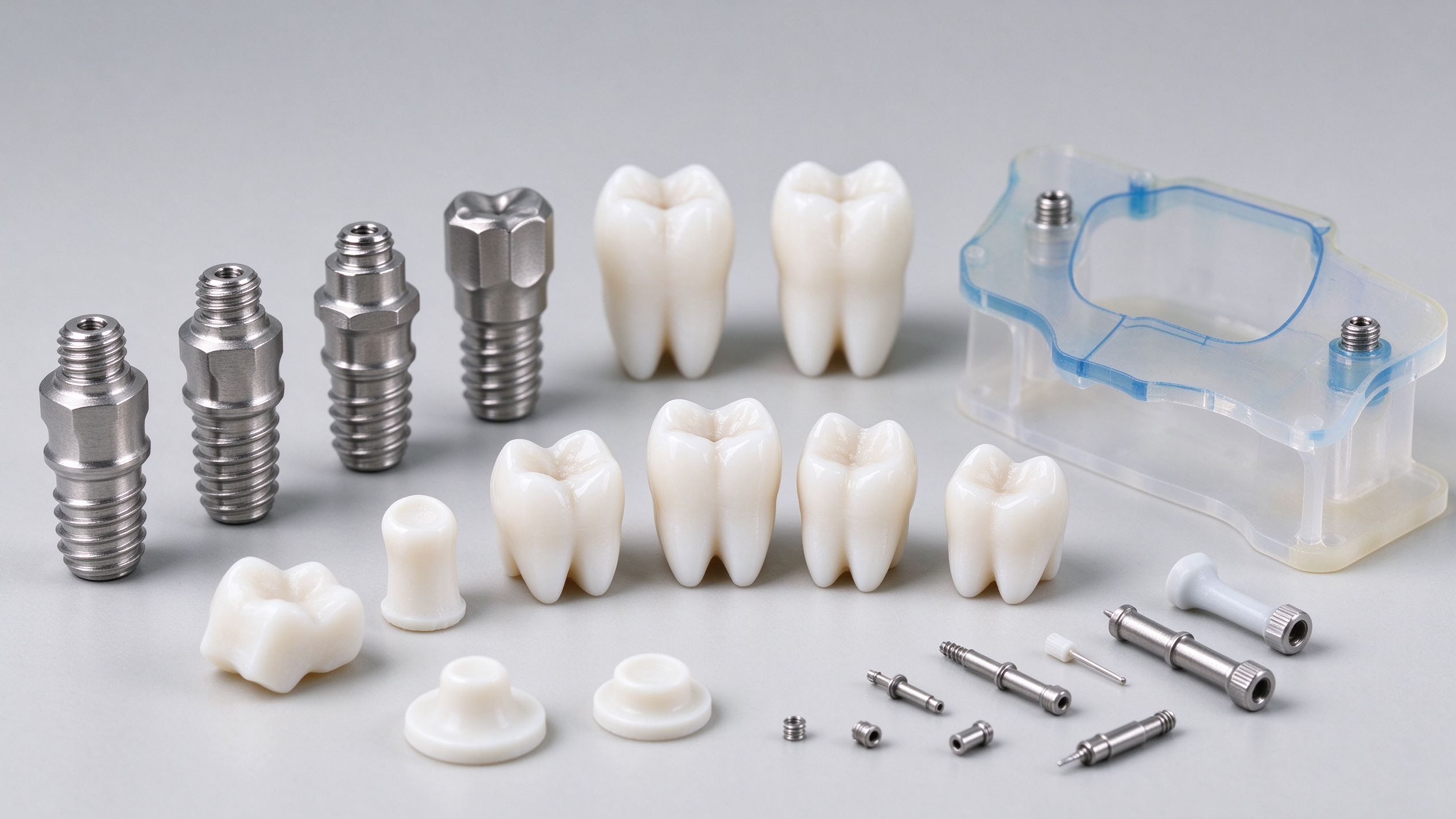
Dental medical CNC machining is the subtractive manufacturing of dental prosthetics and components using CNC milling and turning machines. Unlike industrial CNC, dental machining works at smaller scale, often with patient-specific geometries derived from intraoral scans.
Two main dental CNC workflows:
Chairside / In-office milling — small desktop CNC mills in dental clinics produce same-day crowns from ceramic blocks (CEREC-style workflow)
Centralized dental laboratory milling — high-capacity CNC machines in dental labs or specialized milling centers produce abutments, frameworks, and full-arch prosthetics in volume
Key components produced by Dental CNC Machining:
Implant abutments (titanium, zirconia)
Custom abutment interfaces
Crowns and bridges (zirconia, lithium disilicate blocks)
Removable partial denture frameworks (CoCr, titanium)
Orthodontic brackets and appliances
Surgical guides for implant placement
Healing caps and scan bodies
The defining feature of dental CNC parts: they are nearly always custom — designed from each patient's unique anatomy.
Custom Dental CNC Parts: Abutments, Crowns, and Frameworks
Let's look at the most commonly machined custom dental CNC parts in detail:
1.Implant Abutments
The abutment connects the implant (in bone) to the crown (above gum). It must achieve a bacteria-proof seal at the implant-abutment junction.
Materials: Grade 5 titanium (machined), zirconia (milled)
Precision: ±0.005–0.01mm on the internal connection geometry
CNC process: 4-axis or 5-axis milling from titanium blanks; micro-machining for the connection zone
Surface: polished emergence profile, Ra < 0.2μm in soft-tissue contact zones
2. Crowns & Bridges
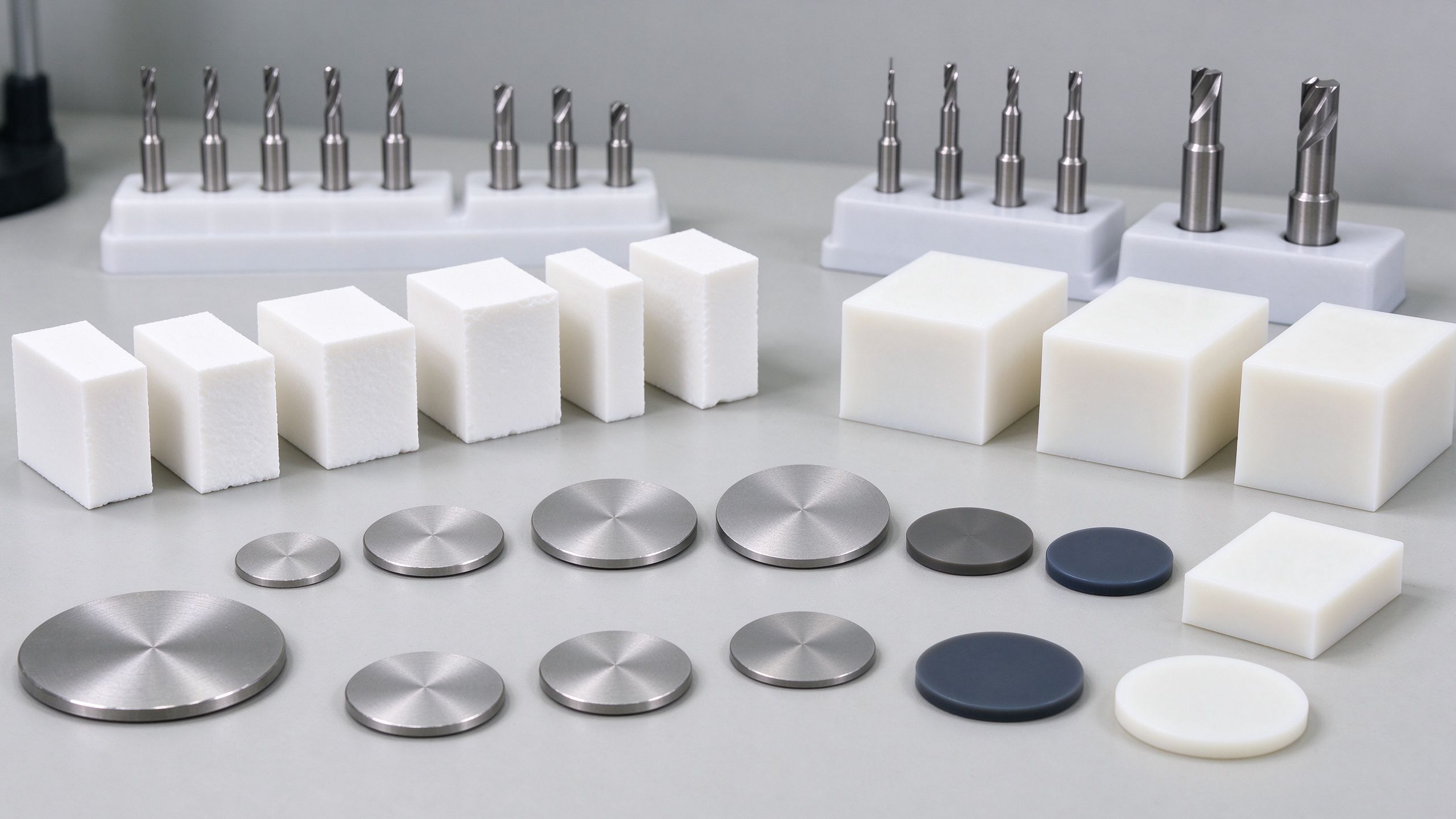
Materials: zirconia blocks (Y-TZP), lithium disilicate, PMMA (temporary)
Precision: marginal fit within 50μm (clinical standard)
CNC process: 5-axis dry milling of sintered/partially sintered ceramic blocks
Surface: glazed and polished after machining
3. Removable Partial Denture (RPD) Frameworks
Materials: CoCr alloy, titanium, or PEEK
Precision: framework must seat precisely on abutment teeth
CNC process: CNC milling (additive or subtractive), often from wax or resin pattern
Surface: high polish for oral comfort and hygiene
4. Surgical Guides
Materials: PMMA or resin
Precision: drill sleeve position within ±0.1mm
CNC process: 3-axis or 5-axis milling from printed or milled resin
Function: transfers digital implant planning to the surgical site
5. Orthodontic Appliances
Materials: stainless steel, titanium, or polymer
CNC process: micro-machining of brackets and wires
Precision: ±0.02mm slot dimensions
Dental Implant CNC Machining: Materials and Precision Standards
Dental implant CNC machining is the most precision-critical branch of dental manufacturing. The implant body, internal connection, and thread geometry determine long-term success rates.
Implant body materials:
Grade 4 / Grade 5 titanium — the standard for dental implants (osseointegration proven over decades)
Zirconia (ceramic implants) — metal-free option growing in popularity
TiZr alloy (Roxolid-type) — higher strength for small-diameter implants
Critical precision features of dental implant cnc machining:
Internal connection (hex/tri-lobe): ±0.002–0.005mm — the anti-rotation mechanism
Thread geometry: precise pitch and flank angles for primary stability
Implant-abutment junction: micro-gap < 5μm to prevent bacterial micro-leakage
Surface treatment: SLA (sandblasted, acid-etched) for osseointegration; machined collar zone
Machining challenges:
Titanium micro-machining with tight tolerances requires Swiss-type or precision 5-axis centers
Thin-wall hollow implant bodies (for screw-retained prosthetics)
Burr-free thread edges (threads must not damage bone during insertion)
Quality standards:
ISO 13485 quality management
ISO 14801 (fatigue testing for implants)
ISO 10993 (biocompatibility)
ASTM F67 / F136 (titanium material standards)
Materials for Dental CNC Machining: Titanium, Zirconia, and PEEK
Material selection drives both clinical performance and machining strategy in dental CNC machining. Here's what you need to know:
Selection rules:
Implant + abutment → titanium (gold standard) or zirconia (aesthetic, metal-free)
Crown for molar → zirconia (strength) or lithium disilicate (aesthetics)
Removable framework → CoCr (rigidity) or titanium (lighter, biocompatible)
Temporary restoration → PMMA or PEEK
Surgical guide → PMMA (rigid, dimensionally stable)
For a deeper look at material properties in the broader medical context, the Medical Machined Parts guide includes a full comparison table.
surface finish and Quality Control in Dental Medical CNC Machining
Dental parts live in a hostile oral environment — saliva, bacteria, chewing forces, temperature swings. Surface finish and quality control are therefore non-negotiable.
Surface finish requirements:
Soft-tissue contact zones (abutments): Ra < 0.2μm — polished to prevent plaque accumulation and gingival inflammation
Implant connection zones: Ra 0.1–0.2μm — smooth to prevent bacterial adhesion
Occlusal surfaces (crowns): glazed ceramic finish for wear resistance
Framework inner surfaces: sandblasted for adhesion of veneering material
Quality control workflow in dental CNC machining:
Digital design validation — CAD check for connector sizes, clearance, and fit
In-process measurement — machine-integrated probing for critical features
Post-machining verification — coordinate measurement, microscopic inspection of margins
Fit verification on models — seating check on 3D-printed or stone models
Final visual inspection — surface defects, porosity, cracks
Documentation — batch records, material certificates, sterilization records
Common defects to watch for:
Marginal gap > 50μm (crown fit failure)
Micro-cracks in zirconia (from aggressive machining parameters)
Titanium smearing or burrs (inadequate tool sharpness)
Surface contamination (improper cleaning)
How to Choose a Dental CNC Machining Partner for Custom Components
Whether you're a dental laboratory, implant manufacturer, or dental clinic, choosing the right dental CNC machining partner is critical. Evaluation criteria:
1. Technology & Equipment
4-axis and 5-axis dental milling machines
Dry and wet milling capability (zirconia vs titanium)
CAD/CAM software integration (exocad, 3Shape, etc.)
2. Material Expertise
Experience with titanium, zirconia, CoCr, PEEK, PMMA
Certified material sources with traceability
3. Precision Verification
In-house measurement equipment
Demonstrated marginal fit performance (< 50μm)
Sample parts for fit testing
4. Compliance
ISO 13485 (if supplying implant components)
Material certificates for all alloys and ceramics
Sterilization and packaging capability
5. Production Flexibility
6. Communication
Digital file handling (STL, DCM formats)
Design feedback and DFM suggestions
Reliable delivery tracking
If you are also sourcing broader medical components, our guide to choosing a medical CNC machining service provider provides a detailed 8-criteria framework that applies to dental suppliers as well.
Frequently Asked Questions About Dental CNC Machining
Q1: What is the difference between dental CNC machining and 3D printing?
A: CNC machining mills parts from solid blocks — ideal for high-precision, high-strength parts like titanium abutments and zirconia crowns. 3D printing excels at complex geometries and surgical guides but has lower precision and limited material strength. Many labs use both.
Q2: How accurate is dental CNC machining?
A: Modern dental CNC milling achieves marginal fits within 20-50μm — clinically excellent. Implant connections are machined to ±0.005mm or better.
Q3: How long does dental CNC machining take?
A: Chairside same-day milling takes 15-30 minutes per crown. Laboratory milling typically delivers standard cases in 48-72 hours, including design and finishing.
Q4: Can dental CNC parts be customized for each patient?
A: Yes — that's the core advantage. Every abutment, crown, and framework is designed from the patient's intraoral scan and machined to individual anatomy.
Q5: Is zirconia or titanium better for dental abutments?
A: Titanium offers proven osseointegration and strength; zirconia offers superior aesthetics for thin gingival biotypes. Many clinicians choose titanium for posterior and zirconia for anterior restorations.
Conclusion: Get Custom Dental CNC Parts from a Trusted Partner
Dental CNC machining combines the precision of industrial manufacturing with the artistry of dentistry. From implant abutments to full-arch frameworks, the technology has transformed what's possible in restorative dentistry.
At Konsdun, we provide dental medical CNC machining for laboratories and implant brands worldwide — titanium and zirconia abutments, implant components, and custom frameworks with ISO 13485 compliance, sub-micron precision, and 48-72 hour standard turnaround.
Email: konsdun.li@gmail.com ; liu@konsdun.com
WhatsApp: +86 133 9282 6147






 Phone
Comment
(0)