Introduction: Why Medical-Grade Materials Matter in CNC machining
Choosing the right material is the single most important design decision in medical CNC machining. A part that machines beautifully but fails biocompatibility tests, or corrodes inside the body, is worse than useless — it is a patient safety risk. Medical-grade materials are not simply "high-quality" versions of industrial metals: they come with certified chemistry, traceable mill records, and documented biocompatibility data.
This guide compares the six material families most commonly used in medical CNC machining — titanium, stainless steel, PEEK, aluminum, cobalt-chrome, and specialty alloys — with real-world property data, machinability notes, and selection rules. For the broader process context, see our complete medical CNC machining guide.
Ti6Al4V Titanium: The Gold Standard for Medical CNC Parts
Ti6Al4V (Grade 5) and its low-interstitial variant Ti6Al4V ELI (Grade 23) dominate implant-grade medical CNC machining.
Key properties:
Tensile strength: 900–1000 MPa (Grade 5), 860–900 MPa (ELI)
Density: 4.43 g/cm³ — roughly 60% the weight of steel
Elastic modulus: ~110 GPa — closer to bone (~10–30 GPa) than steel (210 GPa), reducing stress shielding
Corrosion resistance: Excellent, via a stable TiO₂ passive oxide layer
Biocompatibility: Grade 23 ELI meets ASTM F136 for surgical implants; proven osseointegration
Best applications:
Orthopedic implants (hip stems, bone plates, screws)
Dental implants and abutments
Surgical instruments (lightweight, high-strength versions)
External fixators and trauma hardware
Machining notes:
Low thermal conductivity (6.7 W/m·K) → heat concentrates at the cutting edge; use high-pressure coolant
Work-hardens quickly → sharp positive-geometry carbide tools
Vibration-prone → rigid workholding, minimal overhang
Typical surface speeds: 45–70 m/min (25–40 m/min for finish)
For implant-specific processing details, see our orthopedic implant cnc machining guide.
316L Stainless Steel: The Workhorse of Surgical Instruments
When titanium is too expensive or over-specified, 316L (low-carbon) stainless steel is the default material for medical CNC parts. Its medical-grade variant, 316LVM (vacuum-melted), meets ASTM F138/F139 for implants.
Key properties:
Tensile strength: 485–620 MPa (annealed)
Density: 7.99 g/cm³
Corrosion resistance: Good, especially after passivation (chromium oxide layer)
Magnetic response: 316L is low-magnetic; 316LVM is preferred for MRI-adjacent applications
Sterilization: Fully autoclavable (134°C)
Best applications:
Surgical instruments (forceps, scissors, clamps, needle holders)
Temporary trauma hardware (screws, plates removed after healing)
Medical device housings and brackets
Fluid handling components
Machining notes:
Work-hardens rapidly → use sharp tools, moderate feeds, no dwell
Built-up edge (BUE) common → use sulfurized or chlorine-based cutting fluid
Passivation after machining is mandatory to restore corrosion resistance
Typical surface speeds: 90–120 m/min (much faster than titanium)
When not to use 316L:
Permanent load-bearing implants (creep and corrosion fatigue risk)
MRI-visible precision components (magnetic signature)
Weight-critical aerospace-medical hybrids (use titanium)
PEEK and PEKK: High-Performance Polymers for Medical CNC
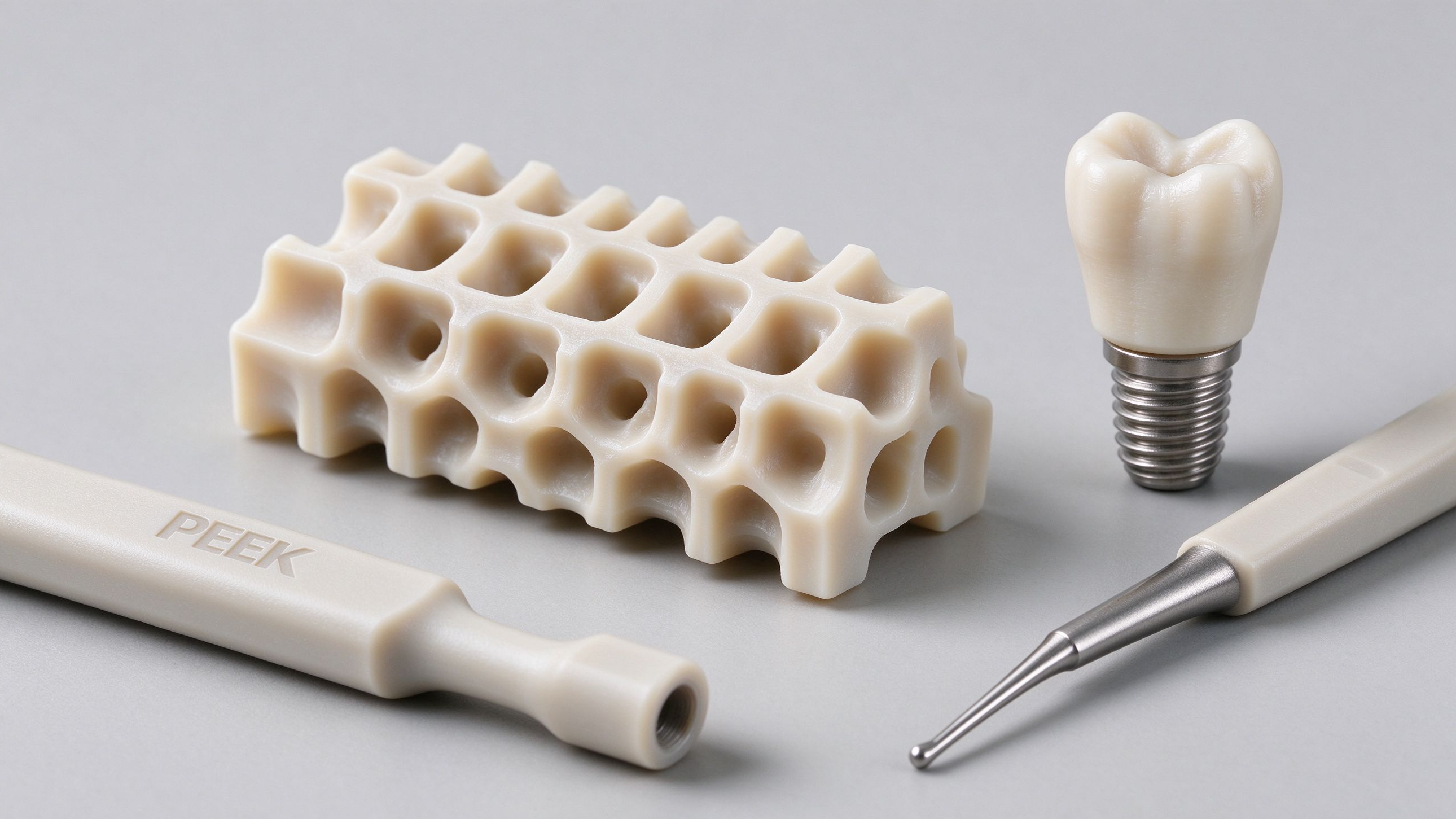
PEEK (Polyether Ether Ketone) and its higher-temperature cousin PEKK are the most important engineering polymers in medical CNC machining. They have revolutionized spinal, dental, and trauma applications.
Key properties:
Tensile strength: 90–100 MPa (unfilled PEEK); up to 200 MPa with carbon-fiber reinforcement (CFR-PEEK)
Density: 1.30 g/cm³ — extremely light
Radiolucence: X-ray transparent — ideal for CT/MRI-visible areas
Elastic modulus: 3–4 GPa (unfilled), ~18 GPa (CFR-PEEK) — closer to bone than metal
Chemical resistance: Excellent to most sterilants, oils, and body fluids
Temperature resistance: Continuous use up to 260°C
Best applications:
Spinal fusion cages (PEEK is the historical standard)
Dental implant abutments and frameworks (aesthetic, metal-free)
Surgical instrument handles (lightweight, radiolucent)
Orthopedic trauma spacers and trial components
MRI-compatible device components
Machining notes:
Machines like aluminum, but heat-sensitive → sharp tools, low spindle speed, moderate feed
Melts and smears at high temps → use air blast or mist coolant
Burrs easily → sharp tools, deburring passes
Available in medical-grade (implantable) and industrial grades — verify medical certification
Important caveat: PEEK's low modulus means it is not suitable for load-bearing joints (hip/knee). Use titanium or CoCr where metal strength is required.
Aluminum 6061/7075 and Engineering Plastics for Device Housings
Not every medical part touches the body. Housings, brackets, fixtures, and external device components use more cost-effective materials.
Aluminum 6061-T6 / 7075-T6 (Medical-Grade)
Tensile strength: 310 MPa (6061-T6), 505 MPa (7075-T6)
Density: 2.70 g/cm³ — lightest structural metal
Best for: Device housings, equipment brackets, sterilization trays, surgical guides, non-implant fixtures
Finish: Anodize (Type II/III) for corrosion resistance and color coding
Machining: Excellent — fastest of all Medical Materials, high surface speeds (300–600 m/min)
Important: Aluminum is NOT biocompatible for implant use — never specify aluminum for body-contact or implant parts.
Engineering Plastics (PEEK aside):
PEI (Ultem): Autoclavable, flame-retardant, for device housings
PC (Polycarbonate): Impact-resistant, sterilizable, for enclosures
POM (Acetal/Delrin): Low-friction, for gears and mechanisms
PTFE (Teflon): Chemical-resistant, for seals and liners
These are typically CNC-machined for low-volume housings and fixtures, then either anodized (aluminum) or bead-blasted (plastics) for finish.
For part examples, see our Medical Machined Parts guide.
Cobalt-Chromium and Specialty Alloys for Implant Bearings
For articulating medical surfaces — where a metal part rubs against another surface millions of times — cobalt-chromium (CoCrMo) is the material of choice.
Cobalt-Chromium (CoCrMo, ASTM F1537)
Tensile strength: 655–1000 MPa (cast/wrought)
Hardness: 300–400 HB — extremely wear-resistant
Best for: Femoral heads (hip), knee articulating surfaces, dental frameworks that need high strength
Why: CoCr-on-polyethylene bearing couples have the lowest wear rates in joint replacement
Machining challenge: Very hard → carbide tool life is short; expect 2–3× tool cost vs stainless
Nitinol (Nickel-Titanium)
Shape memory and superelasticity
Best for: Stents, catheter components, orthodontic archwires (specialty, not general CNC)
Machining: Extremely difficult — work-hardens, gummy; requires specialized techniques
Tantalum
Excellent biocompatibility and osseointegration
Best for: Porous implant coatings, spinal fusion devices
Machining: Difficult, expensive; usually used as coating, not bulk material
Titanium-Zirconium (TiZr / Roxolid-type)
Higher strength than pure titanium
Best for: Small-diameter dental implants where space is limited
Machining: Similar to Ti6Al4V
These specialty alloys are not everyday CNC materials — they appear in high-value, high-precision implant applications where their unique properties justify the cost.
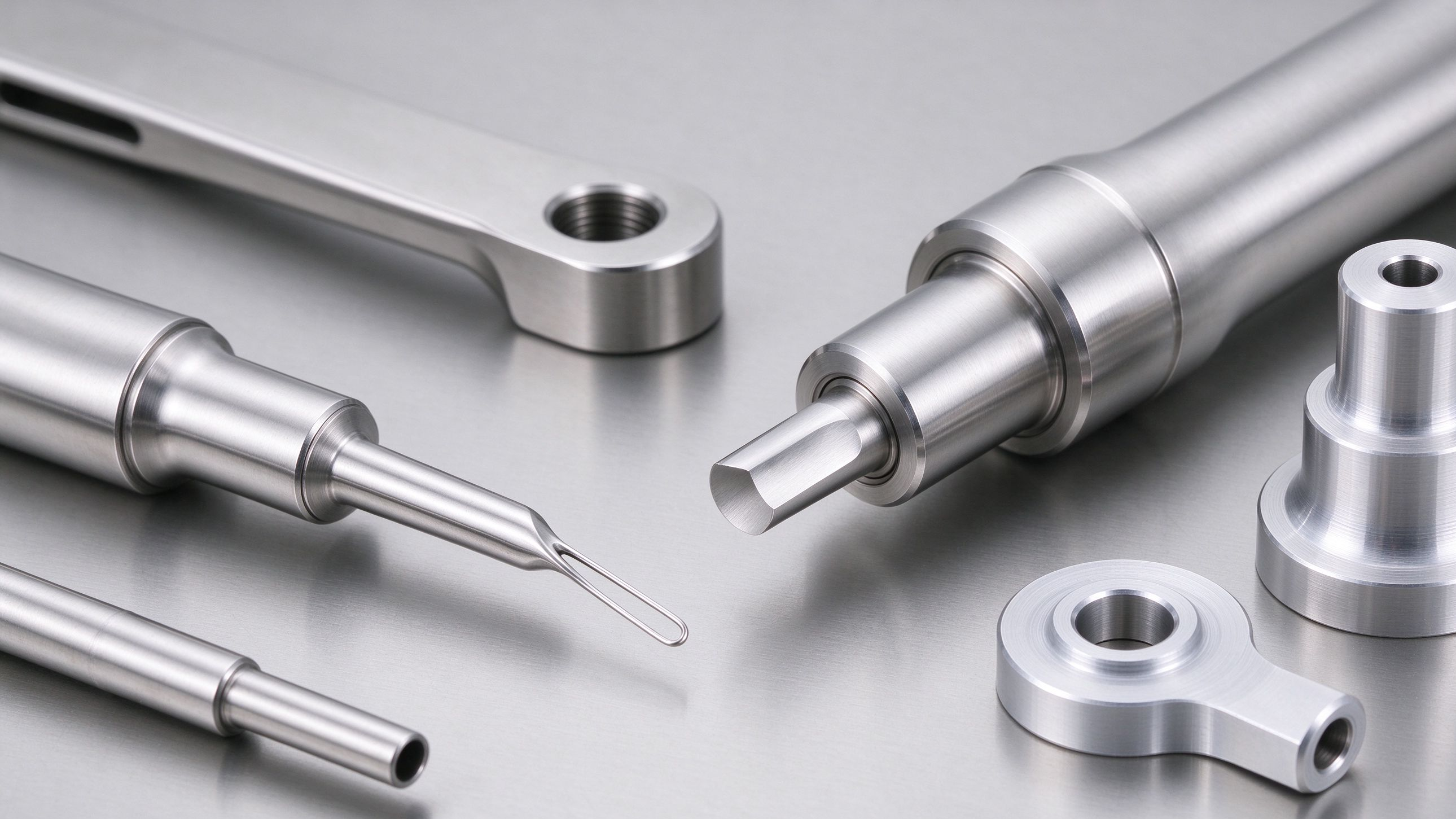
How to Select the Right Material for Your Medical CNC Part
Use this decision framework to narrow down materials quickly:
Step 1: Is it an implant?
Yes, permanent load-bearing → Ti6Al4V ELI or CoCr
Yes, non-load-bearing (spinal cage, dental framework) → PEEK or CFR-PEEK
Temporary implant (removed later) → 316LVM stainless
No → continue to Step 2
Step 2: Does it touch sterile body tissue?
Yes → use implant-grade or surgical-grade material with biocompatibility data (ISO 10993)
No (external device, housing) → aluminum, PEI, POM are acceptable
Step 3: Weight critical?
Yes → PEEK (lightest), then titanium, then aluminum, then stainless
No → cost becomes the deciding factor
Step 4: MRI/CT compatibility needed?
Yes → PEEK, CFR-PEEK (radiolucent), or titanium (non-magnetic)
No → stainless and CoCr acceptable
Step 5: Production volume?
High volume → consider cast/wrought near-net-shape, then CNC finish (reduces cost)
Low volume / custom → full CNC from bar stock (simpler, no tooling)
Common material selection mistakes to avoid:
Specifying titanium when aluminum works (4–6× cost difference)
Using standard (non-medical) stainless for implant parts
Using PEEK for load-bearing joints (insufficient strength)
Forgetting to specify material certification (MTR) requirements
Ignoring sterilization method compatibility (autoclave vs ETO vs radiation)
For precision tolerance guidance after material selection, see our precision medical machining guide.
Frequently Asked Questions About Medical-Grade CNC Materials
Q1: What is the difference between medical-grade and commercial-grade materials?
A: Medical-grade materials have certified chemistry (per ASTM/FDA standards), full traceability (mill heat numbers), and documented biocompatibility testing. Commercial-grade may vary in composition and lacks the documentation required for regulatory audits. For implants and body-contact parts, medical-grade is mandatory.
Q2: Can I use regular 316 stainless for medical parts?
A: For non-contact device housings, yes. For surgical instruments or body-contact parts, specify 316L (low carbon) or 316LVM (implant grade). Regular 316 may have higher carbon content and lacks passivation/biocompatibility certification.
Q3: Is titanium always better than stainless for medical parts?
A: Not always. Titanium is lighter, stronger, and more biocompatible — but it costs 4–6× more, machines slower, and is overkill for many instrument and housing applications. Use stainless where weight and biocompatibility are not critical.
Q4: How do I verify a material is truly medical-grade?
A: Require a mill test report (MTR) / material certificate with heat number, material grade, and chemical composition. For implants, also verify ISO 10993 biocompatibility data. Reputable suppliers provide this on every batch.
Q5: Can PEEK be used for dental implants?
A: PEEK is used for implant abutments, frameworks, and crowns — but not for the implant body itself (which must be titanium for osseointegration). PEEK abutments are popular for aesthetic anterior cases.
Conclusion: Get the Right Material for Your Medical CNC Project
Material selection sets the foundation for every medical CNC part — dictating biocompatibility, strength, cost, and machinability. Titanium and PEEK lead for implants, 316L stainless for instruments, aluminum for housings, and cobalt-chrome for high-wear bearing surfaces.
At Konsdun, we work with the full range of medical-grade materials — Ti6Al4V ELI, 316LVM, PEEK/CFR-PEEK, medical aluminum, and CoCr — all with certified mill certificates and ISO 13485 traceability. Tell us your application and we'll recommend the optimal material and processing approach.
Email: konsdun.li@gmail.com ; liu@konsdun.com
WhatsApp: +86 133 9282 6147






 Phone
Comment
(0)