Introduction: Why surface finishing Matters for CNC Machined Medical Parts
The machining operation gets a part to size — but the surface finish determines whether it is safe to use in a human body. A CNC-machined titanium implant with a raw, as-machined surface can harbor bacteria, corrode unpredictably, irritate tissue, or fail sterilization. Medical Surface Finishing is not a cosmetic extra: it is a functional, regulatory requirement.
This guide covers the full range of surface treatments applied to CNC machined medical parts — mechanical finishing, passivation, electropolishing, anodizing, bead blasting, and sterilization-compatible processes — with real Ra values, applicable materials, and selection guidance. For material context, see our medical-grade materials guide.
Mechanical Finishing: Deburring, Polishing, and Vibratory Finishing
Raw CNC parts have sharp edges, burrs, and tool marks. Mechanical finishing removes these and creates the baseline surface.
Deburring (Mandatory for All Medical Parts)
Any burr on a medical part can injure tissue, trap bacteria, or block assembly
Methods: manual deburring with scrapers, vibratory/tumbling with media, thermal energy deburring (TEM), cryogenic deburring
Result: burr-free edges; edge radii typically 0.1–0.5mm
Vibratory / Tumbling Finishing
Parts are tumbled with ceramic or plastic media and compound in a vibratory bowl
Best for: bulk deburring, edge breaking, uniform mat finish
Typical Ra after: 0.8–1.6 μm
Not suitable: precision features that must hold tight tolerances (media can round edges)
Mechanical Polishing
Progressive abrasive papers (grit 400 → 600 → 800 → 1200 → 2000) followed by polishing compounds
Best for: surgical instrument blades, implant heads, aesthetic device surfaces
Typical Ra after: 0.1–0.4 μm
Mirror polish: Ra < 0.05 μm (femoral heads, surgical blade edges)
Wire brushing / Sanding
Rule of thumb: The smoother the surface, the harder it is for bacteria to adhere — critical for reusable surgical instruments and implant surfaces.
Passivation and Electropolishing for Stainless Steel Medical Parts
Stainless steel medical parts need chemical treatment to reach their corrosion-resistant potential.
Passivation (ASTM A967 / ASTM F86)
What it is: An acid bath (nitric or citric acid) that removes free iron from the surface and promotes a uniform chromium oxide layer
Why it's mandatory: Machining leaves embedded iron particles that would otherwise rust — passivation removes them
Standard: ASTM A967 (industrial), ASTM F86 (surgical instruments and implants)
When: After machining and before use; repeat after any damage
Result: Improved corrosion resistance, clean silver finish, Ra largely unchanged
Materials: 304, 316, 316L, 17-4PH stainless
Electropolishing
What it is: An electrochemical process that dissolves a thin surface layer (10–40 μm), simultaneously deburring, smoothing, and cleaning
Benefits:
Bright, reflective surface (Ra 0.2–0.4 μm)
Passive corrosion-resistant layer formed automatically
Removes micro-burrs and surface imperfections
Reduces bacterial adhesion (super-smooth)
Best for: Surgical instruments, implant surfaces, fluid-handling components
Limitation: Removes material — not suitable for tight-tolerance features
Standards: ASTM F86 for surgical instruments
Which to choose?
For stainless parts that will be implanted or repeatedly sterilized, both processes are commonly specified.
Anodizing for Titanium and Aluminum Medical Components
Anodizing converts the natural oxide layer into a thicker, more durable, and often colored layer. It serves different purposes for aluminum vs titanium.
Aluminum Anodizing (Medical-Grade)
Type II (Sulfuric): Decorative, dyeable; Ra ~0.4–0.8 after anodize; for device housings
Type III (Hard Anodize): Hard, wear-resistant, thicker (25–50 μm); for fixtures, surgical guides, wear surfaces
Medical considerations: Dyes must be biocompatible; anodized surfaces are porous and need sealing for sterilization
Common use: Color-coding surgical trays, device housings, cosmetic finish
Titanium Anodizing
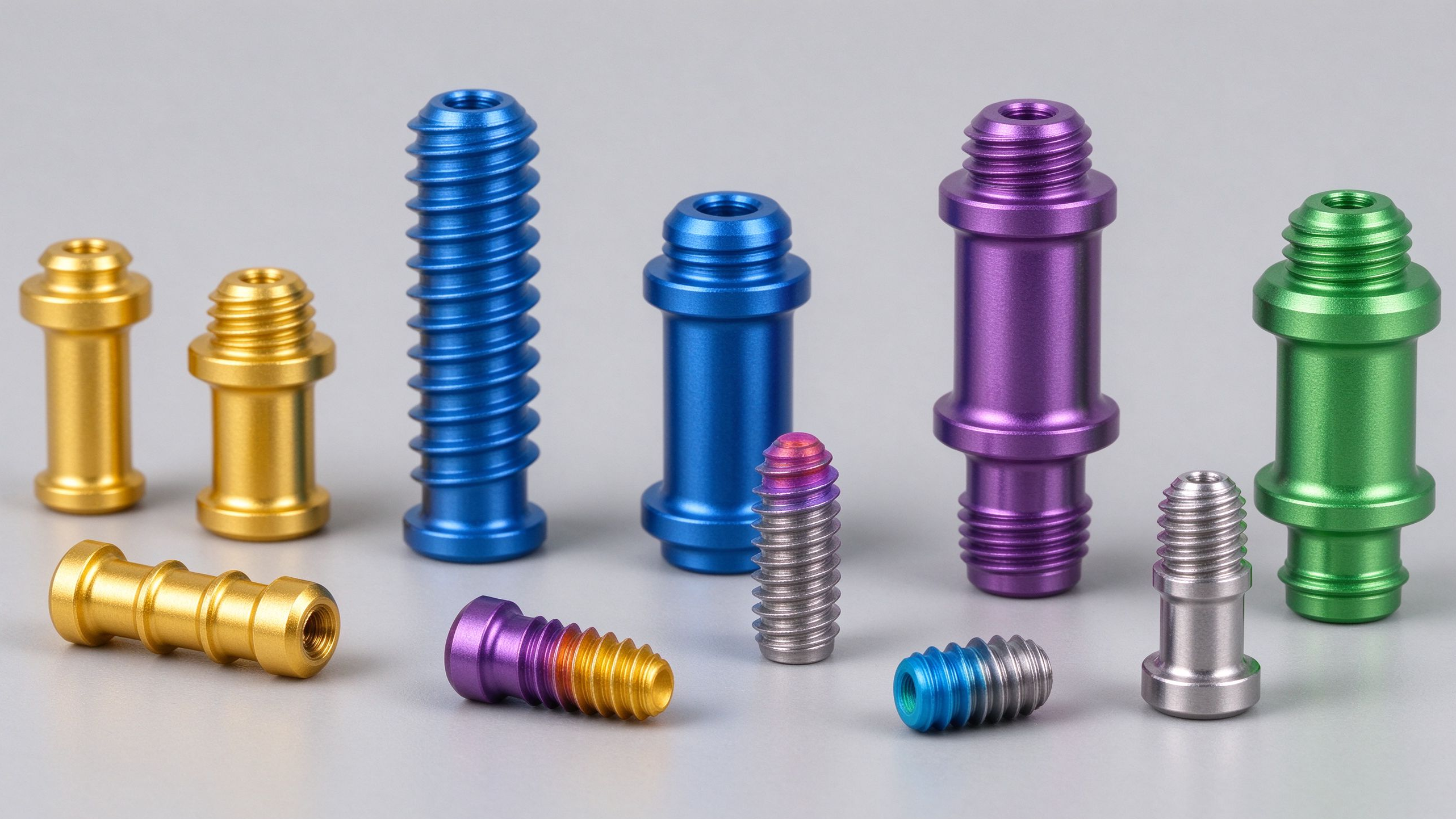
What it does: Electrolytically grows a TiO₂ layer; thickness controls color via light interference
Colors produced: Gold (≈10V), blue (≈20V), purple (≈30V), green (≈40V), grey (≈60V+)
Medical uses:
Color-coding implant components (distinguish sizes during surgery)
Cosmetic finish on titanium instruments
Slightly improved corrosion resistance
Which material?
For dental and implant surface details, see our dental CNC machining guide.
Bead Blasting, Sandblasting, and Porous Surface Treatments
Not all medical surfaces should be smooth. Implant surfaces often need controlled roughness to promote bone growth (osseointegration).
Bead / Sandblasting
What it is: Propelling small media (glass beads, alumina, titanium particles) at the surface to create a uniform matte texture
Typical Ra: 0.8–3.2 μm depending on media size
Medical uses:
Bone-contact surfaces of orthopedic implants (roughness for osseointegration)
Dental implant bodies (sandblasted + acid-etched = SLA)
De-anodizing or cleaning before bonding
Material-specific: Use titanium media on titanium parts (embedded contamination is a concern)
SLA (Sandblasted, Large-grit, Acid-etched)
The industry-standard surface for dental and orthopedic implants
Combines blasting with acid etching to create micro-roughness at two scales
Proven to accelerate osseointegration
Porous Coatings (Plasma Spray / Sintered)
Titanium beads plasma-sprayed onto implant surfaces
Creates a porous layer (100–300 μm) where bone grows into
Used on hip stems and acetabular cups
Applied as a coating, not a bulk finish
Laser Texturing
Lasers create precise, controlled surface patterns
Newer technology; allows customized roughness distributions
Becoming more common in premium implants
Key point: Smooth surfaces are for articulation and tissue contact; rough surfaces are for bone ingrowth. Specify the finish to match the function — don't polish a bone-contact surface.
Sterilizable Medical Part Finishing: Autoclave, ETO, and Radiation Compatibility
A beautiful finish is useless if it degrades under sterilization. Medical surfaces must survive repeated cleaning and sterilization cycles.
Autoclave (Steam Sterilization, 134°C)
The most common method for reusable instruments
Compatible finishes: passivated stainless, electropolished stainless, anodized aluminum (sealed), titanium (anodized or blasted)
Watch out: unsealed anodized aluminum can stain; some polymers (PEEK is fine, but POM may discolor)
Ethylene Oxide (ETO) Gas
Low-temperature method for heat-sensitive parts
Compatible: almost all metal finishes, most polymers
Watch out: porous surfaces must be properly aerated (ETO residue is toxic)
Gamma / E-beam Radiation
Common for single-use devices and sterile-packaged parts
Compatible: titanium, stainless, PEEK
Watch out: some polymers yellow or embrittle (PC, ABS); verify polymer radiation tolerance
Surface finish requirements for sterilizable parts:
Non-porous (or sealed) — prevents bacteria entrapment
Corrosion-resistant — passivated or electropolished for stainless
Smooth edges — no burrs, no cracks where residue can hide
Chemically inert — won't react with disinfectants (Cidex, bleach, alcohol)
Common finish mistakes:
Specifying a porous bead-blasted surface on a reusable instrument (bacteria trap)
Using unsealed anodizing on parts that will be autoclaved
Forgetting to specify "autoclave-safe" — the supplier may default to a decorative finish
For reusable surgical instruments, the standard finish is: machined → deburred → passivated → electropolished (Ra < 0.4 μm) → sterile-packaged.
How to Specify the Right Surface Finish for Medical CNC Parts
Specifying surface finish on your drawing is a critical step. Use this framework:
Step 1: Define the function of each surface
Tissue-contact / implant bone-growth → bead-blasted/SLA (Ra 0.8–3.2 μm)
Articulation / sliding surface → mirror polish (Ra < 0.1 μm)
Tissue-contact smooth (abutment emergence) → polished (Ra < 0.4 μm)
Device exterior / cosmetic → anodized or bead-blasted (Ra 0.8–1.6 μm)
Structural / non-critical → as-machined + deburred (Ra 1.6–3.2 μm)
Step 2: Specify the finish by process, not just Ra
Ra alone doesn't tell the supplier the process
Write: "Pass per ASTM A967, Citric Acid Passivation; Electropolish to Ra < 0.4 μm"
For implants: reference ASTM F86
Step 3: Define edge conditions
All edges: "Break sharp edges 0.1–0.3mm max"
No burrs on functional surfaces
State: "100% deburred; no burrs permitted per ASME Y14.43"
Step 4: Specify sterilization compatibility
Add a note: "Part must withstand 100 cycles of autoclave (134°C) without degradation"
Or: "ETO sterilizable; must pass aeration residue limits per ISO 10993-7"
Step 5: Work with your supplier early
Surface finishing is often outsourced — confirm your machine shop can handle it or has approved subcontractors
Ask for sample parts with the specified finish before production
A well-specified finish line on your drawing might read:
"All surfaces: deburr and break sharp edges (R 0.1–0.3). Stainless surfaces: passivate per ASTM A967. Tissue-contact areas: electropolish to Ra ≤ 0.4 μm. Implant bone-contact zones: bead-blast per ASTM F86 (Ra 1.6–3.2 μm). Part must withstand autoclave sterilization."
Frequently Asked Questions About Medical Surface Finishing
Q1: What surface finish is required for surgical instruments?
A: Surgical instruments are typically passivated and electropolished to Ra < 0.4 μm, with mirror polish on cutting edges (Ra < 0.1 μm). The finish must be burr-free and withstand repeated autoclave sterilization.
Q2: Is passivation mandatory for 316L medical parts?
A: Yes — for any part that will be sterilized, implanted, or exposed to bodily fluids. Machining leaves embedded free iron that would rust; passivation (ASTM A965 or F86) removes it and forms the protective chromium oxide layer.
Q3: Can you anodize titanium for medical implants?
A: Yes, titanium anodizing is commonly used for color coding implant components. But it is not a substitute for bead-blasting/SLA when bone ingrowth is needed.
Q4: What is the best surface for osseointegration?
A: Sandblasted, acid-etched (SLA) surfaces with Ra 1.5–3.2 μm, or porous titanium plasma-spray coatings. These proven surfaces accelerate bone-on-growth compared to smooth or polished surfaces.
Q5: Does surface finish affect sterilization?
A: Absolutely. Rough, porous, or pitted surfaces can harbor bacteria and sterilant residues. Medical parts must have smooth, non-porous, passivated surfaces for reliable cleaning and sterilization.
Conclusion: Specify the Right Finish, Every Time
Surface finishing is where a machined part becomes a safe, usable medical device. The right combination of deburring, passivation, polishing, and sterilization-compatible treatment determines whether your part performs reliably in clinical use.
At Konsdun, we offer a full range of medical-grade surface finishing — passivation (ASTM A965/F86), electropolishing, aluminum/titanium anodizing, bead blasting, and sterile packaging — all integrated with our CNC machining under ISO 13485. One supplier, one process, full traceability.
Email: konsdun.li@gmail.com ; liu@konsdun.com
WhatsApp: +86 133 9282 6147






 Phone
Comment
(0)