Why PEEK Parts Are More Expensive Than They Look
PEEK raw material is genuinely expensive — but material is only part of the story. A PEEK part quote can be 5–10 times higher than the same part in aluminum or POM because of a chain of secondary costs: material waste, tight tolerance handling, annealing cycles, and specialist tooling. Understanding this chain is the first step to reducing what you actually pay.
The good news: most of these costs are controllable. You cannot change the price of the resin, but you can change how much of it is wasted, how tightly tolerances are called, and how many secondary operations the part really needs. That is what this guide is about.
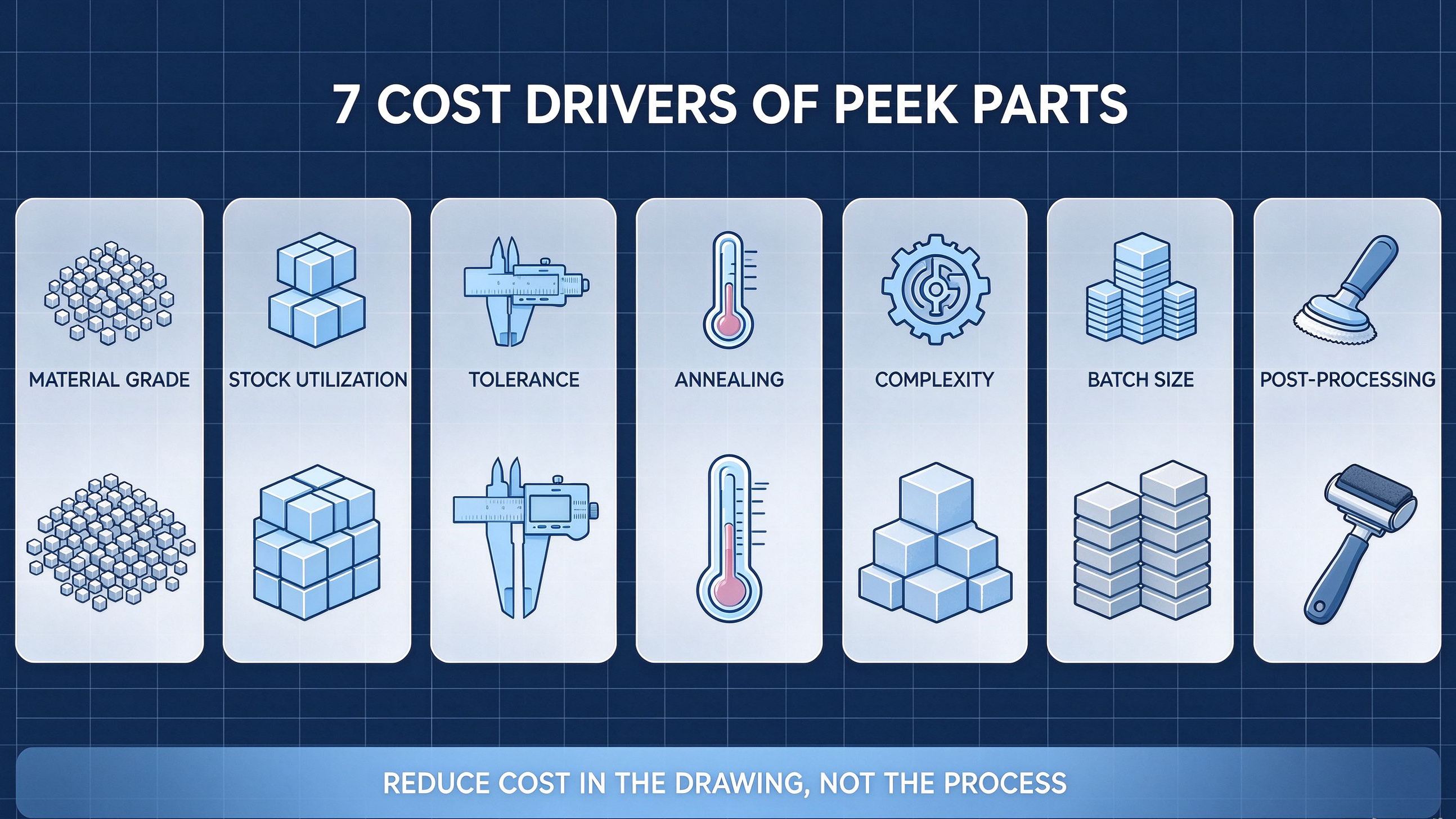
7 Key Cost Drivers of Custom PEEK Parts
Driver 1 — Material grade.
Medical-grade and specialty filled grades (CF30, bearing grades like PEEK 450FC) carry significant price premiums over unfilled PEEK, which itself costs several times more than POM or nylon. Choose the grade that meets the requirement, not the most expensive one that "might work."
Driver 2 — Stock form and material utilization.
PEEK is machined from rod, plate or tube, and the difference between your part's envelope and the stock it is cut from becomes scrap you pay for. A 30 mm part cut from 40 mm plate, or a long part cut from a short rod, can waste 40–70% of the material. Part orientation and stock sizing decisions are real money.
Driver 3 — Tolerance requirements.
Every feature tightened from ±0.05 mm toward ±0.01 mm adds machining passes, inspection time, and scrap risk. Tight tolerances on PEEK also often force an annealing step, which adds cycle time.
Driver 4 — Annealing and stress relief.
A proper anneal (rough, heat, finish) adds hours of cycle time per part. Skipping it is how cheap quotes happen — and how parts warp in the field later. This is a cost you want to keep visible, not hidden.
Driver 5 — Part complexity.
Deep holes, thin walls, tight internal corners, and threaded features all slow the process and raise the risk of scrapped parts. Complexity is priced by the hour, and PEEK parts burn hours faster than metal parts do.
Driver 6 — Batch size.
Setup, programming and annealing are largely fixed costs. On a one-off prototype they dominate; spread over 500 pieces they nearly vanish. This is why per-part price collapses so quickly as quantity rises.
Driver 7 — Post-processing.
Polishing, bead blasting, ultrasonic cleaning, and cleanroom packaging (medical parts) each add labor and handling. Decide which surface requirements are real — cosmetics on a hidden face buys nothing.
PEEK Machining Cost by Batch Size
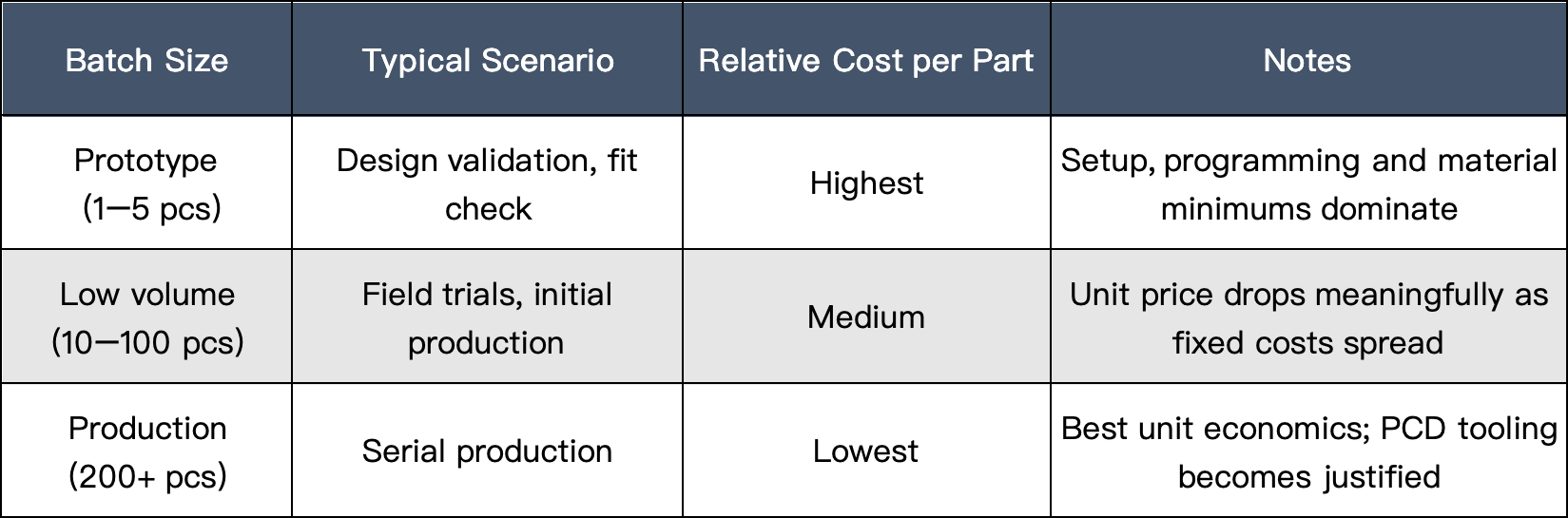
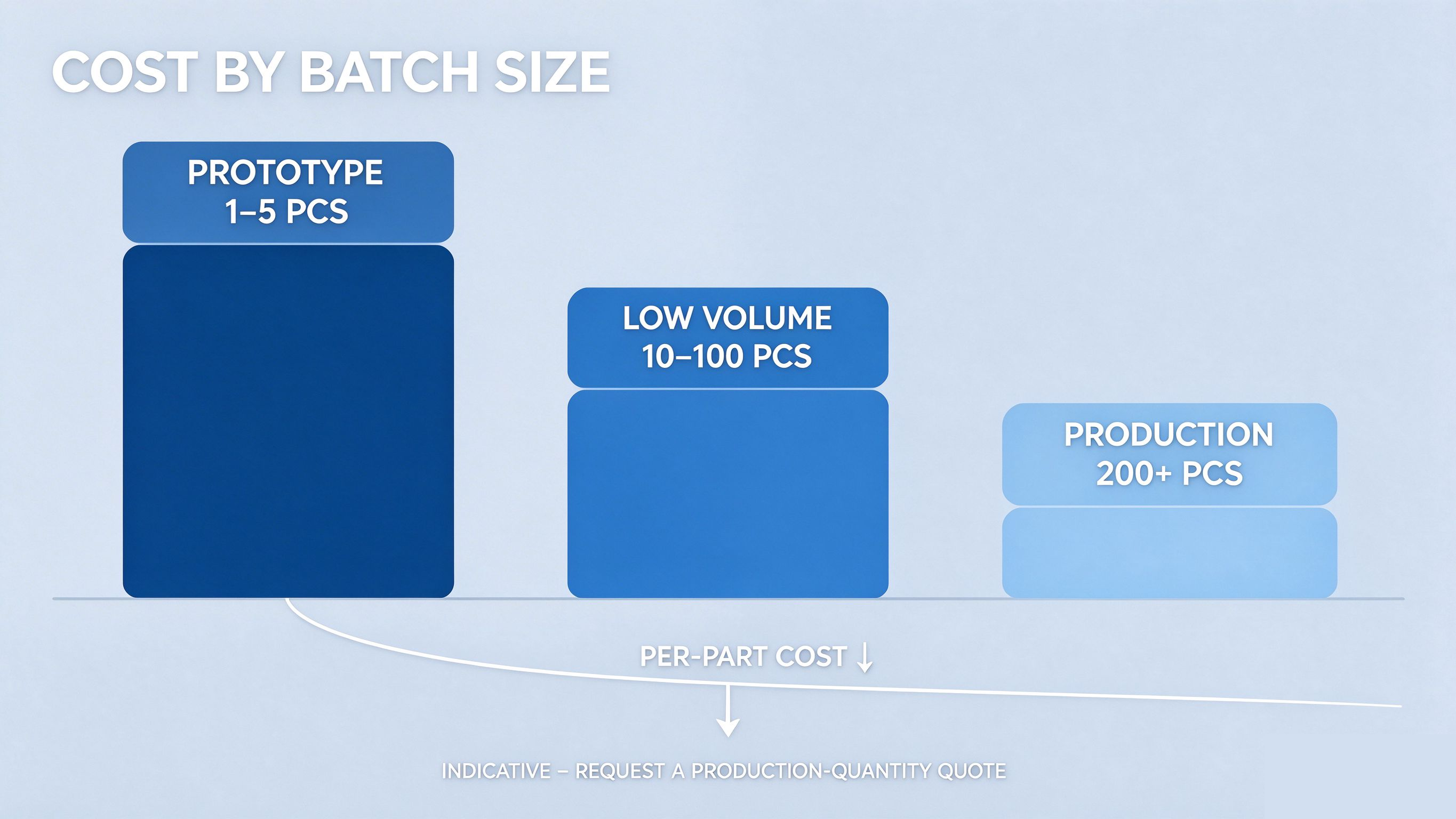
Price per part scales steeply with quantity. As a general picture: prototypes (1–5 pcs) carry the highest per-part price because setup, programming and material minimums are spread over almost nothing; low-volume runs (10–100 pcs) are where unit price drops meaningfully; production runs (200+ pcs) enjoy the best unit economics. Grade still dominates: filled and medical grades add a large premium at every quantity.
Caption: Indicative cost relationship only — actual pricing depends on grade, geometry and current material market. Always request a production-quantity quote.
A common trap is quoting one piece and judging the material cost by it. The material itself is a fixed fraction — ask for a 50-piece price before deciding that PEEK is "too expensive."
How to Reduce PEEK CNC Part Cost
Cut costs in the drawing, not in the process.
First, rationalize tolerances: release every non-functional feature to ±0.05 mm or general tolerance.
Second, design for stock: keep the part within standard rod/plate dimensions and tell the supplier the stock form you expect, so utilization waste is minimized.
Third, avoid over-specifying grade: upgrade from virgin to CF30 only when stiffness or ESD performance truly requires it.
Fourth, batch smartly: if you need 120 parts over a year, machining 120 at once is usually cheaper than 12 orders of 10.
Fifth, review secondary operations: a bead-blasted cosmetic face on a hidden area is money with no function. Each eliminated operation reduces both price and lead time.
The Hidden Cost of Cheap PEEK Quotes
If a PEEK quote is dramatically lower than the market, ask what was removed. The usual suspects: no annealing/stress relief step, one set of cutting parameters for every grade, no material certificate, and inspection by eyeball instead of CMM.
On PEEK, these shortcuts do not fail at delivery — they fail months later as warpage, micro-cracks and dimensional drift in the customer's assembly.
The cheapest quote is rarely the cheapest part. Factor in failure risk, rework and lost trust, and a supplier who documents annealing and inspection is usually the real bargain.
What to Include in Your RFQ for an Accurate Quote
A complete RFQ gets you a tight quote and a short first-round of questions. Send:
2D drawing with GD&T and material note;
3D model (STEP preferred);
required grade by full trade name;
annual quantity and order pattern;
tolerance priority — which features are truly functional;
surface finish and cleanliness requirements;
annealing/stress relief notes if precision matters;
any certifications needed (material cert, ISO 10993 for medical, ISO 9001).
The more you specify, the fewer "clarification rounds" the supplier needs — and every clarification round adds delay, not price. A well-documented RFQ is also the fastest way to compare quotes fairly between suppliers.
FAQ about peek machining cost
Q1. Why is PEEK machining so expensive?
A: High material cost, low stock utilization, slow machining, annealing cycles and specialist tooling combine — typically 5–10× a comparable aluminum or POM part.
Q2. How much does a PEEK CNC part cost?
A: Depends on grade, size, tolerance and quantity — prices range widely; ask for a production-quantity quote, not a single-piece price, before judging.
Q3. Is PEEK more expensive than POM or PTFE?
A: Yes — PEEK costs several times more per kilogram than POM or PTFE, but its strength, temperature resistance and wear life can make it cheaper per part in demanding applications.
Q4. How can I reduce the cost of my PEEK part?
A: Loosen non-functional tolerances, design to standard stock sizes, avoid over-specifying grade, batch orders, and remove cosmetic secondary operations. /
Q5. Why is the cheapest PEEK quote risky?
A: Low quotes usually mean skipped annealing, generic parameters, or no inspection — failures appear later as warpage and cracking.
CAT
Want an honest PEEK quote — with annealing and inspection included? Send your drawing and quantity to us; you will receive a transparent cost breakdown (material, machining, annealing, finishing) and a free DFM cost-reduction review within 24 hours.
Email: konsdun.li@gmail.com ; liu@konsdun.com
WhatsApp: +86 133 9282 6147






 Phone
Comment
(0)