cnc swiss machining is a precision turning process performed on a Swiss-type CNC lathe (also called a sliding headstock lathe). Unlike conventional turning where the workpiece rotates freely on a fixed spindle, Swiss machining supports the material very close to the cutting tool using a guide bushing, and the bar stock feeds through the guide bushing in precise linear increments while the tool cuts.
This near-tool support is the defining feature of Swiss machining. It eliminates workpiece deflection, chatter and vibration that plague conventional turning when machining long, thin, small-diameter parts, making it the go-to production process for precision shafts, pins, sleeves and fasteners.
How Does CNC Swiss Machining Work?
The working principle breaks down into four key components:
Sliding headstock: The entire bar stock moves axially back and forth through the guide bushing, rather than the tool traveling along a stationary part.
Guide bushing: A precision-hardened sleeve that grips the bar material within 1–3 mm of the cutting edge, providing rigid anti-deflection support.
Cross-driven live tooling: Tools on the turret enable milling, drilling, tapping, slotting, cross-hole and knurling operations directly on the part while it is still held in the guide bushing.
Main and sub spindles: Parts are cut off and transferred to a sub-spindle for back-end machining, completing both ends and all features in one single setup.
In one clamping cycle, Swiss machining completes OD turning, facing, drilling, tapping, flat milling, groove cutting, thread cutting and part-off — no secondary handling required.
If you want to understand how axis configurations affect precision across all CNC processes, read our guide: 3-Axis vs 4-Axis vs 5-Axis CNC machining: Which One Is Better?
Key Advantages of CNC Swiss Machining
Unmatched precision for slender parts: Supports length-to-diameter ratios up to 20:1 for extreme cases, and a standard 10:1 — impossible on conventional lathes which typically cap at 3:1. Tolerances as tight as ±0.003 mm on critical diameters.
Zero cumulative error from re-fixturing: All features completed in one setup, eliminating 60%+ of alignment errors caused by multiple clamping operations.
Superior surface finish: Rigid near-tool support minimizes chatter, delivering Ra 0.4–0.8 μm standard finish; high-polish setup can reach Ra 0.2 μm without secondary operations.
High repeatability for production: Once programmed, Swiss machines run unattended with consistent dimensional results. Process capability index Cpk can reach 1.67+ for medium and high volume runs.
Broad material compatibility: Handles bar stock as small as 0.5 mm diameter, including stainless steel, titanium, aluminum, brass, copper, and engineering plastics like PEEK.
For PEEK material-specific properties and grade selection logic, see our guide: peek material properties: Why Engineers Choose It for CNC Parts
Swiss Machining vs. Conventional CNC Turning
The core difference lies in how the workpiece is supported during cutting:
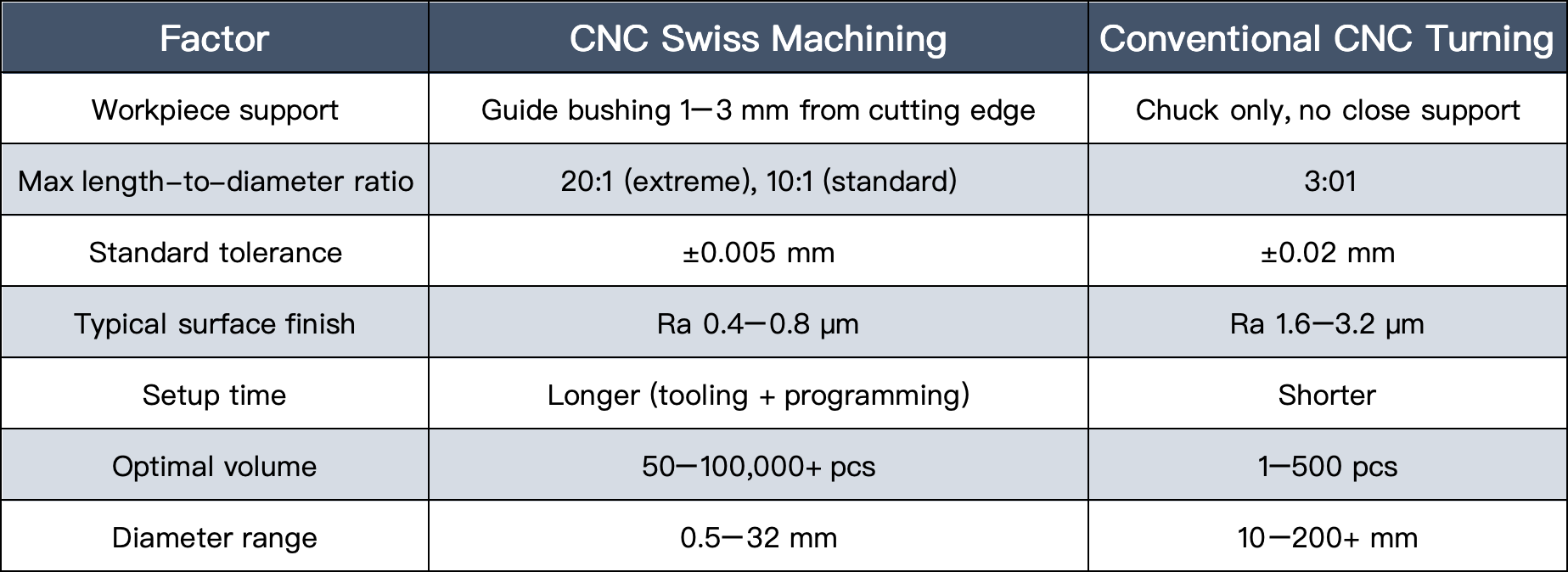
Rule of thumb: if your part is long, thin, small-diameter and requires tight tolerances, Swiss machining is the right choice. If it is short, stubby or larger diameter, conventional turning is more cost-effective.
When Should You Choose CNC Swiss Machining?
Swiss machining is the optimal process when your project meets two or more of these criteria:
Small diameter (typically under 32 mm)
High length-to-diameter ratio (>5:1)
Compound features: cross-holes, flats, gear cuts, threads, knurling, ring grooves
Tight tolerances (±0.01 mm or tighter)
Production volume of 50 pieces or more
Materials prone to work-hardening (stainless steel, titanium)
Quick DFM tip: Minimize sudden diameter steps and add standard process chamfers in your design to further reduce machining cost and lead time.
Conversely, if your part is short and thick, has simple geometry, or is a single prototype, conventional CNC turning or even 3D printing may be more economical. For a broader comparison of additive vs subtractive processes, see: 3D printing vs CNC machining: Pros, Cons & Application Selection Guide
Common Industry Applications
Medical: Dental implant abutments (Ø4.5 mm, ±0.008 mm tolerance), surgical bone screws, endoscopic tool shafts
Aerospace: Micro fuel fittings (Ø3 mm, 12 cross holes), sensor housings, miniature fasteners
Automotive: Fuel injector needle valves (Ø2 mm, 0.003 mm roundness), transmission pins, sensor probes
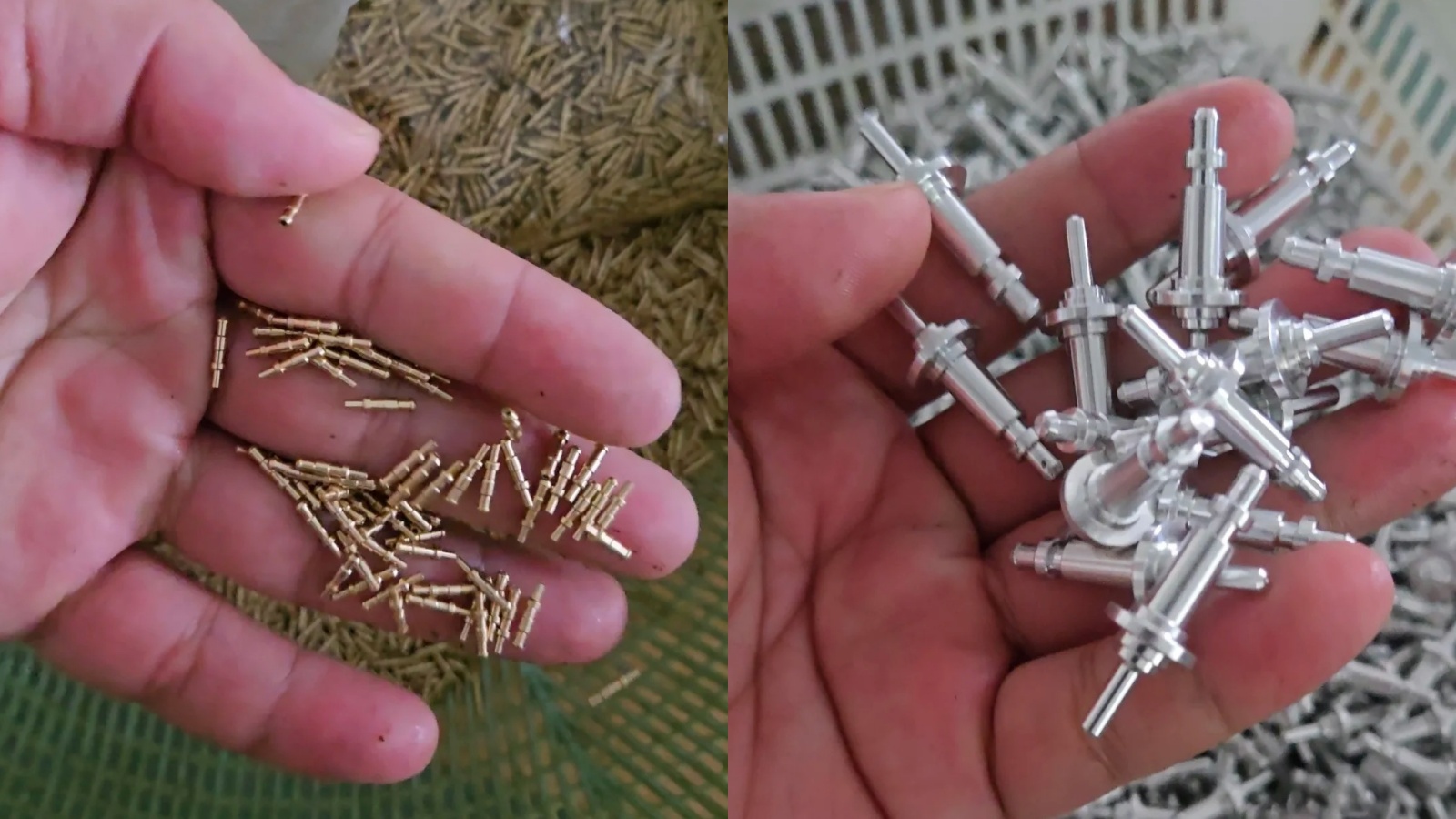
Electronics: Connector contact pins (Ø0.8 mm with knurling), precision shafts, socket components
Hydraulics & pneumatics: Valve spools (Ø6 mm with multiple ring grooves), piston rods, nozzle tips
FAQ
What is the difference between Swiss machining and CNC turning?
The main difference is workpiece support. Swiss machining uses a guide bushing to hold bar stock extremely close to the cutting tool, eliminating deflection on long thin parts. Conventional turning holds the part only at the chuck, causing vibration and poor tolerance on slender components.
What is the maximum and minimum bar diameter for Swiss machining?
Micro Swiss machines can handle stock as small as 0.5 mm; standard production models cover 3–32 mm. Larger heavy-duty Swiss machines can go up to 38 mm, but anything larger generally requires conventional CNC turning.
Is Swiss machining more expensive than conventional turning?
Setup time is longer for Swiss machines due to detailed tooling and programming, so unit cost for very low volumes can be higher. However, for volumes of 500 pieces and above, Swiss machining is typically 15–30% cheaper overall because it completes multiple operations in one setup and eliminates secondary processing.
What materials can be Swiss machined?
Virtually any machinable material: aluminum, brass, copper, carbon steel, stainless steel, titanium, and engineering plastics including PEEK, POM and nylon. Harder and more abrasive materials require carbide or diamond-coated tooling.
Ready to Discuss Your Swiss Machining Project?
At Konsdun, we run multi-axis Swiss-type CNC lathes with live tooling for small-diameter, high-precision turned components. Send us your 2D/3D drawings for a free quote — our engineers will review design feasibility, recommend materials and tolerances, and provide pricing within 24 hours.Konsdun






 Phone
Comment
(0)