Standard CNC machining Workflow for PEEK Plastic Parts (Production SOP)
CNC Machining For PEEK plastic parts is not a simple cutting process. Unlike ordinary ABS, PC, and nylon plastics, PEEK belongs to high-performance semi-crystalline polymer with strict production process requirements. Unstandardized operation will not only cause scrap during processing, but also lead to hidden failures such as delayed cracking, deformation, and loose assembly after the parts are delivered.
Professional PEEK batch production follows a complete fixed process chain: blank selection → pre-machining annealing → rough machining → stress relief placement → finish machining → deburring → surface inspection → dimensional calibration. This standardized procedure is the core difference between workshop trial production and formal industrial mass production.
To fully understand why PEEK requires such strict process control, you need to master its inherent physical and chemical characteristics. You can check our professional material database: peek material properties: Why Engineers Choose It for CNC Parts.
If you are new to PEEK processing logic and want to distinguish professional processing logic from ordinary plastic machining, please refer to our basic industry definition guide: What Is PEEK Machining? Complete Process Guide.
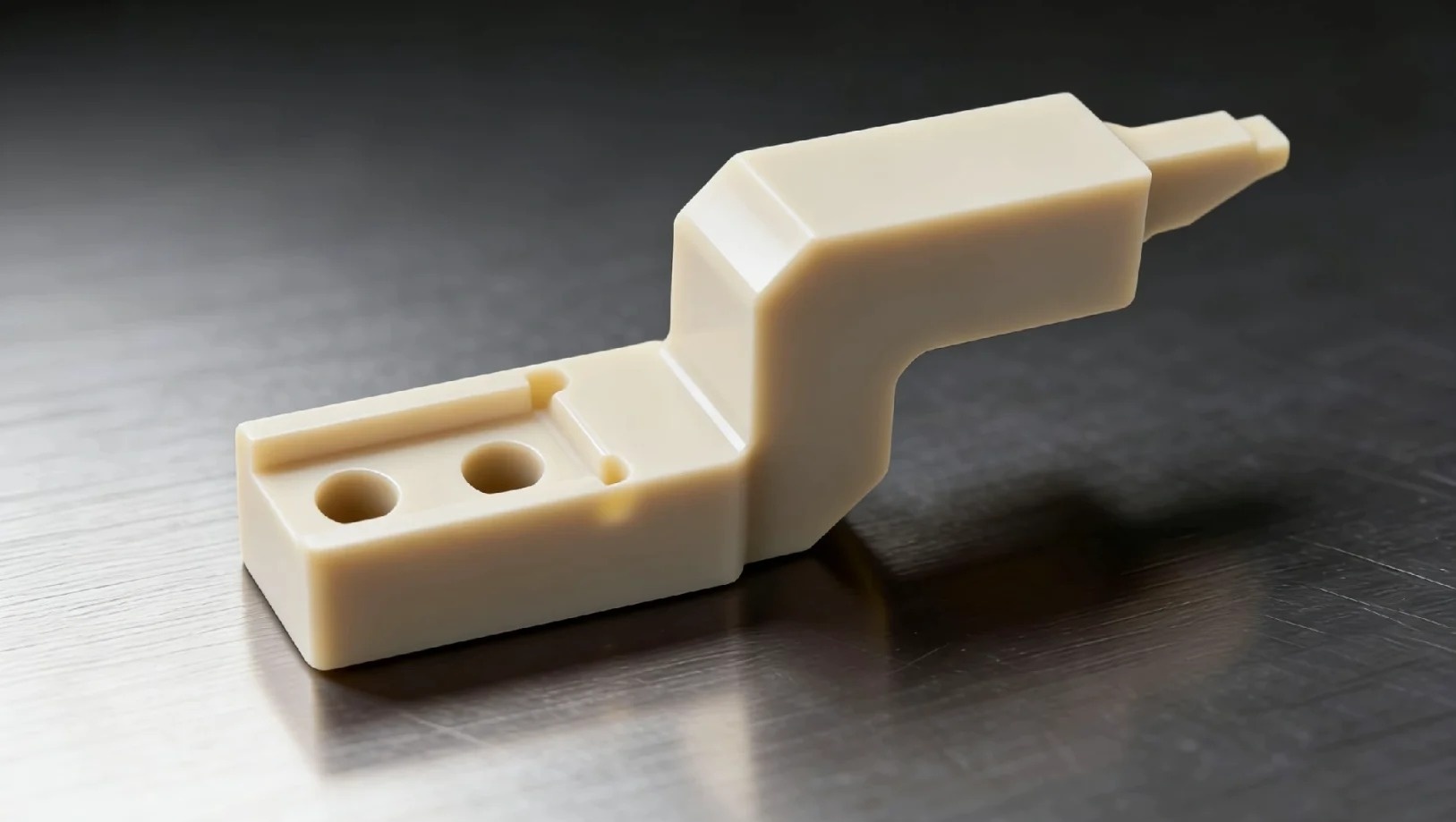
Core Differences Between PEEK Machining & Ordinary Engineering Plastic Machining
Most machinists apply nylon and POM processing habits to PEEK, which is the primary cause of low PEEK yield. Ordinary thermoplastics have low melting points and low internal stress, allowing fast cutting and one-time forming. PEEK is completely different in production logic.
PEEK has high molecular chain rigidity and strong residual stress accumulation characteristics. During high-speed cutting, the material produces micro internal torsion that cannot be observed by the naked eye. Although the size is qualified after processing, the internal stress will be gradually released after days or weeks, resulting in part warping, hole position deviation, and assembly jamming.
This is why many low-quality PEEK parts pass factory inspection but fail customer on-site assembly.
These production errors are not covered in basic PEEK tutorials but are the key points that determine factory qualification rate:
1. Skipping pre-annealing treatment Many small factories directly machine raw PEEK rods and plates. Extruded PEEK blanks contain strong rolling stress. Direct cutting will cause delayed deformation after delivery.
One-time heavy cutting forming Aggressive single-depth cutting generates massive cutting heat and locks internal stress inside the part, greatly reducing long-term stability.
Using liquid coolant for rapid cooling Severe temperature difference causes molecular chain contraction inconsistency, leading to invisible micro-cracks on the part surface.
Excessive clamping force PEEK has good toughness but poor compression resistance. Over-clamping causes invisible indentation deformation, which rebounds after clamping release.
Finishing immediately after roughing Rough machining generates cutting stress. Immediate finishing fixes the stress inside the part, causing later size drift.
Uniform parameters for filled and unfilled PEEK GF30 and CF30 reinforced PEEK have abrasive properties. Using neat PEEK parameters leads to tool wear, burrs, and dimensional inaccuracy.
Practical Yield Improvement Solutions for PEEK CNC Parts
Based on the above common mistakes, professional manufacturers adopt targeted optimization strategies to stabilize the yield above 98%:
Two-stage stress control Perform overall annealing before machining, and place parts for 4–12 hours after roughing to release cutting stress before finishing.
Layered progressive cutting Adopt multiple small-depth cutting instead of one-time heavy cutting to control heat accumulation and stress superposition.
Pure air cooling processing Compressed air is used throughout the process to ensure uniform temperature change of PEEK materials and avoid thermal shock cracks.
Flexible clamping auxiliary tooling Use soft rubber gaskets and uniform pressure fixtures to disperse clamping force and prevent local extrusion deformation.
Thin-Wall PEEK Plastic Parts Machining Core Skills
Thin-wall structure (0.3mm–1mm) is the most difficult category in CNC Machining For PEEK plastic parts. Thin-wall PEEK is prone to tool vibration, wall collapse, and elastic rebound deformation.
The standard solution is symmetrical layered machining + reverse support auxiliary fixture. The machining path adopts outer contour priority, avoids single-sided excessive material removal, and maintains the balance of workpiece stress in real time.
In addition, the spindle speed needs to be increased appropriately, the feed rate reduced, and the cutting load minimized to ensure the flatness and verticality of thin walls.
Long-Term Stability Control of CNC Machined PEEK Parts
Many people only focus on the dimensional pass rate after processing but ignore the service life stability of PEEK parts. Unstandardized processed PEEK parts will gradually crack and deform under high temperature, chemical corrosion, and cyclic load working conditions.
Qualified industrial PEEK parts must eliminate internal processing stress, maintain uniform molecular structure balance, and ensure that the parts will not have dimensional changes or structural failure during long-term harsh environment operation.
FAQ for Production-Level PEEK CNC Machining
Why do PEEK parts deform after being used for a period of time?
It is not quality attenuation, but residual stress release. Most unannealed and one-time cut PEEK parts have hidden internal stress, which slowly releases and causes deformation after assembly and stress bearing.
Can PEEK thin-wall parts achieve zero-deformation processing?
Yes. Through pre-annealing, layered cutting, stress placement and flexible clamping, high-precision thin-wall PEEK parts can achieve long-term stable zero-deformation effect.
Why are the prices of PEEK CNC manufacturers so different?
The gap lies in process standards. Low-price factories save annealing and stress-relief processes, while professional manufacturers strictly implement standardized SOP to ensure post-delivery stability.
Custom PEEK CNC Machining Service
We provide standardized production-level CNC machining for PEEK plastic parts, covering neat PEEK, GF30, CF30, and medical-grade PEEK custom components. We strictly follow industrial annealing treatment, layered cutting processing, and stress relief procedures to ensure high yield and long-term stability of each part.
Send your 2D/3D drawings and technical requirements to get afree DFM review and accurate quotation.






 Phone
Comment
(0)