What Is PEEK Machining?
PEEK machining is a subtractive manufacturing process that uses CNC (Computer Numerical Control) equipment to cut solid PEEK (polyether ether ketone) stock — typically rods, sheets or blocks — into custom, dimensionally accurate components.
Unlike injection molding (which requires expensive tooling and high volumes) or 3D printing (which delivers lower strength and tolerance), CNC PEEK machining balances precision, flexibility and mechanical performance. It supports low-volume prototyping, mid-volume production and high-mix custom parts, with achievable tolerances down to ±0.005 mm for critical features.
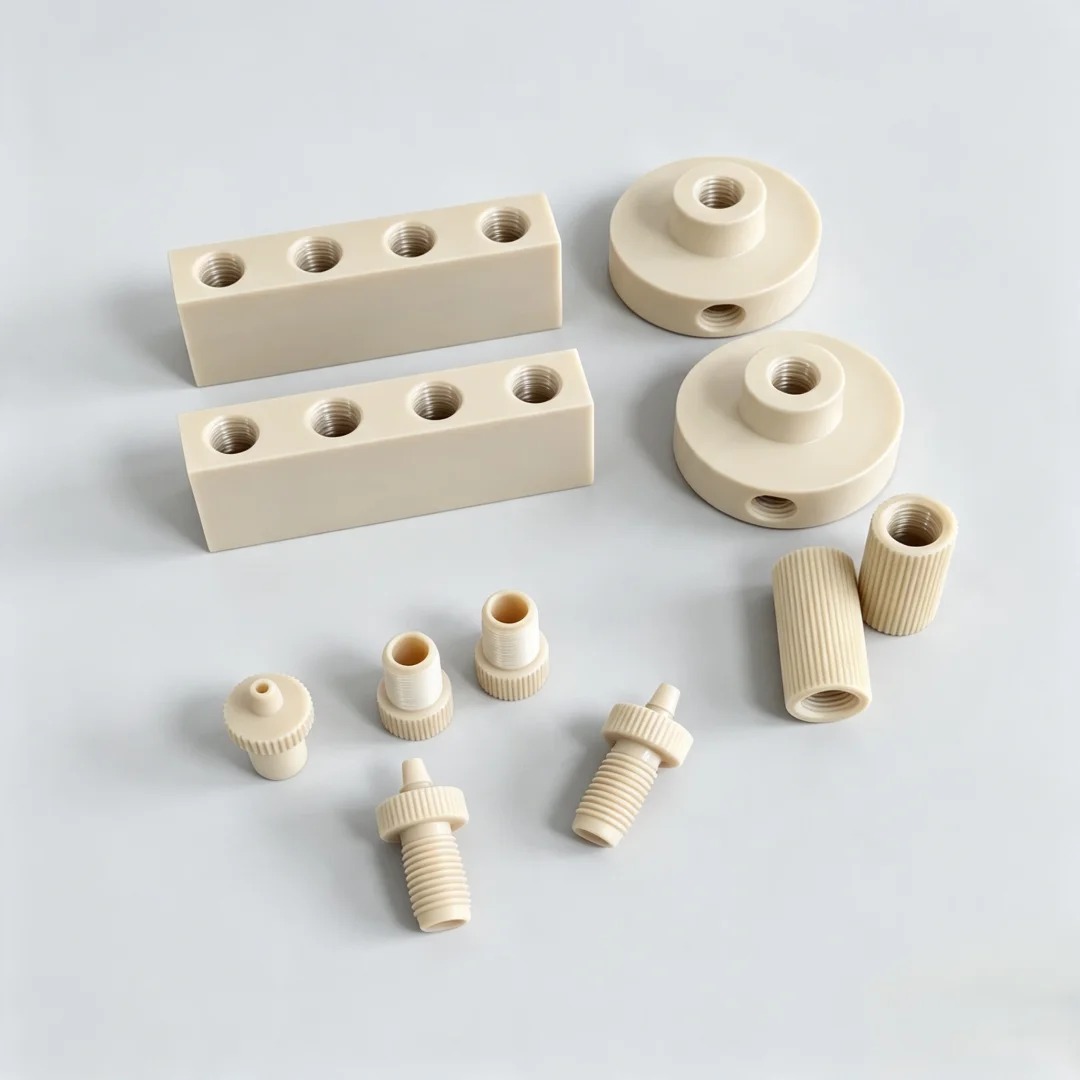
PEEK is not a standard commodity plastic — its unique thermal and mechanical properties require dedicated process setup, rather than using the same parameters as nylon or Delrin. Its high melting point, low creep and chemical resistance are what make machined PEEK parts valuable in harsh environments, but they also create specific machining challenges: built-up edge on tools, thermal dimensional drift and burr formation if parameters are misaligned.
For full quantified property data, grade comparisons and material selection logic, read our dedicated guide:PEEK Material Properties: Why Engineers Choose It for CNC Parts
Professional peek machining services use multi-axis CNC equipment to deliver complex geometries:
CNC milling: 3-axis and 5-axis milling for complex 3D housings, brackets and fixtures; ideal for features like pockets, slots and threaded holes. If you are unsure which axis configuration fits your part geometry, read our detailed comparison: 3-Axis vs 4-Axis vs 5-Axis CNC Machining: Which One Is Better?
CNC Turning / Swiss turning: High-precision cylindrical machining for small pins, valve seats and shafts; delivers excellent concentricity and surface finish.
Secondary operations: Deburring, polishing, bead blasting and stress-relief annealing to improve surface quality and long-term dimensional stability.
Grade-Specific Machining Setup Guidelines
Filler materials change PEEK's cutting behavior dramatically. Below are machining-only recommendations (performance specs are covered in the material properties guide):
Unfilled (Neat) PEEK
Tooling: Sharp carbide end mills and drills
Cutting speed: 200–300 m/min (milling); 250–350 m/min (turning)
Notes: Lowest tool wear, cleanest cuts, easiest to hold ultra-tight tolerances. Anneal after machining for the most stable dimensions.
30% Glass Fiber Filled (PEEK GF30)
Tooling: Carbide or PCD inserts required
Cutting speed: Reduce by ~30% vs. neat PEEK
Notes: Glass fibers are abrasive; dull tools cause chipping and poor surface finish. Air blast cooling recommended.
30% Carbon Fiber Filled (PEEK CF30)
Tooling: PCD diamond tools strongly recommended
Cutting speed: Reduce by ~35% vs. neat PEEK
Notes: Most abrasive grade; standard tooling will wear rapidly and cause dimensional drift. Use air cooling to avoid softening the matrix.
Medical-Grade PEEK
Tooling: Same as corresponding base grade
Notes: Must be machined in a controlled environment to avoid contamination; no cutting fluids that compromise biocompatibility.
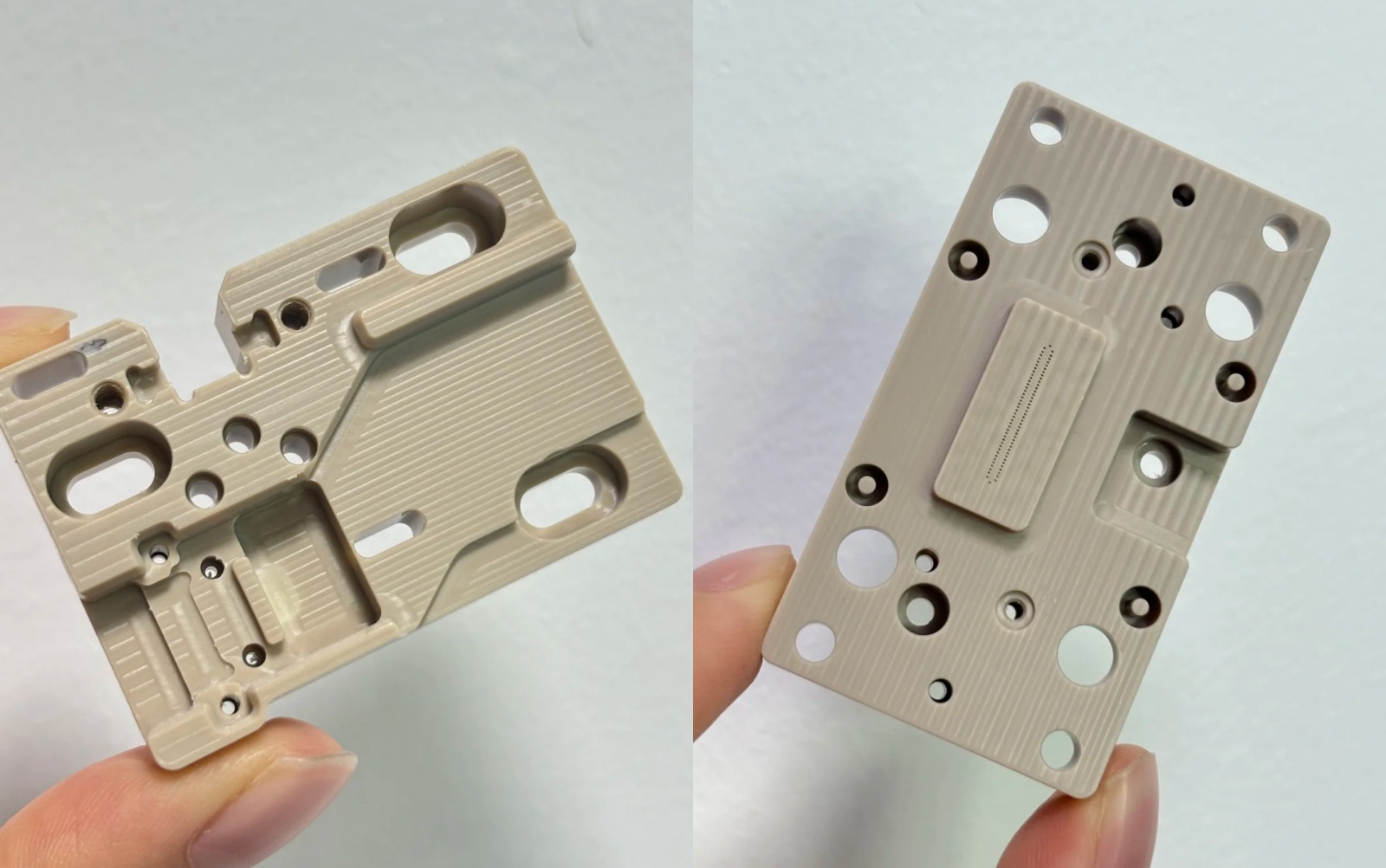
Common PEEK Machining Defects & Fixes
This is one of the most requested practical topics for machinists and engineers:
Burrs on edges: Caused by dull tools or too low feed rate. Fix: Use sharp tooling, increase chip load, and add a light finishing pass.
Dimensional drift / melting: Caused by excessive heat buildup. Fix: Use air blast cooling, reduce cutting speed, and take lighter depth of cut.
Chipping (filled grades): Caused by abrasive fillers breaking free. Fix: Use PCD tooling, reduce feed rate, and climb mill where possible.
Internal stress warping: Caused by aggressive material removal. Fix: Use climb milling, leave extra stock for semi-finish, and anneal between operations.
PEEK Machining vs. Alternative Manufacturing Methods
Choosing the right manufacturing method directly impacts part cost, lead time and performance. The table below summarizes how CNC machining compares to injection molding and 3D printing for PEEK parts:
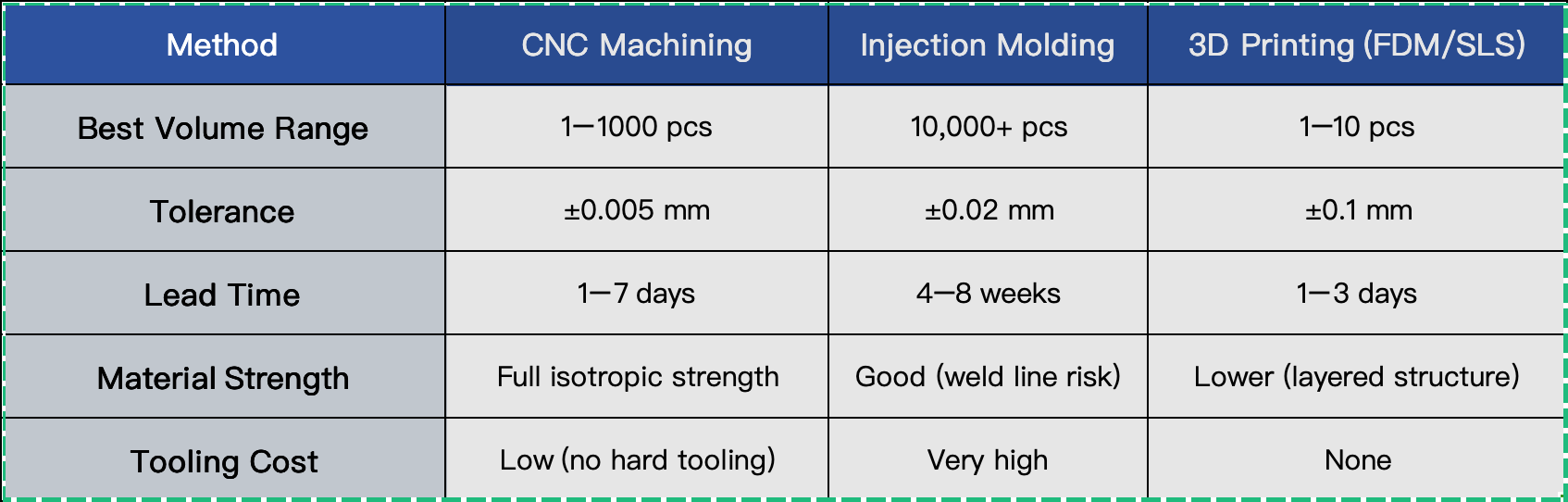
For a deeper side-by-side analysis of CNC machining and 3D printing — including cost curves, surface finish limits and material compatibility — read our comprehensive guide:3D printing vs CNC machining: Pros, Cons & Application Selection Guide
FAQ
What is PEEK machining used for?
It is used to produce custom, low-to-medium volume PEEK parts where precision, strength and environmental resistance are required, such as aerospace brackets, semiconductor fixtures, medical instrument components and industrial valve parts.
Is PEEK hard to machine?
Neat PEEK machines similarly to other high-performance engineering plastics. Filled grades (GF30, CF30) are more challenging due to abrasive fillers that wear standard tooling quickly, but they process reliably with upgraded cutting tools and adjusted parameters.
Can you machine PEEK on a standard CNC machine?
Yes, PEEK can be machined on standard 3-axis, 5-axis and Swiss-type CNC lathes with standard fixturing. Only filled grades require upgraded carbide or PCD tooling.
Should I machine PEEK or 3D print it?
Choose CNC machining for functional parts that need tight tolerances, full isotropic strength and smooth surface finish. Choose 3D printing for very low-volume prototypes with complex internal features where precision is less critical.
Ready to Start Your PEEK Machining Project?
At Konsdun, we specialize in precision CNC machining of high-performance PEEK plastics — from single prototype parts to mid-volume production runs. Our engineering team will help you select the right PEEK grade, optimize your design for manufacturability, and deliver parts with tolerances as tight as ±0.005 mm.
Get a free quote in 24 hours — send your 2D/3D drawings to our team, and we will provide a detailed quotation with material recommendations, lead time and pricing. No minimum order quantity. ISO 9001 certified quality control.






 Phone
Comment
(0)