PEEK (polyether ether ketone) is the highest-performing thermoplastic for precision CNC machined components. It bridges the gap between commodity plastics and metals, delivering metal-like strength at 80% lower weight, plus inherent corrosion resistance and biocompatibility. This guide covers quantified property data, grade differences, machining compatibility and real-world selection logic for engineers and procurement teams.
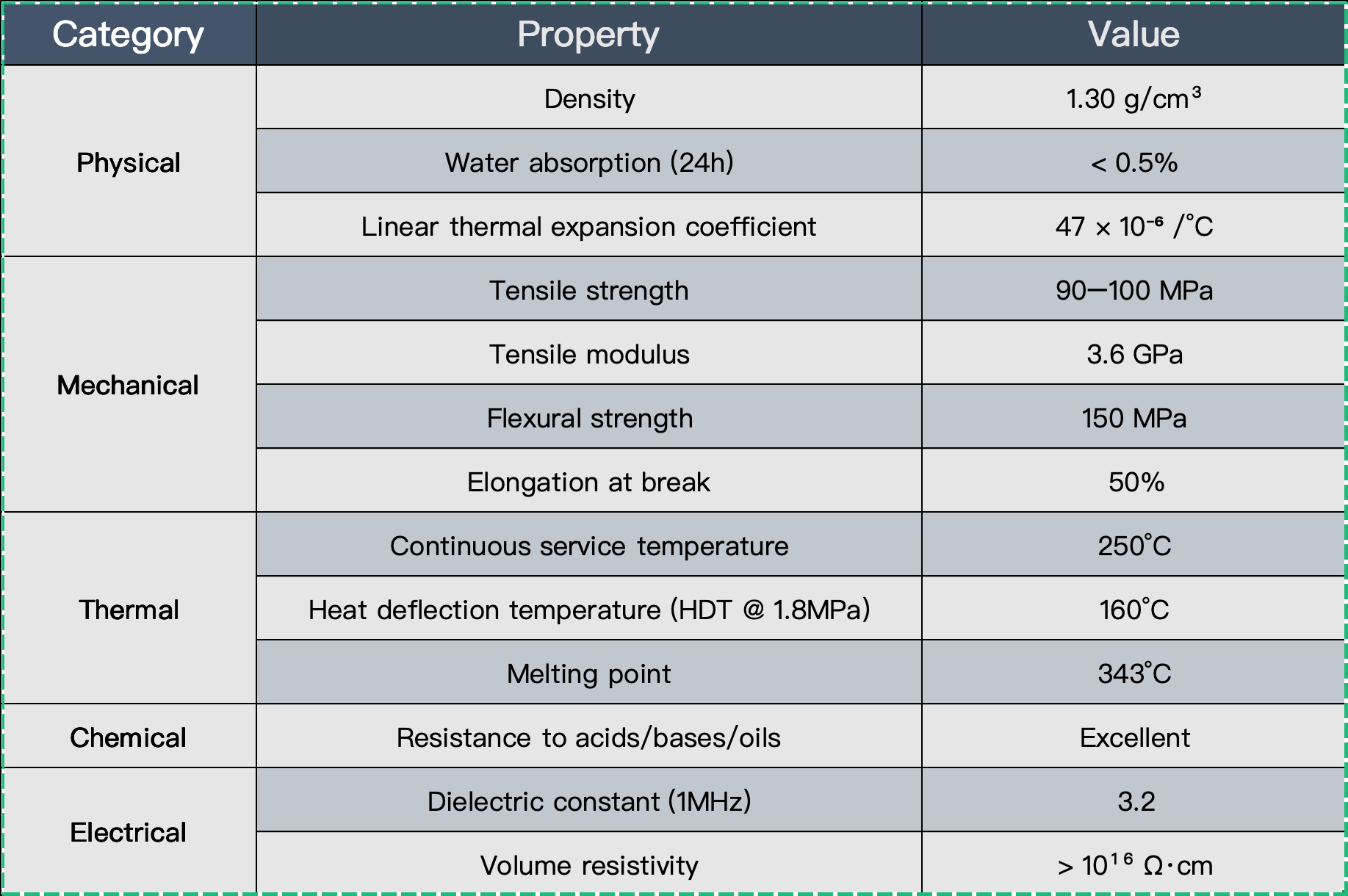
Below are standard property values for unfilled (neat) PEEK at room temperature:
PEEK Grades & Property Differences (Critical for CNC Sourcing)
Property profiles shift dramatically with filler materials. Below are the 4 most common grades for CNC machining:
Unfilled (Neat) PEEK
Best ductility, lowest internal stress, easiest to machine to tight tolerances
Best chemical resistance and electrical insulation
Lower stiffness and heat deflection temperature than filled grades
Ideal for: sealing parts, electrical insulators, fluid handling components
30% Glass Fiber Filled (PEEK GF30)
Tensile strength 提升至 140 MPa, HDT rises to 315°C
Higher stiffness, better dimensional stability at high temperatures
More abrasive on tooling; requires carbide or PCD inserts
Ideal for: structural aerospace parts, industrial equipment components
30% Carbon Fiber Filled (PEEK CF30)
Highest strength-to-weight ratio: tensile strength ~170 MPa, 3x stiffer than neat PEEK
Excellent creep resistance and wear performance; lower thermal expansion
Most abrasive grade; shortest tool life if machined incorrectly
Ideal for: high-load mechanical parts, bearing components, semiconductor fixtures
Medical-Grade PEEK (ISO 10993 / FDA Compliant)
Available in neat, GF30 and CF30 formulations with biocompatible resin
Sterilizable via autoclave, gamma radiation and ETO
Bone-like elastic modulus reduces stress shielding in implants
Ideal for: surgical instruments, implantable components, dental parts
Deep Dive: Key Properties That Matter for CNC Machining
High-Temperature Strength Retention
PEEK retains 85% of its room-temperature tensile strength at 150°C, and over 70% at 200°C — far exceeding nylon, POM and PET. For under-hood and aerospace applications, this eliminates thermal deformation failure common with lower-grade plastics.
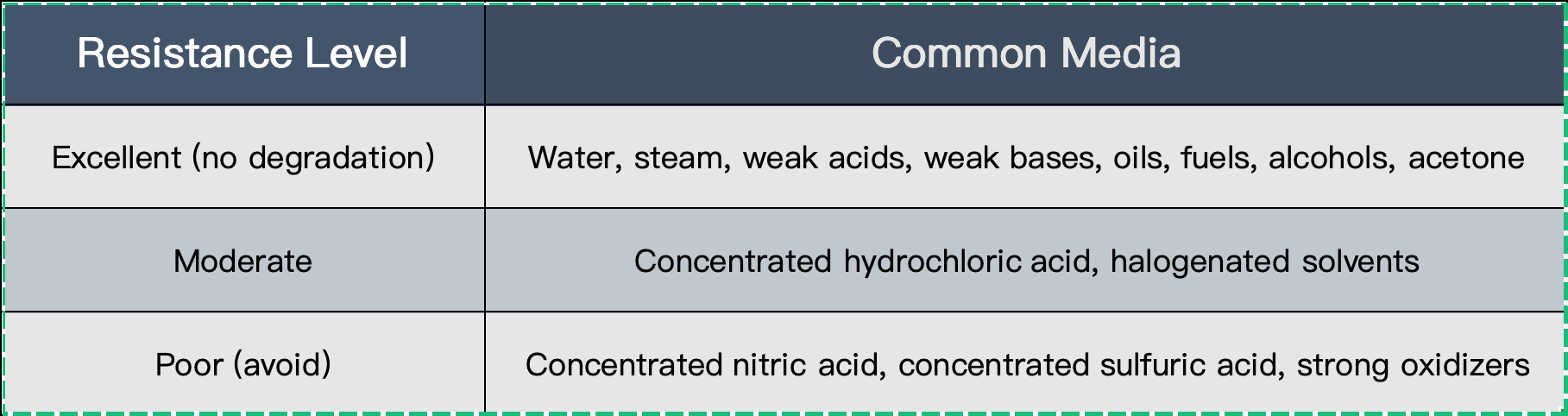
Chemical Resistance Profile
Dimensional Stability
With<0.5% water absorption and extremely low creep under load, PEEK maintains dimensional accuracy after machining. Unlike nylon, it does not swell or shrink with ambient humidity changes. For precision parts, it supports tolerances down to ±0.005 mm for neat PEEK and ±0.01 mm for filled grades.
Intrinsic Flame Retardancy
All PEEK grades achieve UL94 V-0 flammability rating without halogenated additives. Low smoke and toxic gas emission makes it mandatory for aircraft interior and semiconductor equipment parts.
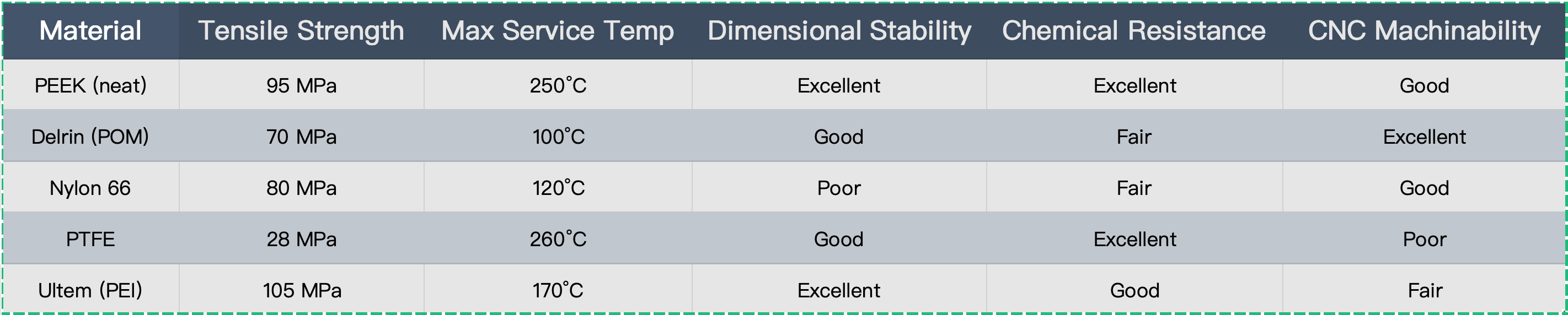
PEEK vs. Common Engineering Plastics (Full Comparison)
CNC Machining Guidelines for PEEK (Optimized for Its Properties)
Match your process to the material grade to avoid burrs, melting and dimensional drift:
Tooling: Use sharp carbide tools for neat PEEK; PCD diamond tools for GF30/CF30 to reduce abrasive wear
Cutting speed: 100–300 m/min for milling; 150–350 m/min for turning (reduce by 30% for filled grades)
Cooling: Air blast cooling preferred; minimal soluble coolant for high-speed operations to avoid thermal shock
Tolerance capability: ±0.005–±0.01 mm for critical features; Ra 0.4–0.8 μm surface finish achievable
Best practice: Anneal semi-finished parts for ultra-tight tolerance applications to relieve internal machining stress
Industry Applications Matched to PEEK Properties
Medical:
Surgical handles, spinal fusion cages, dental abutments — uses biocompatibility and sterilization resistance
Aerospace:
Aircraft brackets, fuel system components — uses high strength-to-weight, flame retardancy and temperature resistance
Semiconductor:
Wafer handling fixtures, test sockets — uses electrical insulation, dimensional stability and chemical resistance
Oil & Gas:
Valve seats, pump components — uses chemical resistance and high-pressure creep resistance
Food & Beverage:
Conveyor parts, filling nozzles — uses FDA compliance and steam cleaning resistance
FAQ (Frequently Searched Questions)
Is PEEK stronger than Delrin?
Yes — PEEK has ~35% higher tensile strength and 2.5x higher maximum service temperature. Delrin is lower cost and easier to machine for low-stress parts.
Does carbon fiber PEEK conduct electricity?
Carbon fiber filled PEEK is slightly conductive (dissipative), which makes it useful for ESD-safe semiconductor fixtures. Neat PEEK is an excellent insulator.
Can PEEK be machined on standard CNC equipment?
Yes — PEEK machines well on 3-axis, 5-axis and Swiss-type CNC lathes with standard fixturing. Filled grades only require upgraded tooling.
Need custom CNC machined PEEK parts with certified material properties? We supply neat, GF30, CF30 and medical-grade PEEK components from prototype to production volumes, with full material traceability and inspection reports. Upload your CAD drawing for a free DFM review and competitive quote.
Curious how these material properties translate into real-world manufacturing? Learn what is PEEK machining — including CNC process setup, grade-specific tooling parameters, common defects and solutions, and how it compares to 3D printing and injection molding.
Read the full PEEK machining guide →






 Phone
Comment
(0)