Why surface finish Is a Functional Requirement, Not Cosmetic
On a metal part, surface roughness is often secondary — a flange face, for example, is sealed by a gasket and plated for corrosion. PEEK has no such escape: the tool-generated surface is the product surface. That surface directly controls four functional outcomes.
Friction: on sliding pairs, a rough PEEK face against a mating metal face raises the effective friction coefficient and accelerates wear.
Sealing: compression seals rely on micro-conformity; an Ra above ~1.6 μm on a seal face leaks under low clamping force. Cleanliness: rough surfaces trap particles and resist wiping — a problem in cleanroom and food-contact use.
Medical contact: surface state changes how tissue and cleaning agents interact, which is why medical drawings carry explicit Ra limits.
There is a second, less obvious reason finish matters on PEEK: its low thermal conductivity. A rough surface means the real contact area between PEEK and its mating part is small, so frictional heat concentrates on tiny asperity peaks — local hot spots that degrade the polymer faster than the average temperature suggests. Specifying finish on PEEK is therefore engineering, not decoration.
How the Machined Surface Is Actually Formed
The surface left by a CNC tool is a direct print of the cutting process. Three features dominate.
Feed marks:
each revolution leaves a helical ridge whose height scales with feed per tooth; halving the feed roughly halves the theoretical roughness.
Tool edge state:
a fresh sharp edge shears PEEK cleanly; a rounded, worn edge rubs, melts and smears polymer onto the part, producing white or shiny patches that no finishing hides completely.
Cutting heat:
PEEK's poor conductivity means heat concentrates at the tool tip; if chip evacuation is poor, the surface re-melts and re-solidifies into a disturbed layer with different stress and appearance.
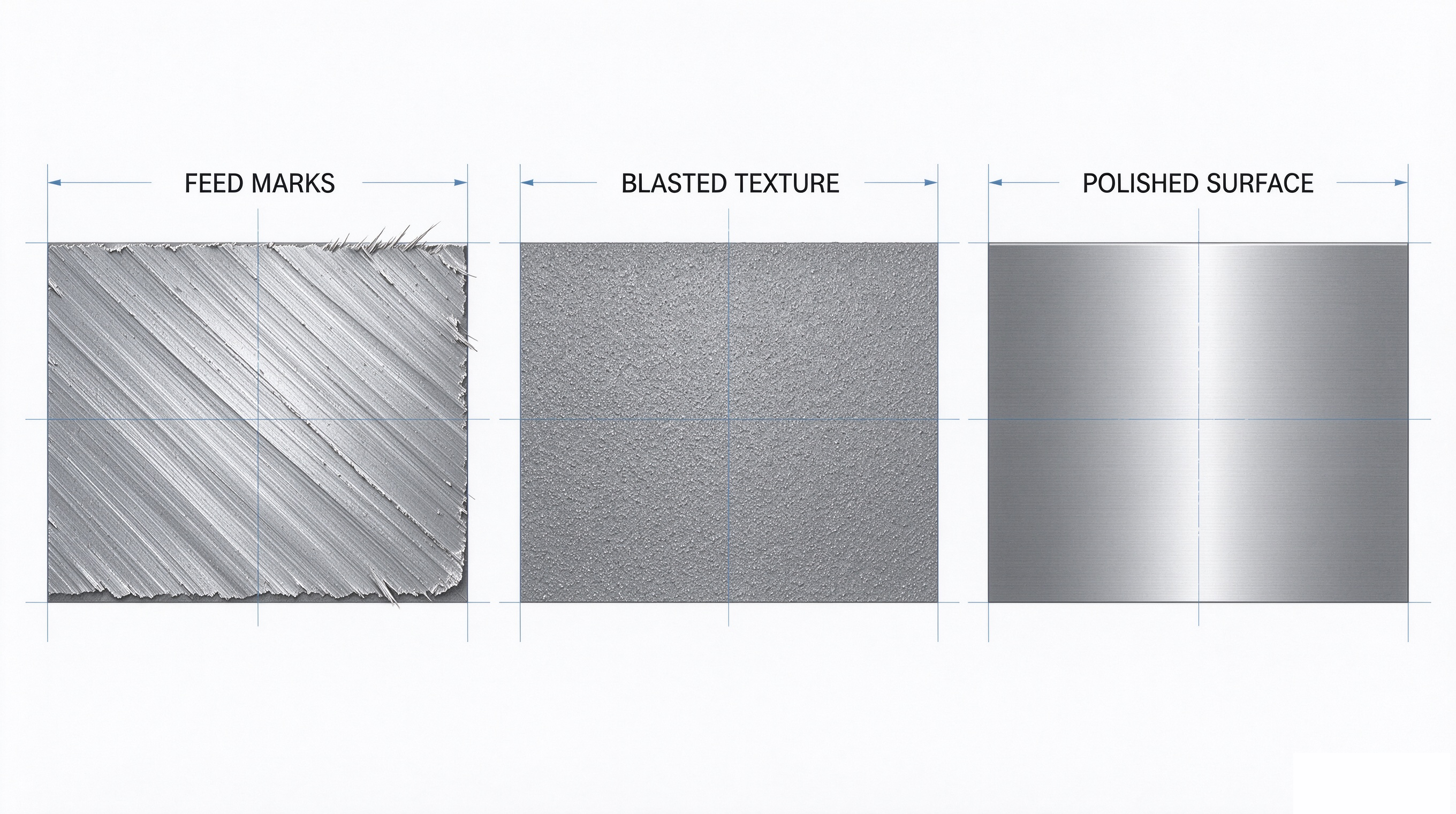
This is why "as-machined roughness" is not a single number: with a fresh carbide or PCD tool and light finishing pass, PEEK easily holds Ra 0.8–1.6 μm; with a worn edge, the same job drifts to Ra 2.5–3.2 μm plus burrs.
Ra also tells only part of the story — Rz (peak-to-valley) matters for sealing, and Rt catches the isolated scratches that matter on optical or medical faces.
When you specify Ra, also define the measurement method (stylus profilometer vs optical), the sampling length and the location; two shops can report different Ra on the same part simply by measuring differently.
The Three Routes: As-Machined, Bead Blasting, Polishing
Route 1 — as-machined:
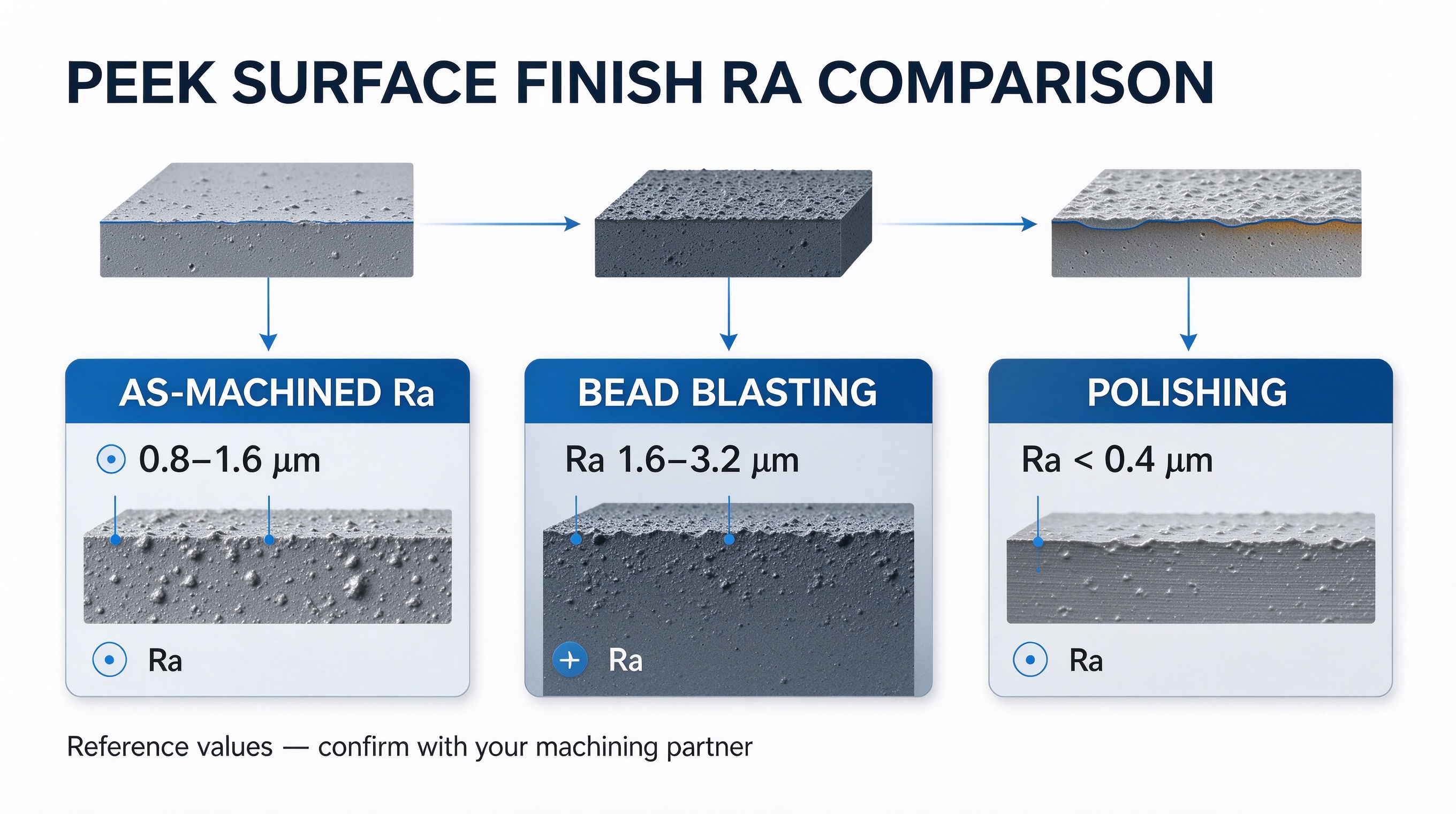
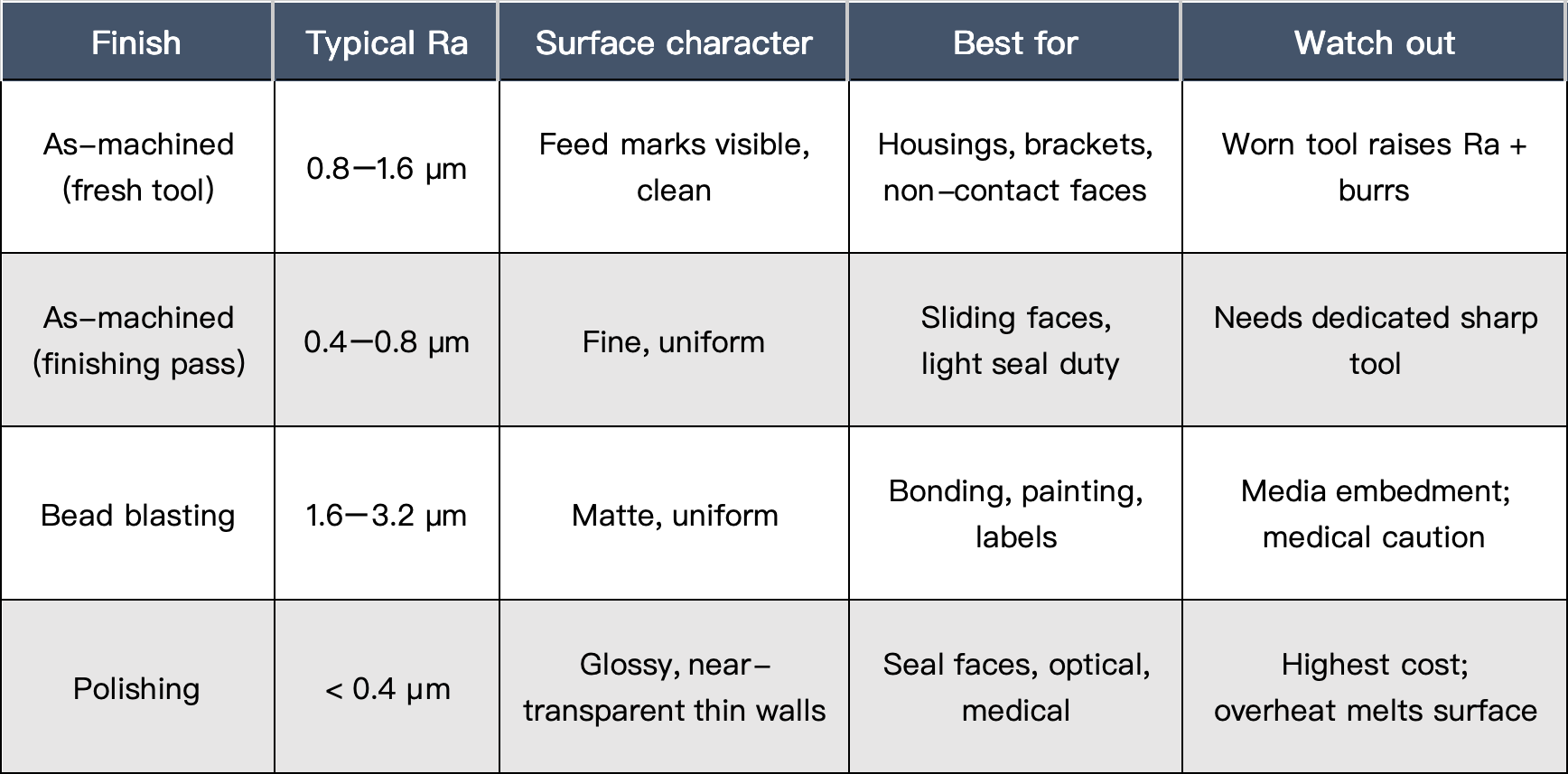
the cheapest and often the most correct choice. Fresh tools leave Ra 0.8–1.6 μm; a dedicated finishing pass with a sharp tool can reach Ra 0.4–0.8 μm without any secondary operation. Use it for structural housings, brackets, and any face that neither seals nor slides.
Route 2 — bead blasting:
glass beads under controlled pressure produce a uniform matte surface, typically Ra 1.6–3.2 μm. It masks tool marks, reduces glare, and roughens the surface for bonding, painting or labeling. The caveat: blasting media can embed in the polymer surface — for medical or cleanroom parts, specify media type and post-blast cleaning, or avoid blasting entirely.
Route 3 — polishing:
mechanical polishing with abrasive compounds brings Ra below 0.4 μm and in thin sections nearly transparent. It is reserved for seal faces, optical-contact faces, and medical interfaces, and it costs the most per unit area.
A word on vapor smoothing: it works by briefly exposing the surface to a solvent vapor that flows the top layer. It is effective on amorphous polymers; PEEK is semi-crystalline and highly chemical-resistant, so the effect is weak and limited to unfilled grades — filled PEEK leaves exposed glass or carbon strands.
For burrs specifically, cryogenic deburring (freezing the part then tumbling) is an option for high-volume thin features, while manual deburring remains the standard for prototypes.
Matching the Finish to the Application
Sealing faces:
polish or a light finishing pass — target Ra ≤ 0.8 μm on the sealing land, and check Rz, because a single deep scratch defeats a smooth Ra.
Sliding and bearing surfaces:
a polished surface minimizes friction, but note that some bearing designs deliberately keep a controlled roughness to retain lubricant; state the requirement rather than assuming.
Bonding and potting:
bead blasting is functionally better than polishing — adhesives need mechanical keying. Cleanroom parts: minimize particle traps — finishing pass, deburr, and ultrasonic cleaning; avoid blasting media that can shed later.
Medical-contact faces:
polish with documented process; surface state is part of the cleaning and biocompatibility story.
How Finishing Interacts with Tooling, Annealing and Cost
Three cross-links decide whether a finish survives.
First, tool condition: blasting can hide a melted edge visually, but the disturbed layer beneath still carries stress — a part that looks fine after blasting can still warp.
Second, annealing changes dimensions slightly (crystallinity increases, density rises); if you polish to Ra < 0.4 μm and then anneal, the polished face moves and the Ra degrades. The correct order is: rough → anneal → finish-cut → polish.
Third, cost: each finish step adds labor and, for tight Ra, inspection time. Releasing non-functional faces to as-machined typically removes 10–20% of machining and inspection cost — the same logic as rationalizing tolerances in our PEEK DFM guide.
Specifying Finish on the Drawing Without Over-Specifying
Use the GD&T surface-texture symbols correctly: define Ra (arithmetic average) or Rz (peak-to-valley) with the limit, the production method, and the sampling length. Mark finish on functional faces only; a blanket "Ra 0.8 all over" is the fastest way to inflate a quote. Where a face serves no function, write "as machined" or "Ra 3.2" and move on.
For parts with thin walls, note that polishing pressure can distort geometry — specify support or a lower finish on those faces. And remember: every finish spec should be achievable by the machining partner with documented evidence; if in doubt, ask for a surface-finish sample coupon before production. The failure modes that finish hides or reveals are covered in our defect troubleshooting handbook.
FAQ
Q1. What is the typical Ra of as-machined PEEK?
A: Ra 0.8–1.6 μm with a fresh tool; a light finishing pass reaches 0.4–0.8 μm. Worn tools drift to 2.5–3.2 μm with burrs.
Q2. Can PEEK be vapor smoothed like other plastics?
A: Only weakly, and only unfilled grades — PEEK is semi-crystalline and chemical-resistant; filled grades expose fibers.
Q3. Does bead blasting affect medical PEEK parts?
A: Yes — media can embed in the surface; medical/cleanroom parts need controlled media, post-blast cleaning, or no blasting.
Q4. Why does my polished PEEK surface still show patches?
A: Dull tools melt and smear polymer before finishing; no secondary operation hides that disturbed layer.
Q5. Polishing adds how much cost?
A: Significant labor plus inspection; releasing non-functional faces to as-machined typically cuts 10–20% of total cost.
CAT
Need a seal-grade or cleanroom-grade PEEK surface? Send your drawing and required Ra — we will recommend the finish route and quote within 24 hours.
Email: konsdun.li@gmail.com; liu@konsdun.com
WhatsApp: +86 133 9282 6147






 Phone
Comment
(0)