Why PEEK Needs Different Tooling Than Metal
Machining PEEK with a metal-cutting mindset produces three failure modes: rubbing instead of cutting (dull edges compress the plastic until it melts), heat build-up at the tool tip (PEEK conducts heat poorly, so it stays in the cutting zone), and fiber tearing on filled grades. The solution starts with tool geometry, then tool material, then parameters.
The good news is that PEEK is very machinable when the tooling is right — it holds fine finishes, tolerates high cutting speeds, and does not chip like brittle plastics. Most "PEEK is hard to machine" stories are really "wrong tooling" stories.
PEEK Tool Geometry: Rake, Helix & Edge Sharpness
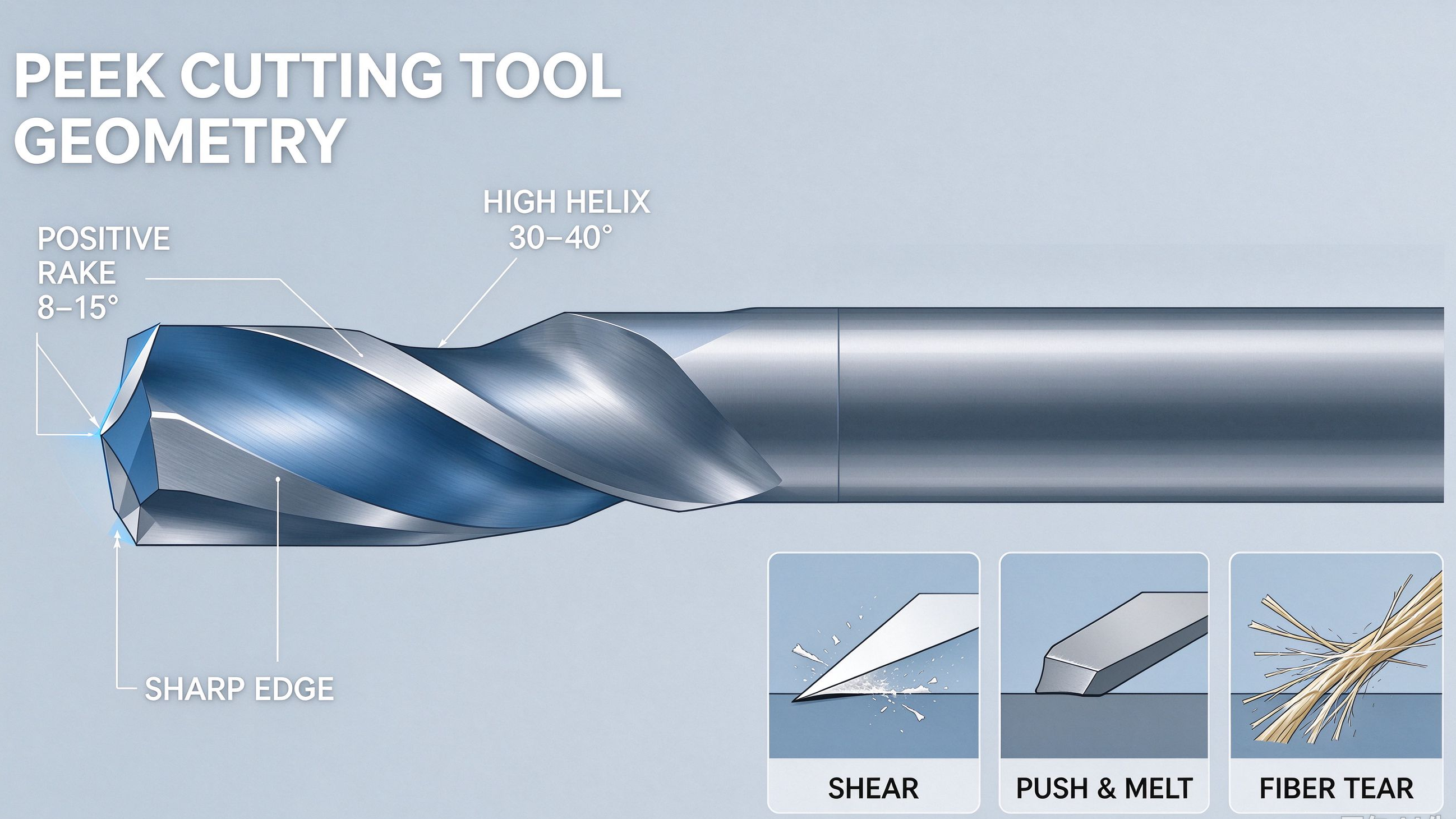
Three geometry features decide PEEK machining success.
First, positive rake angle (typically 8–15°): it shears the chip cleanly instead of pushing it.
Second, high helix angle (30–40° on end mills): it lifts chips out of the cut, preventing re-cutting and heat trapping.
Third, a genuinely sharp cutting edge: a honed edge that works for steel acts like a scraper on PEEK, generating frictional heat that melts the polymer.
For drills, use standard or high-helix geometry with a sharp point angle (118–140° depending on grade).
For taps, choose forming (thread-forming) taps for softer unfilled PEEK, and sharp cutting taps for filled grades that would otherwise tear.
Geometry matters more than the coating — a sharp uncoated carbide tool usually beats a coated but blunt one on PEEK.
Carbide vs PCD Tooling for PEEK machining
Carbide (uncoated or DLC-coated) handles unfilled PEEK and low-volume work economically, and its sharp edges are easy to re-sharpen. It wears faster on filled grades because glass and carbon fibers are abrasive — expect shorter tool life on GF30 and CF30.
PCD (polycrystalline diamond) is the long-run tool for filled grades: several times the edge life of carbide, stable finishes over long batches, and lower per-part tool cost once volume justifies the higher upfront price. A common strategy: carbide for prototypes and short runs, PCD for production quantities of GF30, CF30 or bearing-grade PEEK.
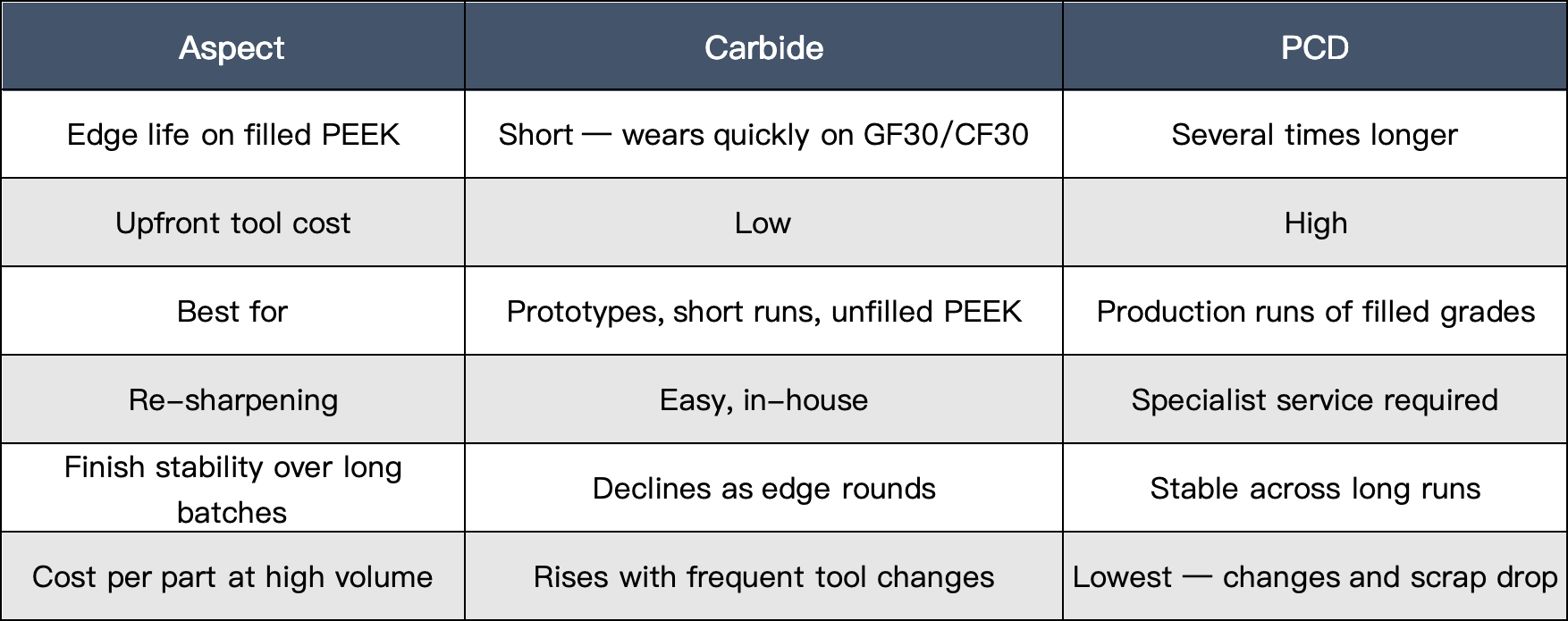
Rule of thumb: if the job runs more than a few hundred parts or holds tight tolerances on filled PEEK, model the PCD option — the quote difference is often repaid by fewer tool changes and fewer rejected parts.
Recommended Tools by PEEK Grade
Unfilled PEEK — sharp carbide end mills (2-flute, high helix), carbide drills, thread-forming taps.
GF30 — carbide with DLC coating for shorter runs, PCD for production; expect edge rounding on carbide and budget tool changes accordingly.
CF30 — PCD strongly recommended; carbon fibers are the most abrasive, and carbide edge life drops fastest here.
Bearing grade 450FC (PTFE + graphite + carbon) — PCD or coated carbide; the graphite content is self-lubricating but the carbon fiber still wears tools.
For all grades, 2-flute end mills are preferred over 4-flute for chip clearance; for finishing passes, use the same tool family but keep a separate, dedicated sharp tool so finish quality does not depend on the rougher's wear state.
Reference Speeds & Feeds for Milling, Turning, Drilling & Tapping
The table below gives reference ranges — actual values depend on machine rigidity, tool diameter, and coolant method. Start in the middle of the range, observe chips and surface, then adjust.
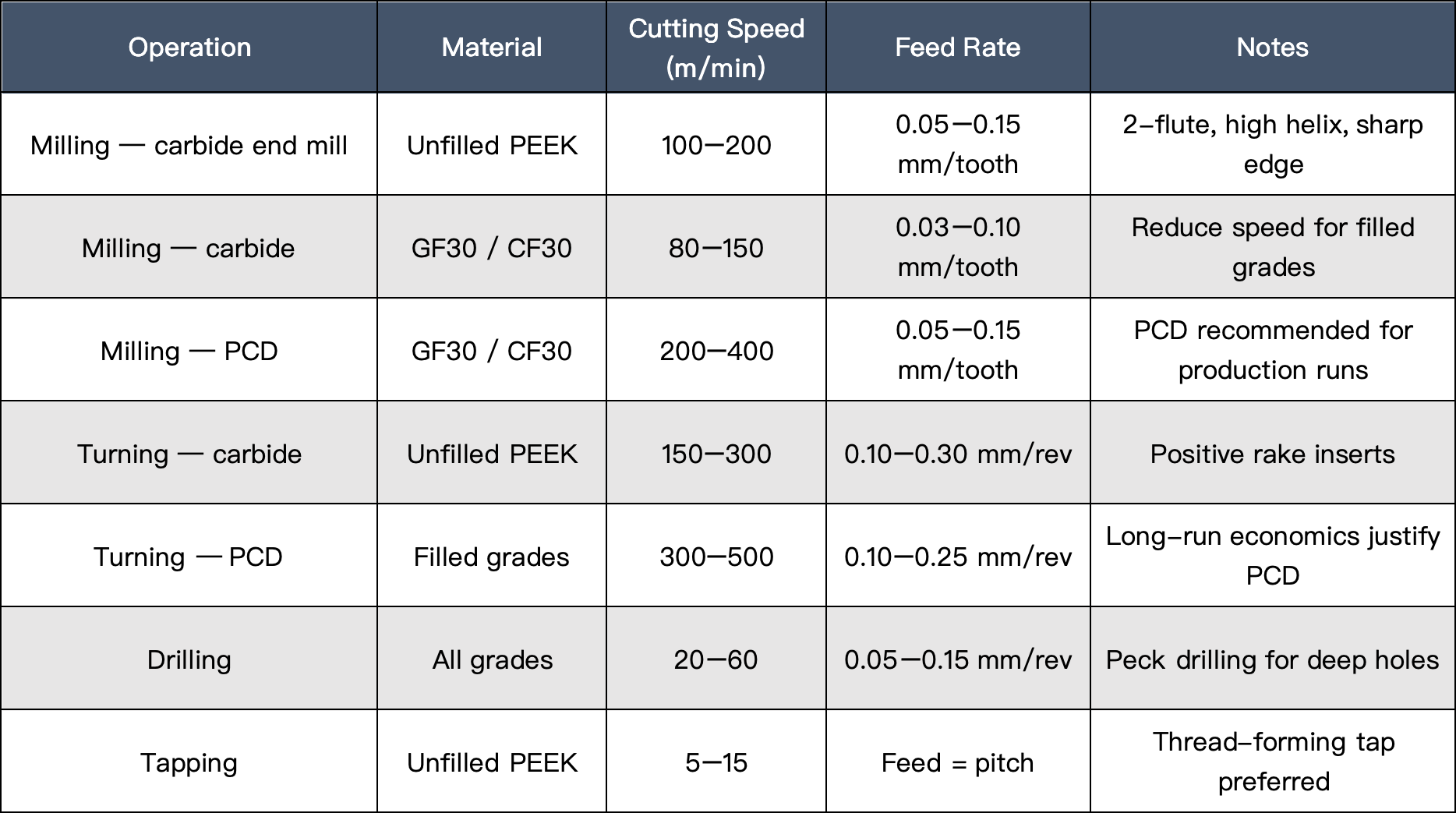
Two rules above all:
keep depths of cut light on thin walls (elastic rebound amplifies every cutting force), and never let the tool dwell — stationary tools in PEEK generate enough heat to melt the surface instantly.
Coolant Strategy: Air vs Mist vs Flood
Air blast is the default for PEEK. It clears chips, cools the cutting zone gently, and avoids the thermal shock that flood coolant can cause when it hits a hot tool edge — on PEEK, that shock is a known source of micro-cracks. For filled grades, use air with mist only if chip packing becomes a problem.
Flood coolant is generally prohibited on PEEK for two reasons: thermal shock cracking, and absorption/contamination issues that matter for medical and food-grade parts. If the machine requires coolant for chip evacuation, prefer a fine mist directed at the chip zone — never a full flood.
How to Detect Tool Wear Before It Ruins Parts
On PEEK, the first signs of a dull tool are on the part, not the tool. Watch for:
(1) hair-like burrs along edges that were clean yesterday;
(2) a rising surface roughness (Ra) on finishing passes;
(3) white or smeared zones — localized melting from frictional heat; (4) slight dimensional growth on features, caused by tool deflection as the edge rounds.
Set change intervals by part count, not feel. Log the number of parts between tool changes for each operation; when burrs or roughness appear early, shorten the interval. On production runs of filled PEEK, a dedicated tool log is cheaper than a rejected batch.
FAQ peek cnc tool selection
Q1. Can I use the same tools for PEEK as for aluminum?
A: Not ideally — PEEK needs sharper edges, positive rake and higher helix. Sharp carbide or PCD tools designed for plastics perform far better.
Q2. Carbide or PCD for PEEK machining?
A: Carbide for prototypes, short runs and unfilled grades; PCD for production runs of filled grades (GF30/CF30) where tool life pays back.
Q3. What is the recommended cutting speed for PEEK?
A: Milling typically 100–200 m/min with carbide (higher with PCD); turning 150–300 m/min; drilling 20–60 m/min. Start mid-range and adjust.
Q4. Why does my PEEK part come out with burrs?
A: Usually a dull tool, too-slow speed, or dwell. Sharp tools, adequate speed and air blast to clear chips usually eliminate burrs.
Q5. Can I use flood coolant when machining PEEK?
A: Avoid it — thermal shock can crack PEEK and coolant can contaminate medical parts. Air blast, with fine mist only when needed.
CAT
Tired of guessing tools and parameters on PEEK? Our engineers machine virgin, GF30, CF30 and bearing-grade PEEK daily — send your drawing and grade, and get tooling recommendations plus a quote in 24 hours.
Email: konsdun.li@gmail.com; liu@konsdun.com
WhatsApp: +86 133 9282 6147






 Phone
Comment
(0)