Product Introduction
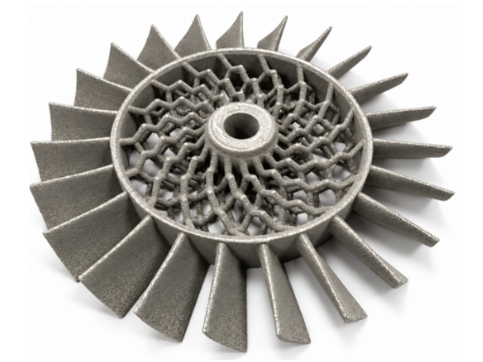
At first glance, this component resembles a conventional turbine rotor. A closer look reveals a different internal construction. Beneath the surrounding blades is an interconnected lattice of small metal struts and open spaces, arranged around a central mounting hub.
Producing this geometry through conventional machining would require significant design compromises or multiple manufacturing operations. Metal additive manufacturing provides another approach by forming the internal lattice and external blades together, layer by layer.
The printed surface retains the textured appearance commonly associated with powder bed fusion. Further machining can be considered for mounting bores, contact surfaces, or other critical interfaces where the final application requires tighter dimensional control.
For engineers developing turbine components, experimental rotor structures, or complex metal prototypes, this manufacturing approach makes it possible to examine designs that are difficult to produce using subtractive methods alone.
KONSTUN Precision Technology supports metal 3D printing projects involving intricate geometry, prototype development, and subsequent precision finishing based on engineering requirements.
Key Specifications & Parameters
Product Type: Metal 3D Printed Turbine Impeller
Manufacturing Technology: Laser Powder Bed Fusion (LPBF / SLM)
Component Structure: Integrated Radial Blades and Internal Lattice Core
Central Feature: Mounting Bore with Raised Hub
External Geometry: Circumferential Blade Arrangement
Internal Geometry: Interconnected Open Lattice Structure
Material Options: Titanium Alloy, Aluminum Alloy, and Suitable High-Temperature Metal Alloys
Reference Alloy: Ti6Al4V, Subject to Material Requirements
Surface Condition: As-Printed Metal Surface; Finishing Options Available
Post-Processing Options: Stress Relief, Support Removal, CNC Finish Machining, surface finishing, and Inspection
Development Scope: Engineering Samples, Design Validation Parts, and Prototype Rotor Components
Product Features & Functions
Internal Geometry Beyond Conventional Machining
The most distinctive feature of this impeller is its exposed lattice core. Small interconnected members form a three-dimensional network within the rotor body. Metal additive manufacturing allows this network to be produced without the direct tool access that conventional cutting operations would require.
Blades and Core Built as One Structure
The outer blades and internal lattice form an integrated printed component. This approach can reduce the need to separately manufacture and join intricate internal features, although the final geometry must still account for printing constraints and post-processing access.
Material Distribution for Design Studies
Open lattice regions replace portions of what would otherwise be solid metal. Engineers can investigate different lattice densities, strut dimensions, and solid-to-open transitions when exploring mass distribution and structural behavior. Any weight or performance benefit must be verified against the final design.
A Central Hub for Mechanical Integration
The raised center hub contains a through bore intended as a potential mounting interface. Its finished dimensions, alignment, and connection method can be specified according to the mating shaft or experimental assembly.
Post-Processing Where Accuracy Matters
Powder bed fusion can produce the overall blade and lattice geometry, while secondary machining may be used to finish selected functional surfaces. This combination is useful when a component requires both intricate internal structures and precise mechanical interfaces.
Specific Application Scenarios
Aerospace Rotor Development
Metal additive manufacturing can be used to create experimental rotor geometries for aerospace engineering studies, including investigations of complex blade layouts and internal structural concepts. Functional use requires application-specific qualification.
Turbomachinery Design Evaluation
Engineers developing turbines, compressors, and related rotating equipment can use printed samples to assess geometry, assembly interfaces, and manufacturing feasibility before progressing to more demanding testing.
Industrial Fluid Equipment Prototypes
The manufacturing approach may be considered for specialized impeller concepts in industrial air and fluid-handling equipment. Actual suitability depends on the operating medium, rotational speed, mechanical loading, and material selection.
Lattice Structure Engineering Research
The component provides a physical example of an integrated metal lattice. Similar structures can be studied for material distribution, stiffness, manufacturing limits, and the relationship between solid surfaces and internal networks.
Advanced Manufacturing Demonstrations
A metal impeller with exposed lattice features can be used in engineering exhibitions, manufacturing demonstrations, and technical evaluations to illustrate the geometric possibilities of metal powder bed fusion.
FAQ
Q1: Why use metal 3D printing for this type of impeller?
A1: Metal 3D printing allows intricate internal lattice structures and surrounding blade geometry to be manufactured together. These features can be difficult or impractical to create through conventional machining alone.
Q2: What is the purpose of the lattice structure?
A2: The lattice creates open regions within the metal component. Its design can be investigated for material distribution and structural behavior, but any improvement in weight, strength, or operating performance needs to be established through engineering analysis and testing.
Q3: Which metal materials can be used?
A3: Depending on the design and available manufacturing process, candidate materials may include titanium alloys, aluminum alloys, or suitable high-temperature alloys. The exact material must be selected according to the application's requirements.
Q4: Does the mounting bore require additional CNC machining?
A4: Not always. However, finish machining may be necessary when the bore requires specific dimensional tolerances, surface finish, or fit with a mating shaft.
Q5: Can the printed impeller be used directly in high-speed equipment?
A5: An as-printed prototype should not automatically be considered ready for high-speed service. Material properties, internal defects, balance, fatigue behavior, and operating loads need to be evaluated before functional use.
Q6: Can the lattice design or blade geometry be modified?
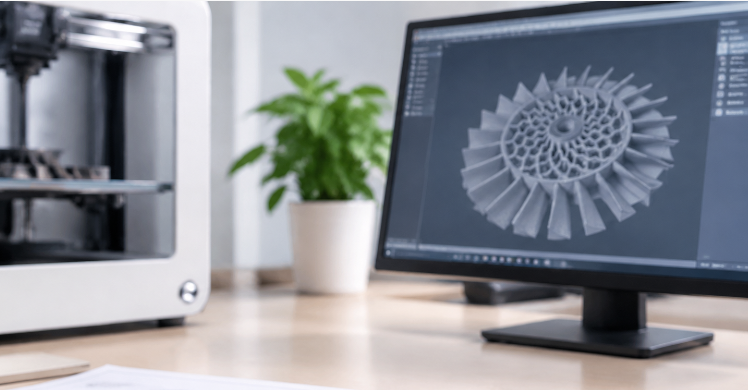
A6: Yes. The internal lattice pattern, hub geometry, blade arrangement, and overall dimensions can be revised in the digital model. Each modification should be reviewed for printability, structural requirements, and post-processing accessibility.






 Phone