


3D printed turbine rotor
A 3D printed turbine rotor is a highly engineered rotating component designed to convert fluid or gas energy into mechanical motion. It is commonly used in systems such as gas turbines, steam turbines, hydraulic turbines, and experimental energy devices. Unlike traditionally manufactured rotors, a 3D printed turbine rotor is produced using additive manufacturing, a process that builds the part layer by layer from a digital model. This approach offers significant advantages in design flexibility, weight reduction, and rapid prototyping.One of the main benefits of a 3D printed turbine rotor is the ability to create complex geometries that are difficult or impossible to produce with conventional machining or casting methods. For example, internal cooling channels, optimized blade shapes, lattice structures, and lightweight support features can all be integrated into a single component. These design possibilities allow engineers to improve aerodynamic or hydrodynamic performance while reducing mass and material waste. A lighter rotor can spin more efficiently, respond more quickly to load changes, and place less stress on bearings and shafts.The material selection for a 3D printed turbine rotor depends on the operating environment. Metal powders such as titanium alloys, nickel-based superalloys, stainless steel, and aluminum alloys are often used for high-temperature or high-stress applications. For lower-load prototypes or small-scale systems, high-performance polymers and composite materials may also be suitable. After printing, the rotor often undergoes post-processing steps such as heat treatment, surface finishing, machining, and balancing to ensure strength, precision, and smooth operation.Precision is especially important in turbine rotors because they rotate at high speed and must withstand significant centrifugal forces. Any imbalance or surface defect can lead to vibration, noise, reduced efficiency, or even mechanical failure. For this reason, quality control measures such as dimensional inspection, nondestructive testing, and dynamic balancing are essential. In many cases, engineers use computer simulations before printing to analyze stress distribution, airflow, and thermal behavior, helping to refine the design and improve reliability.3D printed turbine rotors are especially valuable in research, development, and customized production. They allow rapid design iteration, shorter lead times, and the possibility of producing parts tailored to specific performance requirements. This makes them useful in aerospace, energy generation, automotive testing, marine propulsion, and educational laboratories. As additive manufacturing technology continues to advance, 3D printed turbine rotors are expected to become more durable, efficient, and widely adopted in demanding industrial applications.Overall, a 3D printed turbine rotor represents a modern combination of advanced engineering and manufacturing innovation, offering improved design freedom, material efficiency, and performance potential for next-generation rotating machinery.
Products
Category:
-
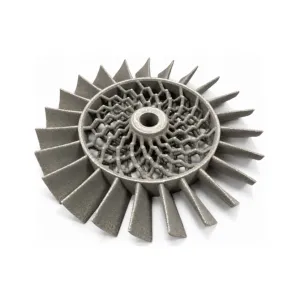
Metal 3D Printed Turbine Impeller with Internal Lattice Core
Category: 3D-Printed PartsBrowse number: 7Number:Release time: 2026-10-08 14:06:13A metal 3D printed turbine impeller featuring radial blades, a central mounting bore, and a complex internal lattice. Produced using metal powder bed fusion technology, this component demonstrates how intricate internal geometry and external blade profiles can be built together for rotor development, structural evaluation, and engineering prototypes.
News
Category:
-
[blog]Metal 3D Printed Impeller Design Guide: DfAM Rules, Material...
2026-10-21 10:42:33
Case
Category:
No search results found!
Video
Category:
No search results found!
Download
Category:
No search results found!
Job
Category:
No search results found!
Featured Products
No search results found!




 Phone