


metal 3D printed impeller
A metal 3D printed impeller is a high-performance rotating component designed to move fluids efficiently in a wide range of industrial applications. Manufactured through additive manufacturing, it is built layer by layer from metal powder using advanced printing technology. This process allows for complex internal and external geometries that are difficult or impossible to achieve with traditional machining or casting methods. As a result, the impeller can be optimized for improved hydraulic performance, reduced weight, and enhanced structural integrity.One of the main advantages of a metal 3D printed impeller is design freedom. Engineers can create blade shapes, flow channels, and support structures that better guide fluid movement and reduce turbulence. This can lead to higher efficiency, lower energy consumption, and improved system reliability. The ability to integrate lightweight lattice structures or hollow sections also helps reduce the overall mass of the component while maintaining strength. In applications where rotational speed is critical, this weight reduction can improve dynamic response and reduce stress on surrounding parts.Metal 3D printed impellers are commonly used in pumps, compressors, turbines, and other rotating machinery. They are suitable for industries such as aerospace, energy, chemical processing, marine engineering, and automotive systems. In these environments, the impeller must withstand high rotational speeds, temperature changes, corrosion, and mechanical fatigue. Additive manufacturing makes it possible to choose materials such as stainless steel, titanium alloys, nickel-based alloys, and other high-performance metals depending on the operating conditions.Another important benefit is rapid prototyping and shorter development cycles. Traditional impeller production often requires expensive tooling and long lead times. With metal 3D printing, engineers can quickly produce prototypes, test multiple design variations, and make improvements without major retooling costs. This flexibility is especially valuable during product development or for specialized equipment that requires custom specifications.In addition to prototyping, metal 3D printed impellers are increasingly used in low-volume production and replacement part manufacturing. When spare parts are difficult to source or legacy systems need maintenance, additive manufacturing offers a practical solution. It enables on-demand production and can reduce downtime by providing parts faster than conventional supply chains.Surface finishing and post-processing remain important steps in producing a high-quality impeller. After printing, the part may undergo heat treatment, machining, polishing, balancing, and inspection to ensure dimensional accuracy and performance. These finishing steps help improve fatigue resistance, reduce surface roughness, and achieve the precise tolerances required for rotating equipment.Overall, a metal 3D printed impeller combines advanced manufacturing technology with functional performance. It offers design flexibility, material efficiency, and customization potential, making it a valuable solution for modern fluid-handling and rotating machinery applications.
Products
Category:
-
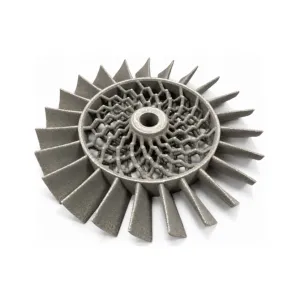
Metal 3D Printed Turbine Impeller with Internal Lattice Core
Category: 3D-Printed PartsBrowse number: 7Number:Release time: 2026-10-08 14:06:13A metal 3D printed turbine impeller featuring radial blades, a central mounting bore, and a complex internal lattice. Produced using metal powder bed fusion technology, this component demonstrates how intricate internal geometry and external blade profiles can be built together for rotor development, structural evaluation, and engineering prototypes.
News
Category:
-
[blog]Metal 3D Printed Impeller Design Guide: DfAM Rules, Material...
2026-10-21 10:42:33
Case
Category:
No search results found!
Video
Category:
No search results found!
Download
Category:
No search results found!
Job
Category:
No search results found!
Featured Products
No search results found!




 Phone