Product Introduction
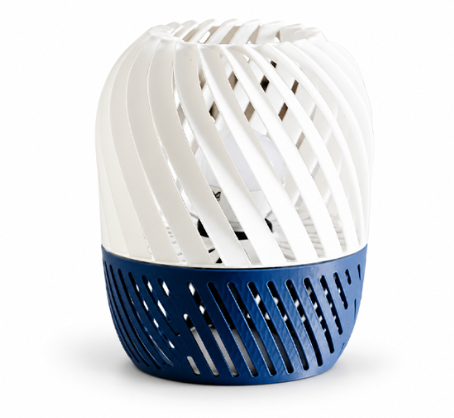
The curved white strips are the most noticeable part of this turbine lamp. Each strip follows a twisting path around the housing, leaving narrow openings between the ribs. When viewed from different angles, the overlapping curves give the shade a different appearance.
A dark blue base supports the upper section. Its diagonal slots follow the same visual direction as the spiral shade, giving both pieces a consistent design. The housing includes space for an internal LED light source, while the separate upper and lower sections allow the assembly arrangement to be reviewed during development.
This design is an example of how FDM printing can be used to produce decorative plastic parts with curved surfaces and repeated openings. Rather than investing in tooling at the concept stage, lighting designers can first examine a physical sample, check the component fit, and make adjustments to the shape.
KONSTUN provides 3D printing support for decorative lamp housings and other plastic product prototypes based on customer designs.
Key Specifications & Parameters
Product: Turbine-Style Decorative Lamp Housing
Manufacturing Method: FDM 3D Printing
Prototype Material: PLA Plastic
Color: White Spiral Shade / Dark Blue Base
Construction: Two-Piece Plastic Housing
Shade Design: Curved Spiral Ribs with Open Sections
Base Design: Rounded Housing with Diagonal Slots
Light Source: Internal Space for a Compatible LED Module
Assembly: Separate Upper and Lower Components with M3 Screw Fastening Design
Development Options: Alternative Colors, Revised Dimensions, Modified Openings, and Material Selection
Product Features & Functions
A Spiral Shape That Changes with the Viewing Angle
The curved ribs wrap around the upper housing rather than running vertically. Their overlapping arrangement creates visual depth, making the lamp suitable for decorative products where the outer form is an important design feature.
Openings Built into the Lampshade
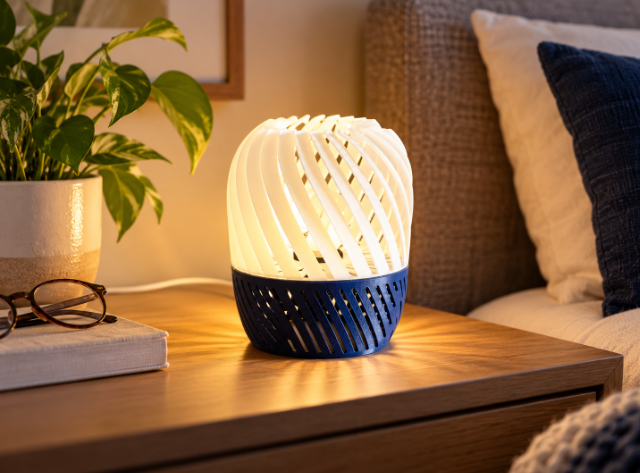
The gaps between the white strips leave parts of the interior visible. With an appropriately positioned LED source, light can pass through these spaces instead of being enclosed behind a continuous plastic wall. The final lighting effect depends on the LED and internal layout.
A Separate Base for Easier Design Evaluation
The blue lower housing forms a distinct section beneath the white shade. This construction allows designers to examine how the pieces fit together and consider changes to the internal mounting arrangement without redesigning the entire exterior.
Complex Curves Produced Without a Mold
FDM printing is useful for exploring the twisted rib pattern during early product development. Designers can adjust the shape or spacing of the ribs in a digital model and produce another physical sample without dedicated injection molding tools.
A Two-Color Appearance
The white and dark blue combination gives the lamp a recognizable appearance. Alternative color schemes can be explored to suit different interior styles, product collections, or brand designs.
Specific Application Scenarios
Decorative Table Lighting
The rounded housing and sculptural shade can be used in tabletop lighting designs for shelves, side tables, and other indoor decorative settings.
Custom Lighting Product Development
Lighting manufacturers can use printed samples to review the shade geometry, housing proportions, and LED installation space before finalizing a design.
Interior Design Concept Displays
The unusual spiral profile makes the housing suitable for design presentations, showroom displays, and demonstrations of decorative lighting concepts.
3D Printed Home Accessories
The same design approach can be explored for other household accessories that use curved plastic ribs, patterned openings, or multi-part construction.
Small-Batch Design Collections
FDM production can be considered for limited quantities of decorative housings, especially when testing different shapes or colors before committing to a larger production method.
FAQ
Q1: How is the turbine-shaped lampshade manufactured?
A1: The prototype uses FDM 3D printing to form the curved ribs and open sections from a digital model. This process allows the spiral geometry to be evaluated without an injection mold.
Q2: Is the shade printed as one piece?
A2: The upper spiral shade is designed as a separate component from the lower base. The complete housing consists of two main plastic sections.
Q3: Can the housing accommodate an LED light?
A3: Yes. The design provides internal space for an LED module. The final lighting assembly should be checked for component fit, wiring, temperature, and electrical safety before use.
Q4: Can the spiral shape or base color be changed?
A4: Both can be revised during the design stage. The number and spacing of the ribs, the base pattern, and the overall dimensions can be adjusted using the 3D model.
Q5: Is PLA suitable for every lighting application?
A5: Not necessarily. PLA is suitable for many appearance prototypes, but its temperature limitations must be considered. For a functional lamp, material selection should be based on the LED system, ventilation, and expected operating conditions.
Q6: Can this design be produced in larger quantities?
A6: Larger production volumes can be evaluated after the design is finalized. Depending on the structure, material, and quantity, another manufacturing process may be more economical than FDM printing.






 Phone