Product Introduction
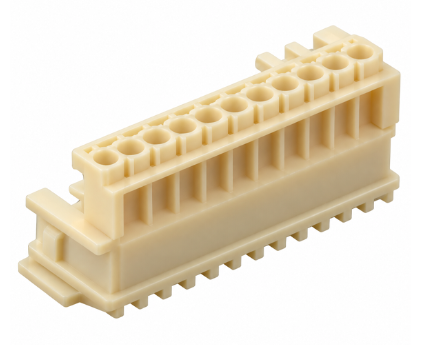
This 3D printed connector housing prototype is used during the development stage of electrical connectors, wire harness connectors, and terminal block assemblies. It provides a physical sample for engineers to test structure, terminal insertion, slot spacing, locking details, and assembly compatibility before moving to mold production.
The product is designed with a row of terminal holes, internal separation walls, side positioning features, and a compact plastic body. These details help simulate the final connector structure and allow early testing of metal terminals, wiring contacts, and mating parts.
Compared with injection molding, 3D printing is more suitable for early-stage design verification because it does not require mold opening and can support faster sample development. For connector projects with thin walls and detailed slot structures, 3D printed prototypes are useful for checking the design direction, but final mass production is usually completed by injection molding after the structure is confirmed.
KONSTUN Precision Technology supports 3D printed plastic prototypes, connector housing samples, and engineering plastic parts for automotive electronics, industrial control, consumer electronics, and wiring system development.
Key Specifications & Parameters
Product Type: 3D printed connector housing prototype
Product Form: Connector insulation base, wire terminal housing, plastic connector prototype, electrical connector sample
Material Options: Nylon, resin, ABS-like material, PA-based material, PU resin, or other prototype plastic materials
Processing Methods: 3D printing, prototype finishing, support removal, sanding, trial assembly, and sample inspection
surface finish: Natural printed finish, light polishing, matte finish, painted finish, or project-based appearance treatment
Structure Features: Multi-slot terminal layout, insulation walls, side locking tabs, positioning ribs, terminal separation structure, compact plastic body
Application Fields: Automotive electronics, industrial control systems, consumer electronics, wiring connectors, terminal assemblies, and electronic product development
Prototype Support: 3D files, STEP, STP, STL, CAD files, drawings, or physical sample reference
Product Features & Functions
Fast Connector Structure Verification
The 3D printed housing helps engineers quickly check connector size, slot layout, terminal position, and assembly structure before investing in injection molds.
Terminal Fit Testing
The multi-slot structure can be used to test whether metal terminals, pins, or wiring contacts fit correctly inside the housing.
Insulation Layout Evaluation
Internal separation walls help simulate the insulation structure between terminals, making it easier to review spacing and circuit separation during the design stage.
Assembly Compatibility Check
Side locking features, positioning ribs, and housing edges can be tested with mating parts to confirm installation direction and connection stability.
Suitable for Small Batch Samples
3D printing is suitable for producing a small number of connector samples for design review, engineering testing, and customer approval.
Bridge to Injection Molding
After prototype verification, the confirmed structure can be adjusted for injection mold development and later batch production.
Specific Application Scenarios
Wire Terminal Testing
Used to test the insertion, positioning, and holding effect of wire terminals before final connector production.
Automotive Electronics Development
Suitable for early-stage connector samples used in automotive wiring, signal connection, and electronic module development.
Industrial Control Connector Prototypes
Can be applied in control systems, automation equipment, and electrical modules where connector layout needs to be verified first.
Consumer Electronics Assembly Testing
Used for small electronic products that require compact plastic connector housings and accurate terminal layout.
Engineering Design Review
Supports engineers in checking appearance, dimensions, slot structure, and assembly feasibility during new product development.
Pre-Mold Sample Confirmation
Helps confirm connector structure before moving to injection mold production, reducing design risk and modification cost.
FAQ
Q1: What is this 3D printed connector housing used for?
A1: It is used for connector structure verification, wire terminal testing, assembly checking, and early-stage product development.
Q2: Why use 3D printing for connector housing prototypes?
A2: 3D printing allows faster sample production without mold opening, making it suitable for testing connector design before mass production.
Q3: Can this part be used as a final production connector?
A3: It is mainly recommended for prototype testing and design verification. For large-scale production, injection molding is usually more suitable.
Q4: What can be tested with this connector prototype?
A4: It can be used to test terminal fit, slot spacing, locking structure, mating parts, assembly direction, and general product layout.
Q5: What materials can be used for this prototype?
A5: Common prototype materials include nylon, ABS-like resin, PA-based materials, PU resin, and other plastic materials depending on testing needs.
Q6: Which industries use this type of connector prototype?
A6: It is commonly used in automotive electronics, industrial control, consumer electronics, wiring systems, and electronic product development.






 Phone