


3D printed connector housing
A 3D printed connector housing is a custom-designed protective enclosure used to hold, align, and safeguard electrical or mechanical connectors. It is typically manufactured through additive manufacturing, which allows for precise shaping, rapid prototyping, and flexible adaptation to different connector sizes and configurations. This type of housing plays an important role in protecting internal connection points from dust, impact, vibration, and accidental contact, while also helping to organize and stabilize wiring systems.One of the main advantages of a 3D printed connector housing is its high level of customization. Unlike standard mass-produced parts, a printed housing can be tailored to meet specific dimensional, functional, and environmental requirements. It can be designed with exact cutouts, mounting holes, locking features, cable entry points, and internal supports to match a particular connector type. This makes it especially useful in projects where off-the-shelf enclosures do not fit properly or where a unique shape is required.Another benefit is rapid development. Because the housing can be printed directly from a digital file, design changes can be implemented quickly and tested without the long lead times associated with traditional molding or machining. This is ideal for engineering prototypes, repair parts, low-volume production, and specialized applications. Designers can iterate multiple versions to improve fit, strength, ventilation, or assembly convenience.Material selection is also an important factor. 3D printed connector housings can be produced using a variety of materials such as PLA, ABS, PETG, nylon, or other engineering-grade filaments, depending on the required strength, temperature resistance, and durability. For indoor use or lightweight applications, standard thermoplastics may be sufficient. For harsher environments, stronger and more heat-resistant materials may be preferred. In some cases, additional surface treatment or reinforcement may be added to improve performance.The structure of the housing can be designed to support secure installation and easy maintenance. Snap-fit features, screw bosses, cable strain reliefs, and modular covers can be incorporated into the design to simplify assembly and disassembly. This helps ensure that the connector remains firmly in place and that the wiring is protected during use. Ventilation openings or sealing features can also be included depending on whether airflow or environmental protection is needed.3D printed connector housings are widely used in electronics, robotics, automotive testing, industrial equipment, and custom devices. They are especially valuable when space is limited or when a unique connector arrangement must be integrated into a larger system. Their ability to combine functionality, precision, and design freedom makes them a practical solution for modern engineering needs.Overall, a 3D printed connector housing offers an efficient, adaptable, and cost-effective way to protect and organize connectors in a wide range of applications. It combines the benefits of custom design with the speed of digital manufacturing, making it a reliable choice for both prototyping and specialized production.
Products
Category:
-
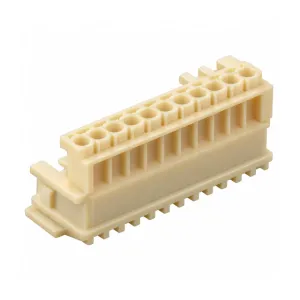
3D Printed Connector Housing Prototype for Wire Terminal Testing
Category: 3D-Printed PartsBrowse number: 63Number:Release time: 2026-09-27 14:17:47This 3D printed connector housing prototype is designed for wire terminal testing, electronic assembly verification, and connector structure development. The part features multiple terminal slots, insulation walls, positioning details, and side locking structures, making it suitable for checking terminal fit, wiring layout, assembly performance, and product design before injection mold production.
News
Category:
No search results found!
Case
Category:
No search results found!
Video
Category:
No search results found!
Download
Category:
No search results found!
Job
Category:
No search results found!
Featured Products
No search results found!




 Phone