Product Introduction
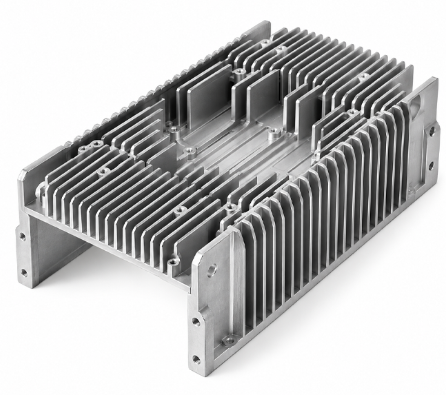
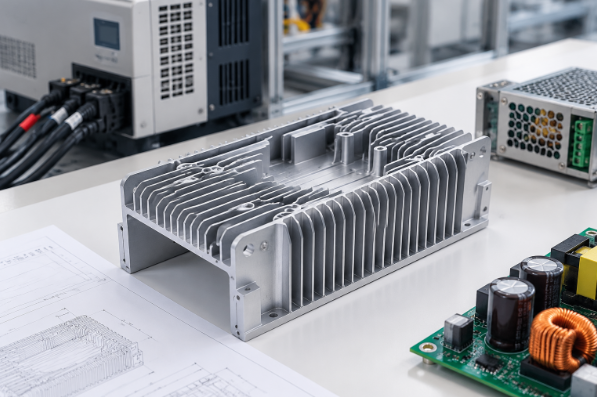
This product is an integrated aluminum heat sink housing used for power electronics and industrial control equipment. It combines the functions of an outer enclosure and a heat dissipation structure in one metal part, helping simplify assembly while improving thermal performance.
The housing features multiple cooling fins, side mounting sections, and an internal space for circuit boards, power components, or driver modules. Compared with a standard enclosure plus separate heat sink design, this integrated structure helps improve heat transfer efficiency and reduce overall assembly complexity.
It is suitable for equipment such as power controllers, industrial inverters, amplifiers, converters, and other electronic systems that generate heat during operation. KONSTUN Precision Technology supports both CNC machining and extrusion-based secondary machining solutions for this type of aluminum heat sink housing.
Key Specifications & Parameters
Product Type:
Integrated aluminum heat sink housing
Product Form:
Power module enclosure, finned heat sink case, industrial heat dissipation housing, aluminum electronic enclosure
Material Options:
6061 aluminum alloy, 6063 aluminum alloy, or other suitable aluminum materials
Processing Methods:
CNC milling, drilling, tapping, machining from solid block, or aluminum extrusion followed by CNC machining
Surface Treatment Options:
Sandblasting, natural anodizing, black anodizing, conductive oxidation, polishing, or other required finishes
Structure Features:
Dense cooling fins, integrated housing cavity, side mounting walls, fixing holes, internal component space, and heat dissipation channels
Application Fields:
Industrial automation, power supplies, inverters, power amplifiers, electronic control equipment, and new energy systems
Drawing Support:
2D drawings, 3D files, CAD, STEP, STP, PDF files, or sample reference
Product Features & Functions
Integrated Heat Dissipation and Housing Design
The product combines the enclosure and heat sink into one structure, which helps reduce assembly steps and improves thermal transfer efficiency.
Efficient Cooling Performance
The finned exterior increases heat dissipation area, making the housing suitable for power devices and electronic systems that generate continuous heat.
Stable Internal Installation Space
The internal cavity provides room for power boards, driver circuits, and control modules, helping maintain an organized equipment structure.
Strong Aluminum Construction
Aluminum alloy offers a good balance of thermal conductivity, lightweight performance, and structural strength for industrial electronic equipment.
Flexible Manufacturing Options
The product can be produced by full CNC machining for prototypes and small batches, or by extrusion plus CNC machining for more cost-effective medium-volume production.
Suitable for Demanding Electronics Applications
It is widely used in controllers, converters, inverters, and other power-related assemblies where both cooling and enclosure strength are important.
Specific Application Scenarios
Industrial Control Systems
Used as a heat dissipation enclosure for control units, drive systems, and automation equipment operating under continuous electrical load.
Power Supply Equipment
Suitable for power supply housings that need stable thermal management and mechanical protection for internal components.
Inverter and Converter Assemblies
Can be used in inverters and converters where heat-generating modules require an aluminum housing with extended cooling surfaces.
Power Amplifier Equipment
Applicable to amplifier-related products that need metal housings with effective heat dissipation and reliable structural support.
New Energy Electronic Devices
Suitable for electronic systems in new energy applications where cooling efficiency and lightweight metal structure are both important.
Power Electronics Modules
Can be used for module-based electronic systems requiring integrated finned enclosures for thermal control and installation support.
FAQ
Q1: What is this aluminum heat sink housing used for?
A1: It is used for power modules, industrial controllers, inverters, amplifiers, converters, and other electronic devices that require both enclosure protection and heat dissipation.
Q2: Why is aluminum commonly used for this type of housing?
A2: Aluminum has good thermal conductivity, light weight, and strong machining performance, making it suitable for electronic heat dissipation structures.
Q3: Can this product be made by different processing methods?
A3: Yes. It can be machined from a solid aluminum block by CNC, or produced by aluminum extrusion followed by CNC secondary machining.
Q4: What is the advantage of an integrated heat sink housing?
A4: It combines cooling and structural support in one part, helping reduce assembly complexity and improve overall thermal management.
Q5: What surface treatments are commonly used for this product?
A5: Common options include natural anodizing, black anodizing, conductive oxidation, sandblasting, and polishing.
Q6: What industries commonly use this type of part?
A6: It is commonly used in industrial automation, power electronics, new energy systems, inverters, amplifiers, and electronic control equipment.






 Phone