Product Introduction
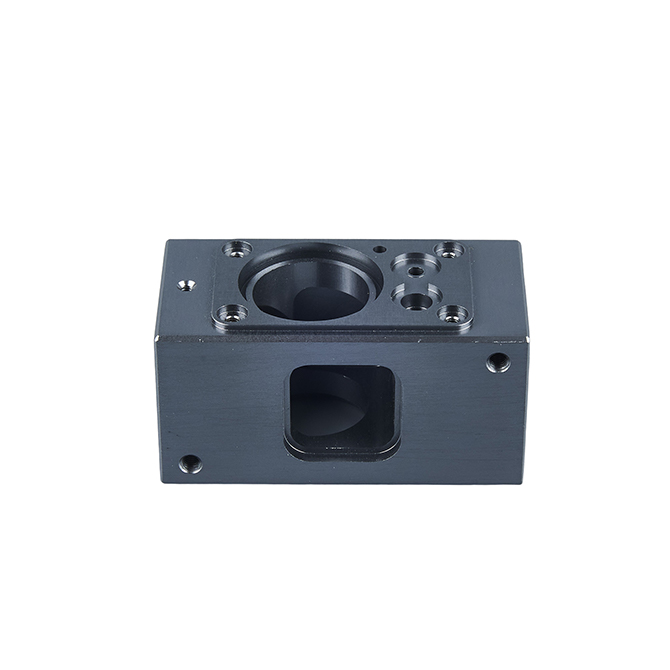
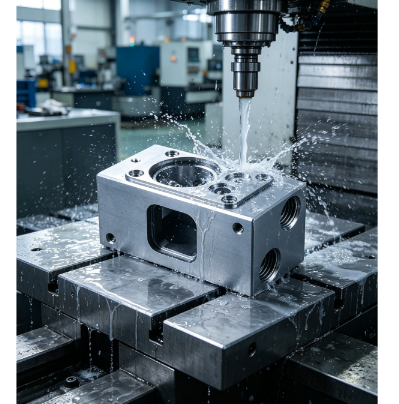
This precision multi-cavity aluminum machined block is fabricated via full 3/5-axis CNC integrated milling to form integrated concave chambers, stepped positioning holes and threaded mounting holes in a single workpiece. The surface undergoes hard black anodizing treatment to form a dense protective oxide film, which improves surface wear resistance and avoids oxidation discoloration during long-term equipment operation. Compared with stainless steel counterparts, aluminum material significantly reduces overall equipment load while retaining sufficient structural rigidity to bear repeated assembly and clamping forces. The integrated forming process eliminates assembly gaps between split components, maintaining consistent dimensional accuracy under continuous mechanical vibration, and supports custom cavity layout, hole position distribution and block thickness based on equipment installation space requirements.
Key Specifications & Parameters
Dimensional Tolerance Control: Stable consistent precision for all cavity depths, hole positions and flatness surfaces, adjustable precision thresholds based on drawing technical requirements
Base Raw Material: 6061-T6 industrial aluminum alloy, high tensile strength and excellent machining performance
Surface Treatment Process: Hard black anodization, optional natural anodizing, sandblasting, laser marking on demand
Supported Machining Technologies: 5-axis simultaneous milling, deep cavity boring, tapping, counterboring, chamfering integrated processing
Customizable Structural Features: Irregular square/round concave cavities, through mounting holes, threaded fixing holes, positioning pin bores, step limiting platforms
Applicable Production Batch Range: Single prototype trial pieces, small-batch 10–800pcs orders, large-scale mass production above 1000pcs
Surface Hardness After Treatment: Hard anodized layer reaches HV350–500, scratch-resistant for long-cycle mechanical use
Main Functions
Lightweight High-Rigidity Mounting Carrier: Aluminum alloy cuts dead weight of equipment moving modules without sacrificing structural bearing capacity, lowering load on linear slide and drive systems.
Multi-Functional Integrated Cavity Accommodation: Built-in multi-size concave chambers provide independent installation space for sensors, air valves and transmission sub-components to simplify overall equipment layout.
Vibration-Stable Positioning Reference Base: Uniform flat base surface and precision pin holes deliver repeatable positioning accuracy, preventing component offset under high-speed automated reciprocating motion.
Anti-Oxidation Wear-Resistant Protective Shell: Black hard anodized surface blocks air and moisture contact with the aluminum substrate, resisting surface scratches and oxidation stains in dry workshop environments.
Standardized Mechanical Connection Interface: Precisely machined threaded holes and counterbores match standard fasteners, enabling quick disassembly and replacement of internal functional sub-modules.
Thermal Conductive Heat Dissipation Medium: Aluminum’s natural high thermal conductivity dissipates heat generated by built-in electronic and pneumatic parts, avoiding thermal deformation of adjacent precision components.
Specific Application Scenarios
Linear Motion Automation Equipment: Mounting base blocks for slide table sub-modules, housing carriers for drive motor and sensor assemblies on automated assembly lines.
Precision Optical Testing Instruments: Multi-cavity aluminum housings holding optical lenses, detection probes and signal transmission circuit modules inside lab testing equipment.
Pneumatic & Hydraulic Control Stations: Integrated valve block housings that accommodate multiple air flow control valves and pressure sensor positioning structures.
Electronic Component Assembly Fixtures: Custom aluminum fixture blocks for PCB pressing, chip positioning and automated welding station clamping platforms.
Small Medical Diagnostic Devices: Lightweight aluminum module bases for portable testing equipment, providing stable mounting space for internal fluid and sensing components.
Semiconductor Auxiliary Handling Equipment: Low-weight vibration-resistant aluminum housing blocks for wafer transfer small automation stations with high positioning repeatability requirements.
FAQ
Q1: Can the cavity size, hole layout and overall outer dimension of this aluminum block be fully customized?
A1: All structural parameters including cavity depth, hole spacing, block length and width can be adjusted according to 2D drawings or 3D STEP/IGES files, and unused cavities can be removed to reduce block weight as needed.
Q2: What differences exist between hard black anodizing and ordinary black anodizing for aluminum blocks?
A2: Hard anodizing forms a thicker, harder oxide layer with stronger scratch and wear resistance, suited for frequently clamped automation fixtures; ordinary thin anodizing fits static Instrument Housings with lower mechanical friction.
Q3: What is the maximum depth of deep concave cavities that can be milled on a single aluminum block?
A3: Single-side cavity depth up to 60mm is available with dedicated deep boring cutters, and internal cavity wall flatness can still maintain stable precision after processing.
Q4: Does the black anodized surface affect thread fit accuracy of internal tapped holes?
A4: Thread holes are masked during anodizing treatment, so the oxide film will not cover internal threads, ensuring normal matching of standard bolts and positioning pins.
Q5: Can laser marking of part numbers or model codes be added on the outer surface of the aluminum block?
A5: Permanent laser marking can be processed on flat outer surfaces without damaging the anodized protective layer, with clear text that will not wear off during long-term equipment use.
Q6: What aluminum alloy grades are available besides 6061-T6 for this multi-cavity housing block?
A6: 6063 for low-load static housings and 7075 high-strength aluminum alloy for heavy-load clamping fixtures are optional, each with different weight and hardness performance.
Q7: Will the aluminum block deform after long-term continuous operation in temperature-changing workshop environments?
A7: 6061-T6 alloy has low thermal expansion coefficient; one-clamping 5-axis processing eliminates internal machining stress, so no obvious dimensional deformation occurs under normal indoor temperature fluctuation ranges.






 Phone
Phone